

Every summer, the village of Alise-Sainte-Reine in Burgundy holds a festival honoring the bold leader Vercingetorix (c. 82-46 BC), chief of the Gallic tribes, who surrendered to Julius Caesar in 52 BC after a five-day siege.
Not far from there, at Alesia MuseoParc, the round archaeological center that opened a few years ago, actors stage battles between Roman legionaries and Gallic warriors, at the site where researchers believe the final, decisive battle took place: the Battle of Alesia. It was the battle that ended the Gallic revolt, after which the Gauls were subjugated and their leader was taken prisoner. He was paraded in Julius Caesar’s triumph upon his return to Rome, before being put to death.

How do you preserve the memory of a defeat?
The French don’t see the Gauls’ defeat in a negative light. First, it was the Romans who built aqueducts, paved roads and raised bridges, giving the region 300 years of peace. Second, the Gallic defeat was a noble one. And finally, how could anyone forget that the first Frenchman to speak of liberty (one of the three principles of the Revolution) was the proud Vercingetorix.
Despite his surrender, Vercingetorix is seen in France as a national hero, and the phrase “our ancestors the Gauls” is familiar to every French schoolchild. The well-known Parisian restaurant named after that very phrase, Nos Ancêtres les Gaulois, the famous Gauloises cigarettes, and of course the millions of comic book readers around the world who know the beloved cartoon Gauls Asterix and Obelix, all testify to that.
But things weren’t always this way. For nearly 2,000 years, the Gauls and their leader had almost vanished from the collective memory of the people of France. It was Napoleon III who, in the 1860s, ordered a search for the suspected site of the Battle of Alesia. A series of archaeological excavations followed, uncovering the remains of a thriving Gallo-Roman city, fortifications and a wealth of weapons.
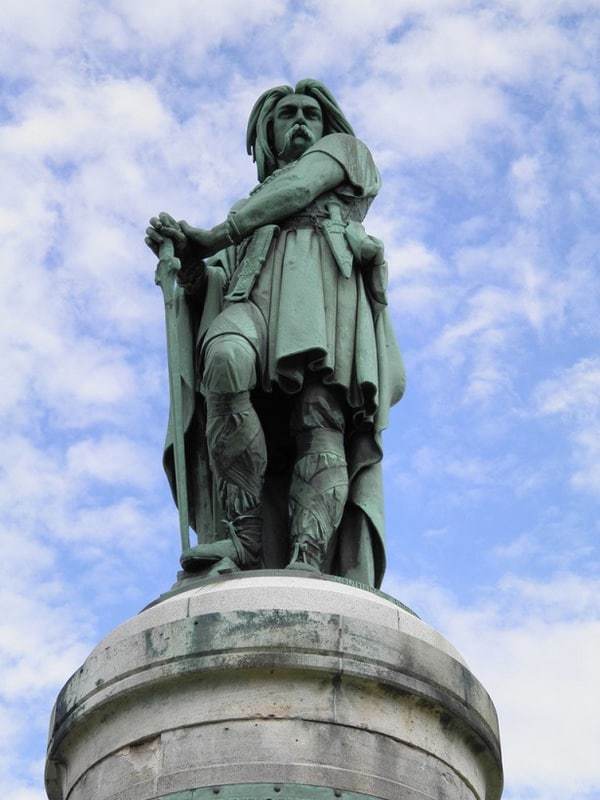
Napoleon didn’t stop there. He commissioned Aimé Millet (1819-1891) to sculpt Vercingetorix as a romantic bronze statue, standing 6.6 meters tall, which has stood on a granite rock since 1865. It was no accident that Napoleon erected this giant, mustached statue of Vercingetorix and made sure to breathe life into the mythic Gallic leader. In fact, the emperor, who suffered from a crisis of legitimacy and feared the rising power of Prussia, saw in Vercingetorix a unifying heroic figure who could inspire the spirit of national resistance among the people of France. As proof, consider the inscription carved into the statue’s base:
“La Gaule unie, formant une seule nation, animée d’un même esprit, peut défier l’univers”
Which translates roughly as: “Gaul, united, forming a single nation, animated by the same spirit, can defy the universe.”
It was hardly a surprise that beneath the Gallic mane of hair and the curling mustache, the Gallic hero bore a suspiciously close resemblance to the face of the young, mustached Napoleon III. Either way, the inscription on the statue failed to predict what was coming: in 1873, Napoleon III died in exile in Britain. Napoleon, who may have believed his own propaganda about the “united, invincible Gauls,” let Bismarck drag him into a war with Prussia in which France suffered a humiliating defeat.
What is there to see at Alesia MuseoParc?
Back to the present: Alesia MuseoParc is an engaging, informative center for the whole family, with interactive displays, audio guides, and a full-size reconstruction of the double line of fortifications and siege engines, alongside the remains of the Gallo-Roman city of Alesia, which thrived until the year 400 AD.
Some of the explanations are in French, but the Gallic battle tactics, Julius Caesar’s brilliant strategy, and the reenactment of the battle are presented in an informative and engaging, animated way. The round archaeological museum and center were designed by the Swiss-French architect Bernard Tschumi (born 1944), who also created the Acropolis Museum in Athens in 2009.
To bring the story of the siege to life, Tschumi clad the building in a wooden structure, meant to blend naturally with the Roman wooden fortifications. He covered the building’s roof with trees, grass and low shrubs, which slightly obscure its shape for anyone looking down from the top of the hill (the historical vantage point of the Gauls).

The enormous costs of Alesia MuseoParc, which reached 75 million euros, and the meticulous planning that took nearly a decade, didn’t prevent a sharp debate from raging behind the scenes. It’s a controversy that has stretched over many years: whether the final battle for Gaul actually took place at Alesia’s current location.
There’s no dispute that the many weapons uncovered at Alesia, and even the remains of the fortifications and the Roman camp, show that the site was home to a thriving city with a theater, a forum and orderly streets. However, according to the findings of the French archaeologist André Berthier (1913-2000), who studied Julius Caesar’s writings in painstaking detail, the actual battle took place southeast of Alesia, at Chaux-des-Crotenay, at the foot of the Jura mountains.
I should note here that few voices support Berthier’s theory, and his arguments run into a solid wall of national pride and economic interests. And if you want to know what the residents of Alise-Sainte-Reine think, they have no doubt whatsoever: Vercingetorix belongs entirely to them.
To visit the museum’s official website, click here.
Related reading