

On the last day of January 2024, I visited the replica Cosquer Cave (La grotte Cosquer) in Marseille, and it was, and still is, a truly unique experience. The original cave was discovered, officially at least, in 1985 by professional diver Henri Cosquer in the Calanques National Park (Le parc national des Calanques), near Cap Morgiou. There are rumors that other divers knew about the cave earlier, but none of them lingered on it before Cosquer did. The earliest paintings have been dated to 33,000 years ago, and the latest to 19,000 years ago (the Paleolithic period).
Does all the credit really belong to Henri Cosquer alone? Three divers from Cosquer’s circle, twenty years younger than him, remain largely unknown, even though Cosquer owes them the discovery of the cave’s paintings. All three agree that without them, Cosquer could never have explored the cave. They are two women, one of them Cosquer’s niece, and a man, all of whom learned to dive together with “the big brother,” as they called him.
Cosquer turned to the three young divers for help exploring the cave. They agreed enthusiastically, went down into the cave with him about a dozen times, helped him with the diving and the exploration, and were the ones who actually discovered the paintings. After they had served him well, Cosquer chose to erase them from the spotlight and never mentioned them, not even once. Three people left out in the cold, now approaching their sixties, left with a bitter taste. Cosquer refuses to answer journalists’ questions on the matter.
French-speaking readers are welcome to read more about this story at this link.
From a Dry Cave to an Underwater One
The prehistoric people who frequented the cave could walk right into it. But today, for the past nine thousand years, the cave lies almost entirely underwater (37 meters down), hidden in the depths and sinking further all the time. In September 1991, a fatal accident took place there: three cave researchers from Grenoble lost their lives after failing to find their way back out of the cave. You enter the cave through a crack in the rock that leads to an underwater corridor opening into the chambers and passageways beyond. The three researchers, who were not experienced divers, went down into the cave without proper safety arrangements, accompanied by a diving instructor, who was the only one to come out of the disaster alive.
Henri Cosquer and another diver found the bodies and brought them up. The three unfortunate men were just a few meters from the cave’s entrance, and they still had air left, but they panicked, and that is why they did not survive. Two days later, Cosquer reported the discovery of the cave to the maritime affairs authority. He knew that after the fatal accident, he would no longer be able to keep the cave’s discovery a secret, and he wanted to make sure he would be recognized as its sole discoverer. He arrived with a lawyer who made sure his financial interests were secured.
The official announcement allowed the authorities to ban uncontrolled dives in order to prevent further disasters. That is how a project to study and preserve the discovery of the cave began, and not only because of the safety risks to human life, but also because the cave itself would eventually disappear underwater.
Some of the paintings have already faded away, and the cave as a whole will not be able to withstand the water washing over it. Eventually, it will be completely flooded. It became urgent, then, to copy the paintings and recreate the cave. This task became possible thanks to a 3D scan of the original cave. The replica meets the need to preserve the paintings and the site as a whole, and it also allows the general public (a million visitors since it opened in the summer of 2022) to visit an almost exact copy of it (slightly smaller than the original).
Here’s a fascinating video on the behind-the-scenes making of the second Cosquer cave:
A Breathtaking Journey Through Time
The final result of the cave and its paintings being recreated is breathtaking. We arrived at the building known as “La Villa Méditerranée,” located on the plaza of the Mucem (Le Mucem), short for the Museum of European and Mediterranean Civilizations, about a ten-minute walk from the Vieux-Port.

After buying our tickets, we crossed a bridge over the water. To the left, you can see a replica of Henri Cosquer’s boat, the “Cro-Magnon.” It’s an amusing coincidence: the boat Cosquer bought and used for his dives, one of which led him to discover the cave, happened to be called “Cro-Magnon.” It carried that name before he ever found the cave, and he wasn’t even the one who named it; the sailor he bought it from had. The restored boat anchored by the entrance bridge isn’t the original one, but a replica of it. Just as there’s a Cosquer Cave 1 (the original) and a Cosquer Cave 2 (the replica), there’s also the discovery boat 1 (original) and the discovery boat 2 (replica).
We crossed the bridge into the building and arrived at a diving center complete with all the necessary gear: wetsuits, fins, tanks. But don’t worry, all of this once served Henri Cosquer, but for us visitors, it’s just a set piece. We went down in an elevator shaped like a diving capsule to the entrance of the cave. We were given an audio guide and boarded a small car that seats six people, three in the front row and three in the back (there are 44 of these automated cars available to visitors).
The car began gliding over the water, first entering the first chamber, then the second. Thirty-five minutes of slow travel let us take in the wonder of the twin cave across two hundred and twenty meters. There were magnificent stalactites and stalagmites, as well as mushroom-lamp-shaped formations growing from the ground and sword-like shapes hanging from the ceiling. The engravings and paintings by the anonymous prehistoric artists completed an experience we took in with a sense of awe.
The car stopped by each wall painting in turn as a beam of light was cast on it and explanations played. Pay attention to how the light reflects on the water and on the cave walls, and how it plays with the ripples spreading in circles. It’s important to understand that during the prehistoric period when the artists painted on the cave walls, the climate in Provence resembled today’s Iceland. That explains the paintings of penguins (great auks, to be precise, an extinct species), seals, and fish. Cosquer Cave is, as of now, the only one in the world depicting marine animals, and the penguin figure has become its unofficial “logo.”
Most of the paintings depict horses, but there are also ibex, saiga antelope, bulls, deer, bison, cave lions (an extinct subspecies), seals, penguins, fish, handprints of men, women and children, and geometric shapes, abstract signs that are interpreted as sexual symbols.
Also worth noting is “the slain man,” a schematic human silhouette, 28 centimeters long, lying on its back, struck by two arrows, one in the chest and shoulder, the other piercing much deeper through the back and crossing the head. This motif of a human depicted as a victim also appears in other caves. The lack of specific features may point to this being symbolic: not a specific person, but a victim as a symbol. Researchers agree that these sacrificial images go beyond their literal meaning, but although interesting theories about hidden meanings have been proposed, nothing is certain.
There’s much that remains hidden beneath the surface regarding all of the cave’s paintings. One hypothesis suggests they depict a creation myth in which the animals being created emerged from deep within the earth. The cave itself is a symbol, a hidden, sacred site suited for meditation and creation, where opposites meet: safety and danger, existence and death. The cave is like a womb. The symbolic meaning of the paintings, as well as the meaning the cave held for the artists who painted its walls, remains unclear.
The prehistoric artists likely made their pigments using small fires, and the charcoal can still be seen in many places throughout the cave. Crabs that left behind their shells, or their lives, on the cave floor dot it here and there.
It’s so moving to connect with people who painted the animals they saw thirty thousand years ago and imbued them with spiritual meaning! And the handprints, the abstract signs, what were they trying to express? The artists who copied the paintings and engravings of their prehistoric counterparts from computer models onto the screen, working them onto sponge panels, all express excitement and pride at the privilege of transmitting and sharing this legacy.
The panels that make up Cave No. 2 were also shaped to match the walls of Cave No. 1: their forms replicate the natural indentations and protrusions, the traces of human hands in the paintings and engravings, the handprints left intentionally and unintentionally, and the marks of the tools the artists used. From time to time, the artists made use of the cave’s natural features, a bump here, a stain there, to incorporate them into their artwork.
The magical journey through the dim light of the cave-cathedral, with its column-like trunks, came to an end. After getting off the car, you head to an auditorium to watch a striking ten-minute film about the discovery of the cave. From there, you go up (for those who struggle with the many stairs, there is an elevator) to the third floor of the museum, to “La Galerie Méditerranée,” the Mediterranean Gallery.
The Exhibition Hall on the Third Floor
After the film ended, we went up to the exhibition hall on the third floor, whose highlight is the animals from the cave paintings, reproduced at life size. Photography is not allowed during the boat ride through the cave, for understandable reasons, but in the gallery, you can use your phone as much as you like. That’s exactly what we did (all the gallery photos were taken by us). First, here’s a fairly wide shot where you can clearly see a cave lion cub up front:

The three large penguins from the cave are an attraction in their own right, since as of today, no other depiction of such marine animals is known from prehistoric caves. In the gallery, you can see them even more clearly than in the cave, in the same scene, performing a courtship dance:

A seal, also a rare find in caves:

The view over the sea, the Jolliette harbor and the Cathédrale de la Major is stunning, especially when it softens the menacing bison:
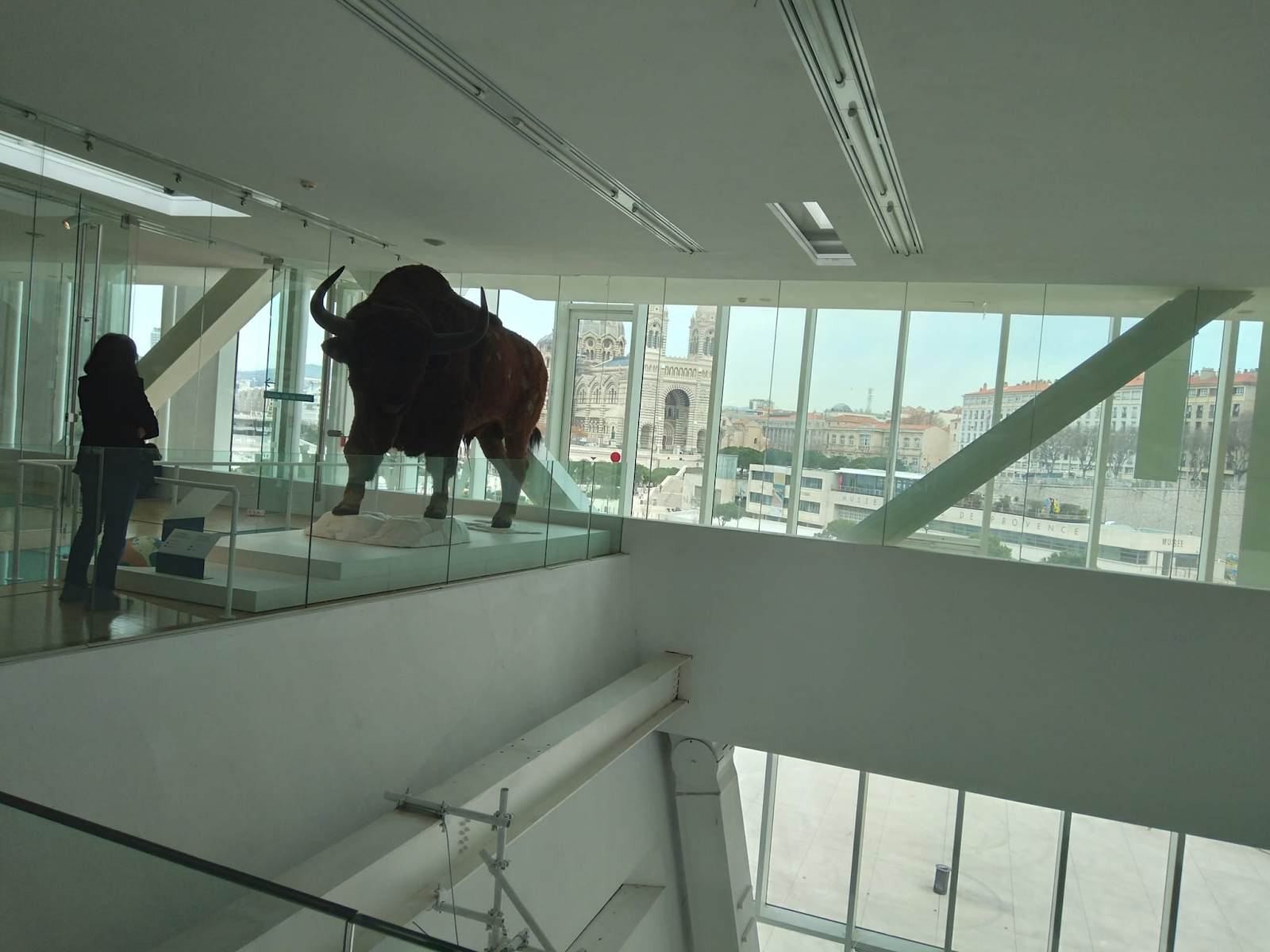
Bison in the exhibition hall, photo: Orna Lieberman
At the bottom of the picture, you can see the massive columns supporting this part of the structure, which leans out over open space. The gallery floor hangs over a void, and the glass floor tiles dotted across it did give us pause… but don’t worry, more than a million visitors have already walked across it, and it has remained solid.
And another view of the impressive cathedral:

View of the Cathédrale de la Major from the exhibition hall, photo: Orna Lieberman
Besides the impressive animal models, you can also see a graceful prehistoric woman, pregnant and adorned:

The figure of the prehistoric woman was modeled on the skeleton of a 37-year-old woman of high status, whose grave was discovered in a cave in northern Italy, near the town of Menton, in 1872. Her striking headdress, made of shells and deer teeth woven into a net, and her lavish grave goods, including flint blades, point to a privileged status. This video offers a glimpse into this woman, known as “La Dame du Cavillon”:
Prehistoric finds like surprising pieces of jewelry (including the prehistoric woman’s striking headdress) and musical instruments, along with explanations about the ice ages, round out the visit. You exit through the museum shop, where you can find interesting items for both adults and children.
We ended our museum visit with lunch at the museum’s own restaurant, “Le France,” which serves its main courses in glass jars that are warmed before being brought to the table. It’s not the most convenient way to eat, but I’d still recommend their dish of the day. In the photo you can see a dish of linguine with veal and mushrooms, and a dish of John Dory with sweet potatoes, citrus fruit and vanilla sticks:

Fans of sweets and other desserts won’t be disappointed. The prices are reasonable, about twenty-five euros per person. The stunning view is free.
Visiting the replica cave works well for kids, but I’d recommend it only from age six and up. That said, you get the message by now: when you’re in Marseille, the replica Cosquer Cave is a must-see.
Related reading