
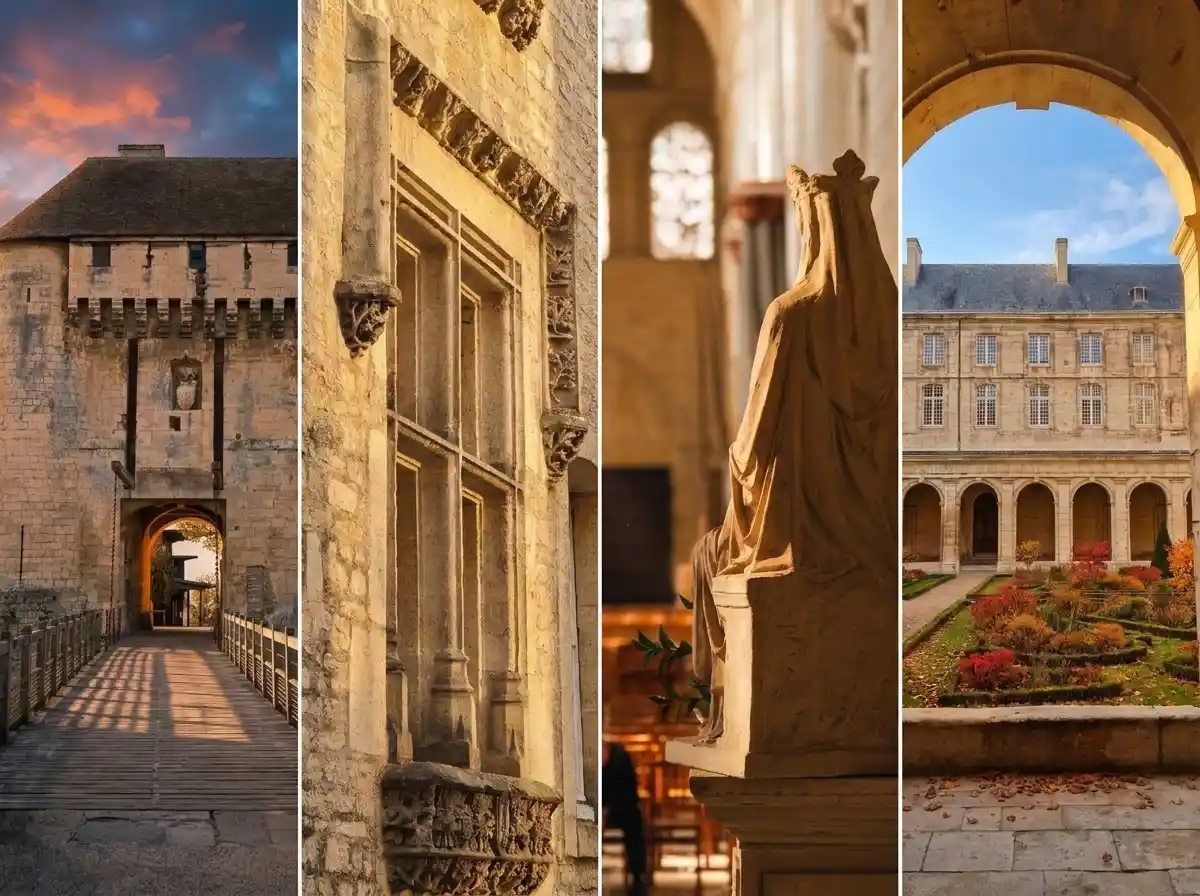
In short
- What is there: the Abbaye aux Hommes and William the Conqueror’s tomb, the Château de Caen, the Abbaye aux Dames and Matilda’s tomb, and the Mémorial de Caen.
- How to get there: by train from Paris-Saint-Lazare, about two hours, or by car.
- How long: one day for the three sites of William and Matilda, and a few more hours for the Mémorial.
- Closing day: the castle museums are closed on Mondays, except in July and August.
- Free: the castle compound and ramparts, the self-guided visit to the Abbaye aux Dames, and the castle museums on the first weekend of every month.
- Parking: the underground garage of the city hall, next to the Abbaye aux Hommes.
- Bonus: the story of William the Conqueror’s funeral, at which his body burst open.
Caen is the capital of the Calvados department in Normandy, about two hours by train from Paris. It has an abbey built to atone for a marriage the Church forbade, one of the largest fortified compounds in Europe, the tomb of a king whose body burst open at his own funeral, and a museum that tells the story of the entire 20th century.
In September 2025, on a trip with my parents in Normandy, I came to Caen for the first time. The truth? I did not expect much. In my head Caen was first of all the “martyred city” (ville martyre) of 1944, a town destroyed in the battles after the landings on the Normandy beaches, and I expected a gray and somewhat angular city. How wrong I was. I found a lively city with a glorious past, the city of William the Conqueror (Guillaume le Conquérant, 1027–1087) and of his wife Matilda of Flanders (Mathilde de Flandre, 1031–1083). And that is where our walk begins too, at the abbey William built.
I planned to spend two days in Caen, but in the end I gave one of them to a trip through the villages of Cambremer and Beuvron-en-Auge, and I did not regret it. Even in one day I managed to see almost all the main sights, so this itinerary is for a single day: William’s Abbaye aux Hommes, the castle of them both and Matilda’s Abbaye aux Dames, plus the Mémorial for those who have time left. You will find the full story of the city, from William’s turbulent romance to the bombings of 1944, in the article on the history of Caen, and I strongly recommend reading it before your visit.
Practical information for a visit to Caen
How to get to Caen
By train: trains to Caen leave from Paris-Saint-Lazare station, and the ride takes about two hours. The tickets are easy to book ahead through Omio, which shows all the rail operators on one screen and spares you the French rail website.
By car: if you plan to tour Normandy and also reach the D-Day beaches and the villages around them, a car will make your life much easier.
Parking in Caen
I parked in a garage next to the Abbaye aux Hommes and walked from there to every stop on the route. If you come by car, there are two main options:
- Parking in the center (paid): the underground garage of the city hall (Parking Hôtel de Ville), right next to the Abbaye aux Hommes, is open 24 hours a day, and the first half hour is free. Note that the entrance height is limited to 1.90 meters.
- Budget parking: park-and-ride lots (Parc Relais) on the edge of the city, such as Parc Expo or Côte de Nacre, and from there a bus or tram to the center.
16 place Guillouard (Parking Hôtel de Ville)
Public transportation in Caen
Caen has a good public transportation network called Twisto, with trams and buses. If you plan a full day of sightseeing, the 24-hour ticket (Ticket 24 Heures) costs €4 and gives you unlimited rides. There is also a one-hour ticket, which suits a single ride. You will find the current prices on the Twisto website.
Guided tours from Caen
Even though I always prefer to wander on my own, sometimes a good guided tour reveals stories that are hard to find by yourself. These are the tours that set out in Caen itself:
Caen is also a convenient starting point for organized tours to the D-Day beaches, which save you the driving and the search for the sites scattered along the coast:
How long to stay, and when to come
One day is enough for the three sites of William and Matilda. The Mémorial needs a few more good hours, so if you want to see it too, you will need another day, or at least half a day. It is worth planning the visit around the closing days:
- The Musée de Normandie and the Musée des Beaux-Arts in the castle are closed on Mondays (except in July and August).
- On the first weekend of every month, entry to the castle museums is free, and it is always free for young people under 26.
- The Abbaye aux Hommes and the Abbaye aux Dames are closed on December 25 and January 1.
A one-day itinerary in Caen
The route passes through the three sites that William and Matilda built, the couple who shaped Caen as we know it: we start at the Abbaye aux Hommes that William built, continue to their mighty castle, walk through the Vaugueux quarter, and finish at the Abbaye aux Dames that Matilda built. It is a route that tells a whole story of love, politics, religion and legacy.
Abbaye aux Hommes
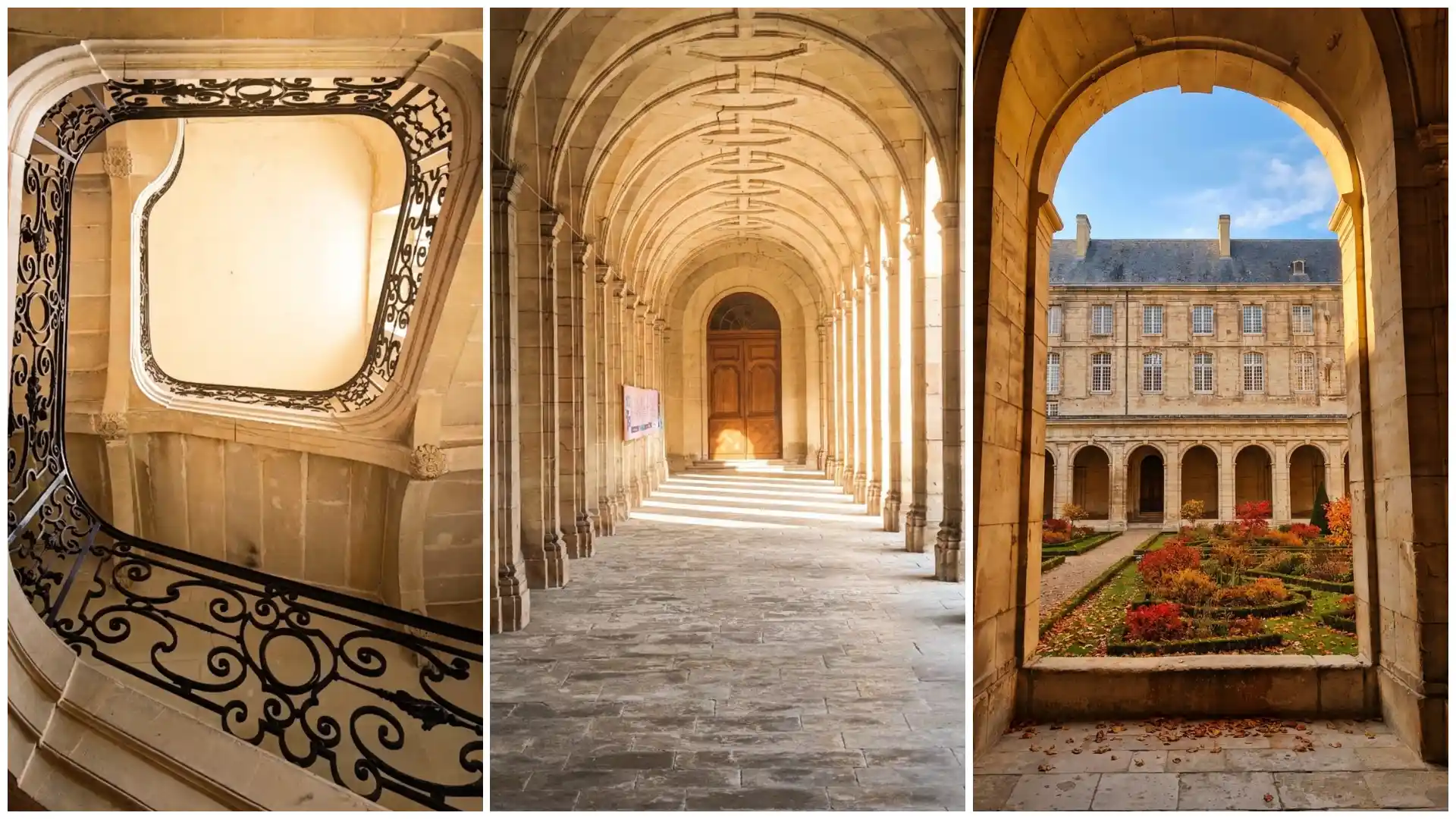
We start the day at one of the most impressive buildings in Normandy. The Abbaye aux Hommes, which today serves as Caen’s city hall (Hôtel de Ville), combines Norman Romanesque architecture with Gothic style. The building was originally meant to show off the duke’s power, and it certainly does the job. The church attached to it, the Church of Saint-Étienne, takes your breath away with its pointed spires, which rise to a height of 80 meters. Standing in front of its facade, I understood why Norman architecture became a model to copy all over Europe and England.
Do not miss the tour inside the abbey buildings themselves. In the 18th century the Maurist monks (Mauristes, a Benedictine order) decided that the walls from the Middle Ages were no longer comfortable enough for them, and they rebuilt the monks’ quarters in a classical style that looks more like a palace than a monastery. On the tour you will see the quiet cloister surrounded by Tuscan columns, the chapter house (Salle Capitulaire), which now serves as the city’s wedding hall, and the monumental staircase, which will make you feel you have walked into a period film.
But the real story here is the story of how the place was founded. William and Matilda were distant relatives, and Pope Leo IX (reigned 1049–1054) forbade their marriage on grounds of consanguinity. They, like rulers who are not used to hearing “no”, ignored the ban and married anyway, and for years they were excommunicated. Only thanks to the diplomacy of the Italian scholar Lanfranc of Pavia (Lanfranc de Pavie, died 1089) were they finally pardoned. The price? Each of them promised to build an abbey in Caen, and that is how William’s Abbaye aux Hommes and Matilda’s Abbaye aux Dames were born (we will reach the second at the end of the route).
This building also has an especially moving chapter in the modern history of France. In the summer of 1944, when the battle for Normandy began, Caen was bombed without mercy. While the city was being destroyed around them, thousands of residents found shelter within the thick walls of the abbey, which was then the Lycée Malherbe high school. The area was declared a “sanitary island” (Îlot sanitaire), and according to tradition the townspeople spread out huge sheets and painted red crosses on them, some of them in blood, in the hope that the Allied pilots would recognize them and not bomb the building. Most of the abbey survived, and thousands of people owe it their lives.
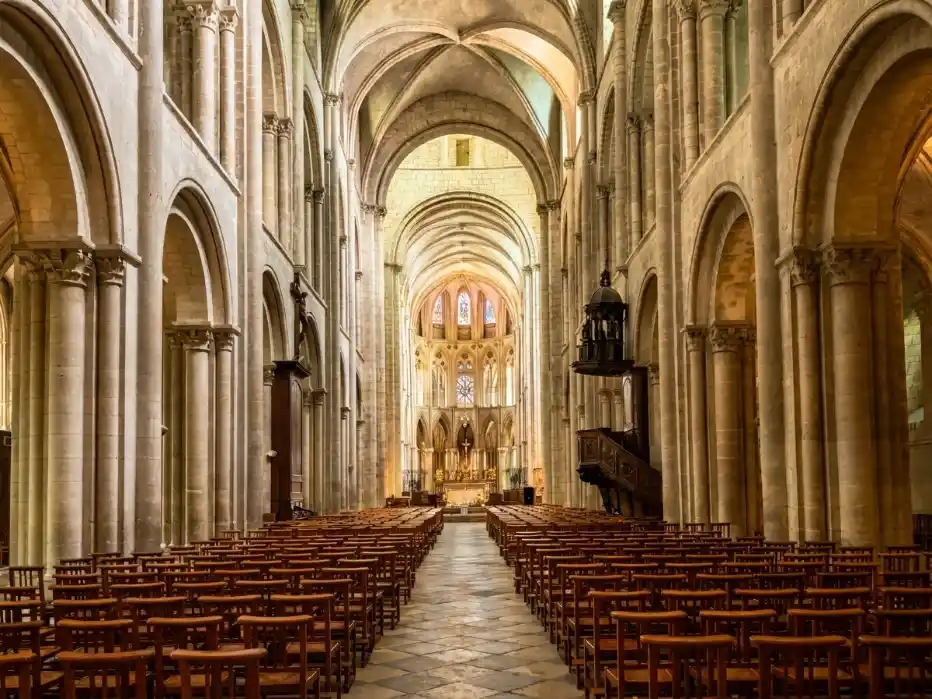
The Church of Saint-Étienne also holds William’s tomb. Well, at least what is left of him (a modest marble slab marks its place in the choir). His funeral in 1087 was a dramatic and even slightly tragicomic affair. During the funeral procession a great fire broke out in the city, and most of the crowd fled. When they finally got to burying him, it turned out that the body had swollen so much that it would not fit into the stone coffin, and when they tried to force it in, the belly burst and filled the church with a terrible stench, which made the few mourners who were left run out as fast as they could. Later, in the Wars of Religion and in the French Revolution, the tomb was desecrated again and again, and today all that is left in it is a single thigh bone attributed to the duke.
- Opening hours: Monday to Thursday 9:00–18:00, Friday 9:00–17:00, and on weekends 9:30–13:00 and 14:00–18:00. Closed on December 25 and January 1.
- Prices: €4 for an adult, and €6 when there is a temporary exhibition. Free entry under 18.
- Tickets: for more information and tickets, visit the official website of the abbey.
Château de Caen
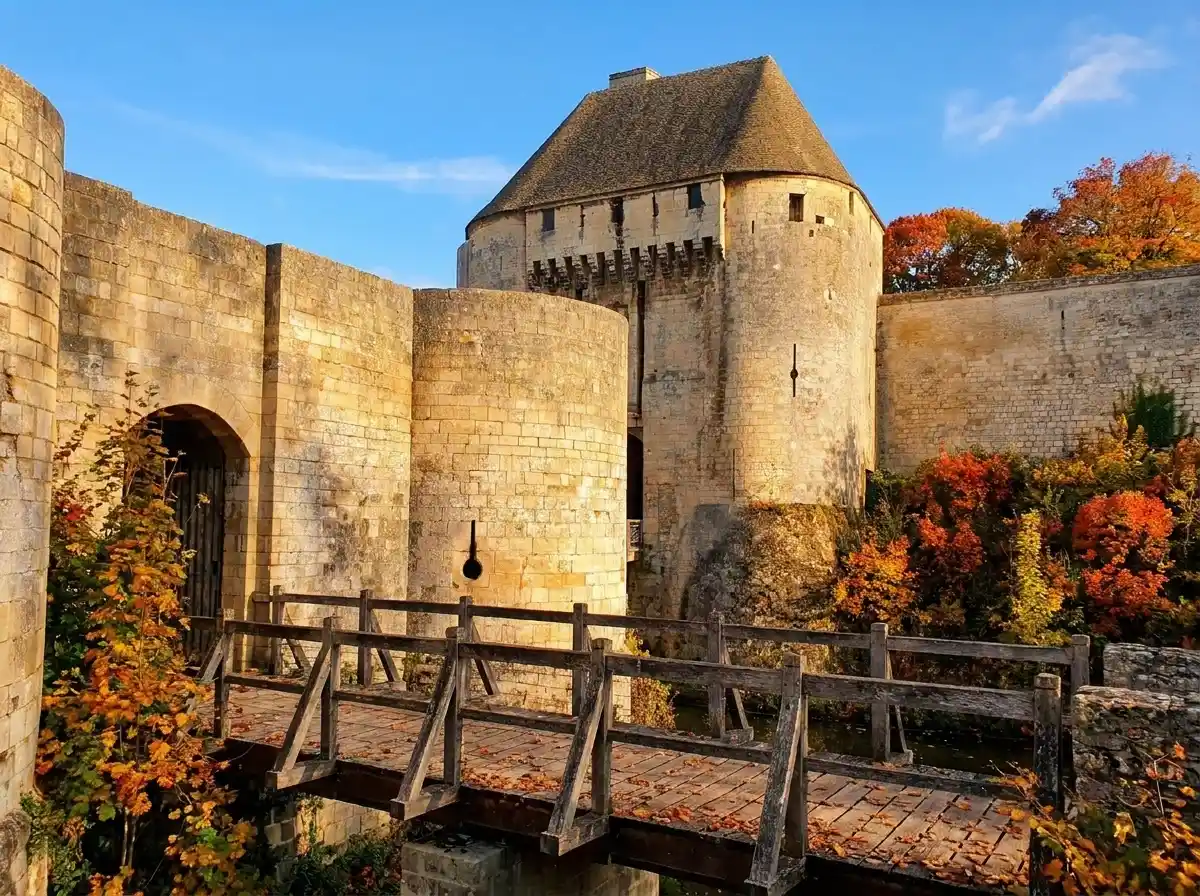
From the abbey we continue to the heart of Norman power, the Château de Caen. This is not just another romantic castle, but one of the largest fortified compounds in Europe, covering about 5.5 hectares. William the Conqueror began building it around 1060, and the fact that he chose to place it on a small hill inside the city, and not on an isolated peak outside it, shows his wish to rule his new capital up close.
For hundreds of years the castle was a favorite residence of the dukes of Normandy and the kings of England, such as Henry I (reigned 1100–1135) and Henry II (reigned 1154–1189), who held a glittering royal court here. When the French king Philip Augustus (reigned 1180–1223) conquered Normandy in 1204, he fortified it even further and added the barbicans, the massive defensive works at the entrances, such as the “Gate of the Fields” (Porte des Champs), which still stands there with its turrets and deep moat. The castle also played a central role in the Hundred Years’ War.
Walking along the ramparts is an experience in itself, and they give you a view over the whole city (a good chance to take photos and look for the spires of the two abbeys). Inside the gates you will discover a kind of city within a city. In the middle of the compound stands the Church of Saint-Georges (Église Saint-Georges), which served the garrison and the castle’s residents.
Another interesting building is the Exchequer Hall (Salle de l’Échiquier), built in the 12th century in the days of Henry I, a rare example of civic architecture from the Middle Ages. Its name apparently comes from the checkered cloth, like a chessboard, on which the treasury officials counted the duchy’s taxes. Next to it you will see the remains of the keep (donjon), a massive square tower that was torn down in the French Revolution so that it would not serve as a symbol of tyranny. Today only its foundations and the deep moat around it are left, but their size alone tells the story.
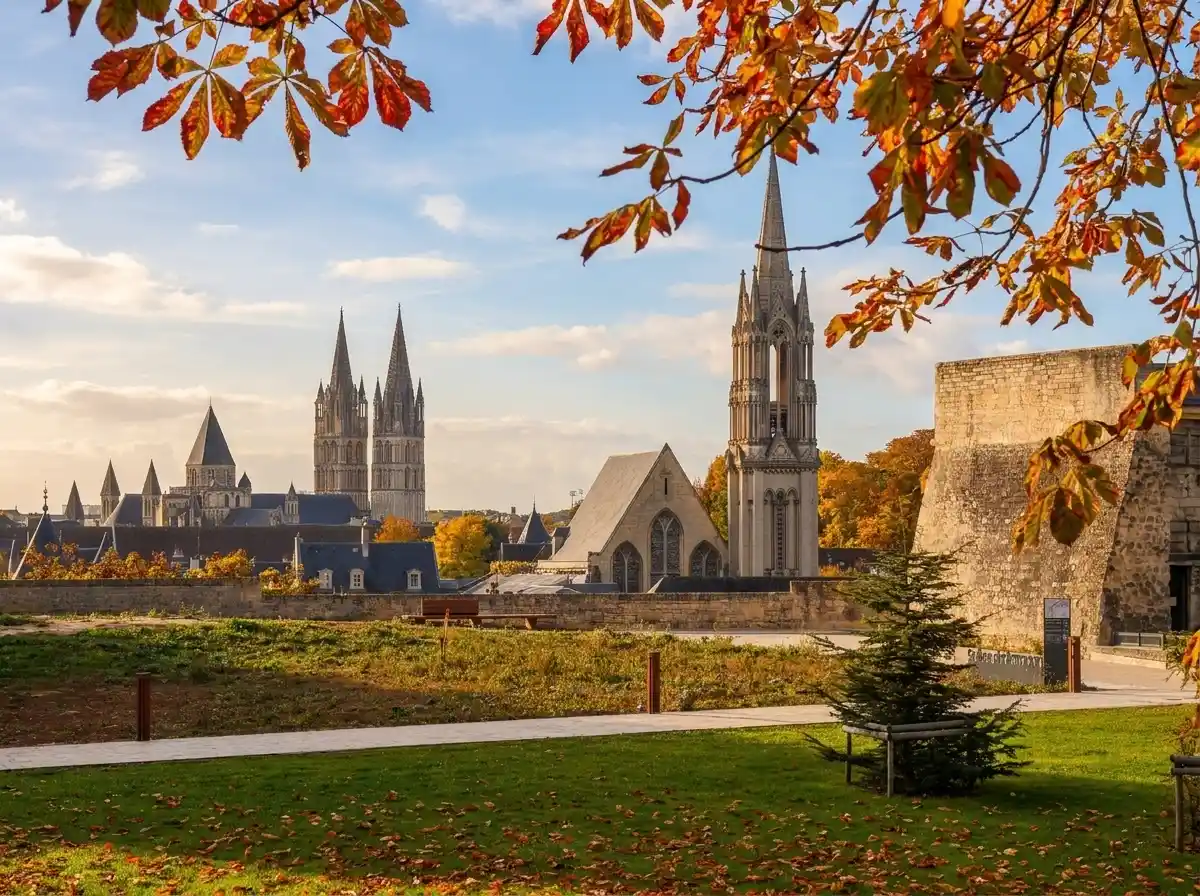
Inside the compound there are two important museums: the Musée de Normandie, in the governor’s lodgings (Logis du Gouverneur), devoted to the history, archaeology and everyday life of Normandy, and the Musée des Beaux-Arts, with a large collection of European painting from the Middle Ages to the 20th century. Among its works you will find Monet’s painting Étretat, la Manneporte, reflets sur l’eau, which shows the cliffs of Étretat. If you love art, do not skip it.
In recent years the city has been investing in a big project at the castle: the cars have left the walls (yes, the French made a parking lot inside William the Conqueror’s castle…), and the inner area is becoming a green park. Inside the compound you will also find the medicinal herb garden (Jardin des simples), which recreates a healing garden from the Middle Ages, and the sculpture garden of the Musée des Beaux-Arts.
- The castle compound and ramparts: open every day (except July 14), and entry is free.
- The museums: Tuesday to Friday 9:30–12:30 and 13:30–18:00, and on weekends and holidays 11:00–18:00. Closed on Mondays (except in July and August).
- Prices: entry to each museum separately costs €5, and €7 during an exhibition. The combined ticket for both museums (Pass Museo) costs €8 (€10 with the exhibitions) and is valid for three days. Entry is free under 26 and on the first weekend of every month.
- Tickets: at the ticket desks or in advance on the official ticket website of the castle and museums.
A meal in the Vaugueux quarter
From the castle you walk down to the Vaugueux quarter, a small quarter of lanes and half-timbered houses with quite a few restaurants. The restaurant where I ate in Caen I will not recommend to you, because it was mediocre. On the other hand, Le Bouchon du Vaugueux is listed in the Michelin Guide, which describes it as a bistro in the spirit of the Lyon “bouchon”, with a bar and crowded tables, and a kitchen that combines tradition with modern techniques. I have not eaten here yet. The restaurant is closed on Sundays and Mondays, and you book a table directly online. Restaurant website
Abbaye aux Dames
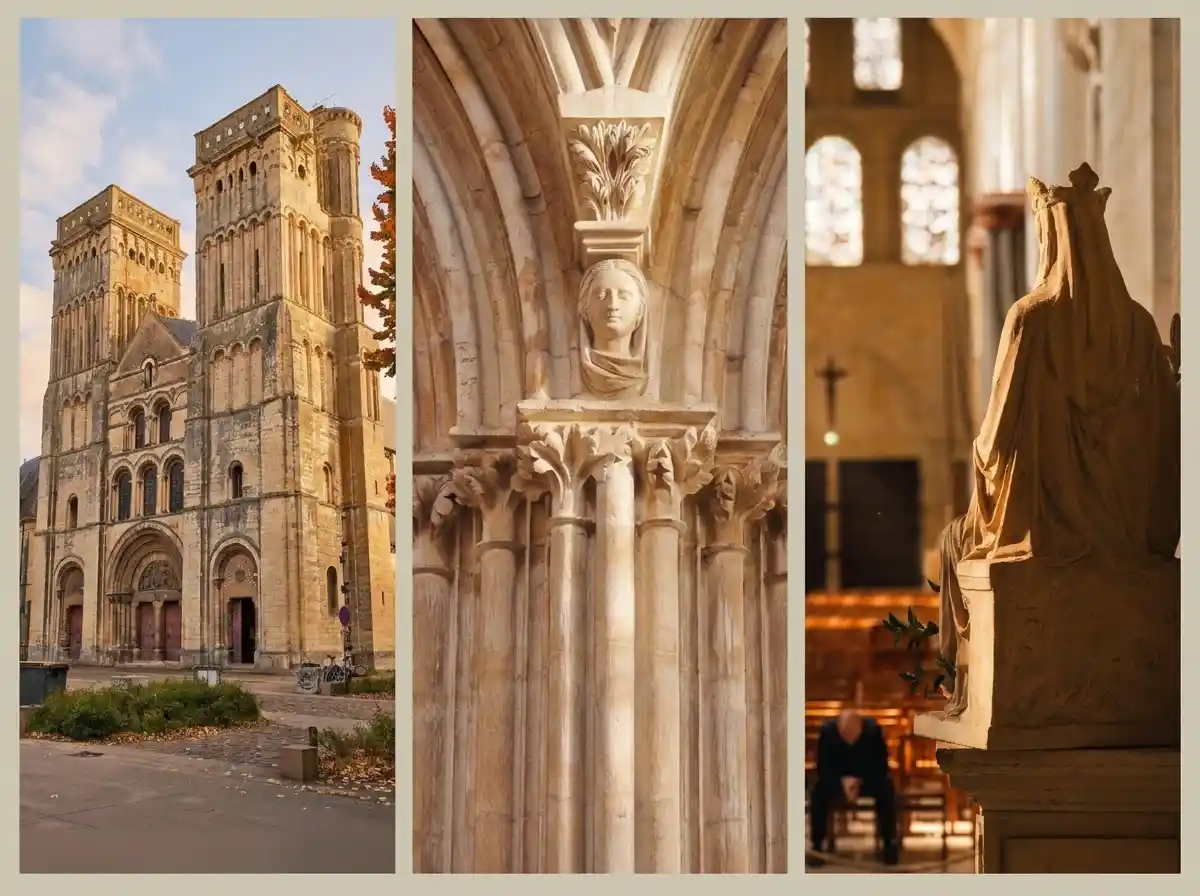
After the military might of the Abbaye aux Hommes and the castle, we end the day at the Abbaye aux Dames, the institution Matilda nurtured and where she is buried. The atmosphere here is completely different, quiet and restrained. Work on the Church of the Holy Trinity (Église de la Trinité) began in 1062, and it was consecrated in 1066, the year Matilda’s husband set out to conquer England. It is a rare Romanesque church, with soft light that filters in through the windows.
Under the choir of the church hides an original crypt from the 11th century, which has survived almost whole. You go down old stone steps into a dim space, held up by a forest of small, closely packed stone columns, where several of the abbey’s first abbesses are buried. Throughout its history the abbey was run by powerful women, usually noblewomen or women of the queen’s own family, such as Cecilia of Normandy (Cécile de Normandie), the daughter of William and Matilda, who was one of its best-known abbesses. The institution enjoyed great wealth and special privileges, which made it one of the strongest in Normandy.
The emotional focus here is Matilda’s tomb, in the middle of the choir, under a shiny black marble slab with an original inscription from the 11th century. Unlike her husband’s tomb, Matilda’s was preserved over the centuries. Even when the Calvinists broke in during the Wars of Religion, her bones survived (although her ring was looted), a sign of the respect the people of the area felt for the city’s founder.
The abbey buildings went through big changes. In the 18th century, as at the Abbaye aux Hommes, the nuns decided that the medieval buildings were too old (after all, why live in cold stone cells when you can build a palace?), and the abbey was rebuilt in a classical style to the plans of Guillaume de La Tremblaye. By the way, a young woman named Charlotte Corday (1768–1793) was educated within the walls of this abbey before the Revolution. She later murdered Jean-Paul Marat (1743–1793) in his bathtub in Paris.
The French Revolution put an end to the nuns’ life here. In the 19th century the compound became a city hospital (Hôtel-Dieu), and it served as one until the 1980s. It was then thoroughly renovated, and today it is the seat of the Normandy regional council (Conseil régional de Normandie). Do not miss a walk in the Parc Michel d’Ornano next door, a well-kept French garden with wide lawns and a huge cedar of Lebanon in the middle. From the edge of the park there is one of the most beautiful views of the city.
- Opening hours: the site is open all year (except January 1, May 1 and December 25). On weekdays 9:30–12:00 and 14:00–17:30, and on weekends until 18:00.
- Prices: the self-guided visit to the abbey and the church is free. To see the closed areas, including the crypt, you have to join a guided tour (highly recommended!), which costs €5 (free under 18) and sets out every day at 14:30 and 16:00.
- Tickets: you need no ticket for the self-guided visit. You will find information about the tours on the website of the Normandy region.
Mémorial de Caen
Sadly, for lack of time I did not manage to visit as I had planned, but since this is one of the most important attractions in Caen and in all of Normandy, I decided it could not be skipped. The Mémorial is much more than just another military museum.
The museum describes itself as “an international center for history and peace”, and it does not just show tanks and rifles, but tells the history of the whole 20th century, with an emphasis on the price of war. The exhibition starts with the circumstances that led to World War II (the rise of fascism, the failure of the League of Nations), goes through the occupation and the Holocaust in France, reaches the battles of the landings in Normandy, and continues to the Cold War, the building and fall of the Berlin Wall, and up to our own day.
It is worth giving the place a few good hours. Besides the wings on the battle for Normandy and on the Cold War, do not miss the original underground bunker beneath the museum, the headquarters of the German general Wilhelm Richter, who commanded the coastal sector facing the British and the Canadians on D-Day. At the end of the visit I suggest going out to the peace gardens (the American, British and Canadian gardens), a place where you can catch your breath and take in everything you have seen.
- Opening hours: the museum is open every day, and the hours change with the season. You will find the current hours on the official website, and last entry is about an hour and a quarter before closing (but do not arrive only an hour before, that is really not enough!).
- Prices: an adult ticket costs €20.80, with discounts for students and for visitors aged 65 and over.
- Tickets: the lines can be long in high season, so I strongly recommend booking a ticket ahead. You can buy an entry ticket to the Mémorial through Tiqets with this link.
What else to do in and around Caen
If you have time left in the city, it is worth a peek into the Church of Saint-Pierre (Église Saint-Pierre) opposite the castle, and on a Friday a visit to the market on the Place Saint-Sauveur. If you have a day or two in the area, here are a few ideas I have written about on the site:
- The D-Day beaches and the Bayeux Tapestry: a route in the footsteps of the Normandy landings, which also passes through Bayeux and the famous tapestry that tells the story of William’s conquest.
- Honfleur: the port town of the Impressionists, with the largest wooden church in France.
- The Cider Route: a route through villages and the makers of cider and calvados.
- Deauville and Trouville: two neighboring seaside towns.
- Rouen: the capital of Upper Normandy, with a two-day itinerary.
If you are planning a longer trip, Caen is one of the stops on the two-week Normandy itinerary I put together.
Where to stay in Caen
On this trip I stayed in Yael Soliman’s apartment in Deauville, but I think it is worth staying in Caen itself. That way you can discover the city at your leisure, enjoy it in the evenings too, and use it as a base for the D-Day beaches, the Cider Route and Bayeux.
-
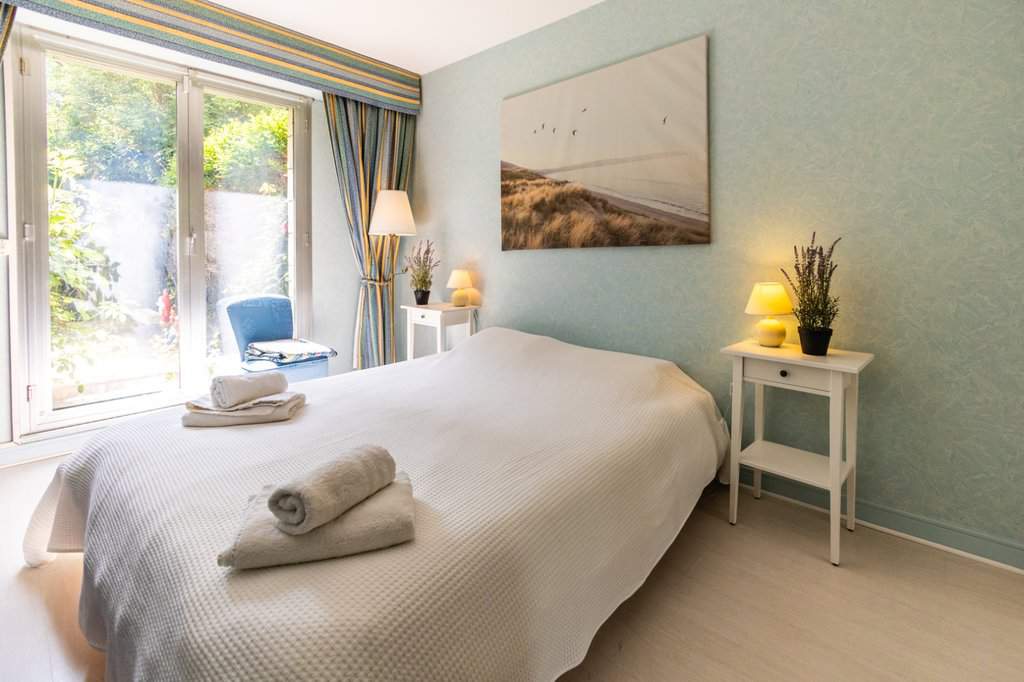
Yael Soliman’s apartment in Deauville
I stayed in this apartment on the trip. It is one street away from the sea and the Deauville boardwalk, with a private garden, an equipped kitchen and a washing machine, and it makes a good base for trips around Normandy, including to Caen.
You will find all the lodging options in the city on Booking, and if you prefer to stay closer to the D-Day beaches, here are the recommended hotels in Bayeux.
Frequently asked questions about Caen
How do you get to Caen from Paris?
How much time do you need in Caen?
On which day are the museums in Caen closed?
What can you see in Caen for free?
Where do you park in Caen?
Is it better to stay in Caen or in Bayeux?
Related reading