
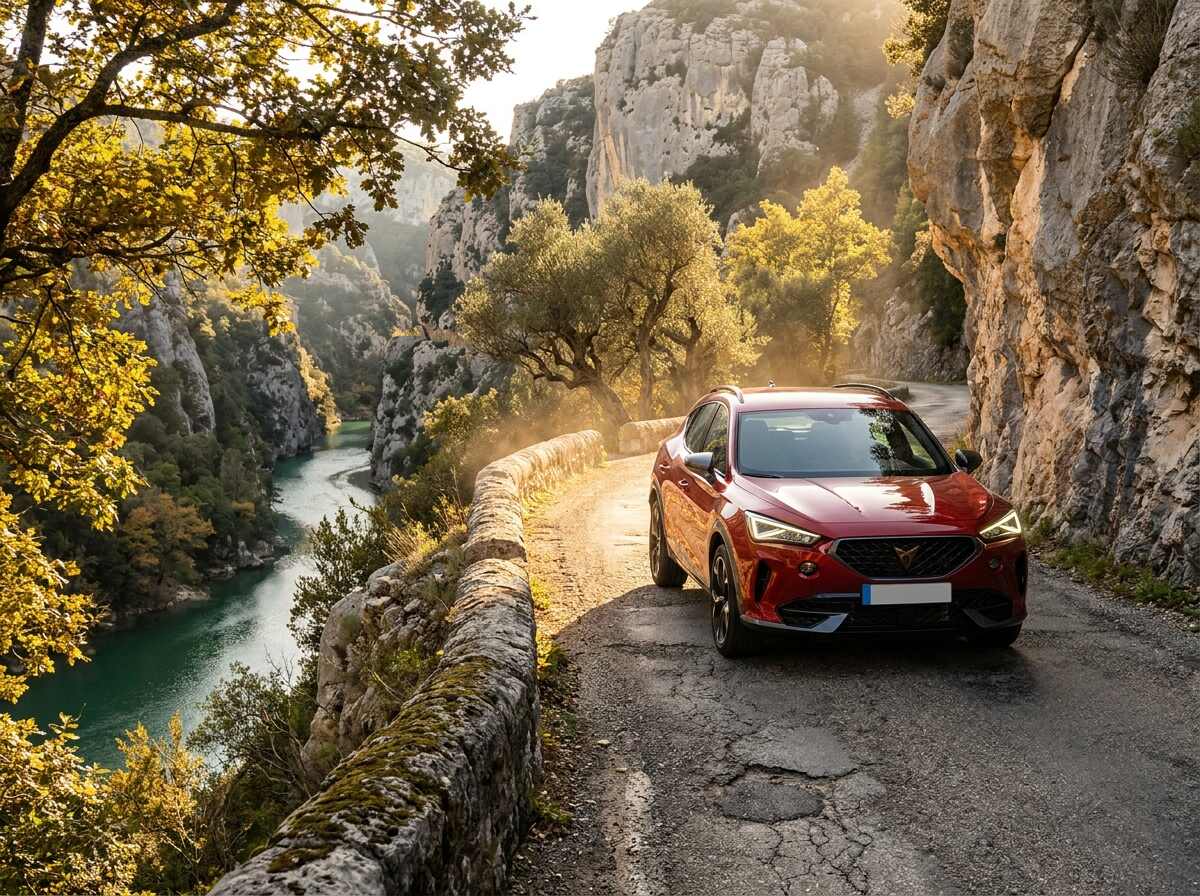
In short: car rental in France
- Book early: prices climb and the choice shrinks, and most rental cars in France have a manual gearbox. Automatics are rarer and more expensive.
- What you need: a valid driver’s license (with an international driving permit if it is not in French), a passport and a credit card for the deposit.
- What it costs: out of season a manual mini car costs 20 to 30 euros a day. In July and August a family or automatic car costs 70 to 120 euros a day.
- Speed limits: 50 km/h in built-up areas, 80 or 90 on a two-lane road, 110 on a divided expressway and 130 on the autoroute. In the rain the limits drop.
- Priority to the right: with no sign, the car coming from the right goes first, even when it comes out of a small side street.
- Crit’Air: required in the low-emission zones of the big cities, such as Paris and Lyon. Rental cars in France usually come with it.
- Toll roads without barriers: on the A79, A13 and A14 you pay online within 72 hours of passing.
- Winter driving: from 1 November to 31 March the mountain law requires 3PMSF winter tires or snow chains in mountain areas.
Renting a car in France is the truly convenient way to travel the regions: you reach the villages and small towns, stop at a vineyard you saw by the road, and plan the day by the weather rather than by the timetable of the regional train. Outside the big cities public transport is thin, and anyone who wants to travel the different regions of France, like Provence, the Loire Valley or the French Riviera (Côte d’Azur), will soon find that without a car many of the beautiful places are simply out of reach.
As someone who has driven France’s roads dozens of times, I have gathered here everything you need to know before you turn the key: which sites to book through, what to bring to the counter, where to pick up the car, the traffic rules that surprise visiting drivers, toll roads, the Crit’Air sticker and winter driving, and finally a few roads that are worth renting a car for.
Recommended sites for renting a car in France
Before I list the sites, one tip worth cutting out and keeping: book the car as early as you can. The longer you wait, the higher the prices climb and the smaller the choice gets. This matters twice over if you need an automatic car: most rental cars in France have a manual gearbox, and automatics are rarer, in high demand and more expensive. Booking a few months ahead, especially for the summer peak, gets you an available car at a reasonable price.
These are the car rental sites I recommend in the Francophile’s Toolkit:
Booking.com
Booking’s car rental engine brings the big rental companies together in one place. If you already book your lodging there, everything sits in the same account.
Discover Cars
A search engine that compares prices from hundreds of car rental companies on one screen, and lets you filter by automatic gearbox and pickup point.
I recommend checking each of them before you close a deal, because price gaps for the same car on the same dates can be surprising. And by the way, always look for a rental with full insurance (Super CDW, zero excess). You can read about the difference between it and regular CDW in the FAQ at the end of the article.
What do you need to rent a car in France?
On a short visit to France you can drive with your home driver’s license, as long as it is valid. Under French law, though, a foreign license that is not written in French must come with an international driving permit or an official translation, so it is worth getting an international permit before you leave home. Before you reach the rental desk, make sure you have:
- A valid driver’s license, together with an international driving permit if your license is not in French.
- A valid passport.
- A credit card for the deposit, according to the rental company’s terms.
- Your flight number or train ticket, if you pick up the car at the airport or at a station. Some companies ask for it.
Watch the small print too: some companies require at least a year of driving experience (and more for big or luxury cars), and drivers under 25 pay a daily surcharge.
Where is the best place to pick up a rental car in France?
Where you pick up the car decides whether your first day starts on a highway or in a traffic jam in the city center. There are three main options:
- The airport: the convenient option if you head straight for the highway. Every major airport has rental desks, and you will find the full details in my car rental guides for Paris, Nice, Lyon, Marseille and Bordeaux.
- A train station: good if you arrive by fast train in the region you want to explore, for example at Aix-en-Provence TGV station, which has rental offices.
- A branch in town: only worth it if you are staying within walking distance of the branch, and even then keep in mind the narrow streets you will drive through until you are out of town.
Planning a trip in one region far from Paris? You do not have to drive there from the capital. You can take a fast train to your base town and pick up the car there. That saves hours of highway driving and the rental days in which the car just sits in a parking lot. Train tickets are easy to book ahead through Omio, which puts the train operators on one screen, and you can read about the trains themselves in the article Trains in France. If you plan to return the car in another town, check in the booking what the one-way fee is.
You will find an example of a full road trip, for which I picked up the car at Montparnasse station, in my Burgundy itinerary.
What you must know about driving in France in 2026
Driving in France is orderly and pleasant, but the authorities enforce the rules firmly. These are the laws, regulations and changes worth knowing:
1. Speed limits and basic traffic rules
- Speed limits: 50 km/h in built-up areas (and 30 km/h in many cities, Paris included). On a two-lane road outside built-up areas 80 km/h, but some departments have gone back to 90 km/h, so the sign decides. On a divided expressway (voie express) 110 km/h, and on the autoroute 130 km/h.
- Speed drops when it rains: on the autoroute the limit drops to 110 km/h, on a divided expressway to 100 km/h, and on a road limited to 90 it drops to 80 km/h. A road at 80 km/h stays at 80.
- Priority to the right (Priorité à droite): a rule that confuses many visiting drivers. In France, when there is no stop or yield sign, the car coming from the right has priority, even if it comes out of a small side street. At roundabouts priority usually goes to the cars already in the roundabout, apart from a few historic spots (such as around the Arc de Triomphe in Paris), where it goes to the cars entering.
- Required equipment in the car: a high-visibility vest (inside the cabin, not in the trunk!) and a warning triangle. There is no longer a fine for not carrying a breathalyzer (éthylotest), but the legal blood alcohol limit is only 0.05%.
2. Navigation and speed cameras (the law against Waze)
French law forbids devices and apps from showing the exact location of speed cameras. So apps like Waze adapt themselves automatically when you cross the border into France, and instead of warning about a camera they show a general danger zone (zone de danger), which can stretch over a few kilometers with the camera hidden somewhere inside. Drive by the rules: fines reach the rental company, and it will pass them on to you together with a handling fee.
3. Low-emission zones and the Crit’Air sticker
Big cities in France have set up low-emission zones (ZFE, Zone à Faibles Émissions). In Paris, for example, the zone covers everything inside the A86 ring road, and Lyon also restricts the entry of polluting vehicles. Every vehicle entering such a zone must show a Crit’Air sticker on the windshield, which marks its pollution level. In spring 2026 the French parliament voted to abolish these zones, but the Constitutional Council struck down the abolition, and the zones remain in force.
The good news for anyone renting: rental cars in France are usually new and come with the sticker, so you only need to check at the counter that it is really on the windshield. If you arrive in a car rented in another country, order the sticker in advance, only on the official government site certificat-air.gouv.fr, for a few euros.
4. Toll roads without barriers (Péage en Flux Libre)
Most highways in France (the ones marked with the letter A) are toll roads. On most of them the familiar system still works: you take a ticket at the entrance and pay at the exit, by credit card or in cash. On some roads, though, there are no barriers at all, for example the A79, and the A13 and A14 toward Normandy. Instead of barriers there are camera gantries that read the license plate.
- How to pay: if the car has an electronic toll tag (télépéage), the rental company charges you. If not, you pay yourself on the road operator’s website within 72 hours of passing. On the A13 and A14 that is the Sanef website, and you can also pay at tobacco shops that offer the Nirio service.
- What happens if you do not pay: the bill reaches the rental company, which will pass it on to you together with a handling fee.
5. Winter driving and the mountain law (Loi Montagne)
If you travel to France between 1 November and 31 March, pay attention to the mountain law. In mountain areas of 34 departments (the Alps, the Pyrenees, the Massif central, the Jura, the Vosges and more) you must carry one of two things: four winter tires marked with the 3PMSF symbol (a mountain with three peaks and a snowflake), or snow chains or “snow socks” in the trunk for the two driving wheels. Since November 2024 tires marked only M+S no longer meet the requirement. The start of the zone is marked by a sign, and some rental companies offer the equipment for an extra fee. Make sure your car complies, so that the gendarmerie does not send you back the way you came on the road to the ski resort.
Interesting roads for driving in France
The beauty of renting a car in France is that the drives between destinations become a trip in their own right. Here are a few roads worth getting behind the wheel for:
The Route des Grandes Alpes
If mountain, green and snowy landscapes are your thing, this road, which stretches for no less than 720 kilometers, will show you the scenery of the French Alps at their best. Since it was completed in 1937, the road has been considered one of the most beautiful in France. It starts on the shores of Lake Geneva (Lac Léman) and runs all the way to Menton on the French Riviera. The road is open only from June to October.
Watch a video of two cyclists who did the whole road on their own in 11 days.
The Route Napoléon
The Route Napoléon first opened in 1932, and it follows the route Napoleon marched in 1815, after he returned from his exile on Elba, from the beach of Golfe-Juan to Grenoble. I recommend splitting it into sections and enjoying the wealth of scenery along the way, which is dotted with small towns and picturesque villages typical of southern France. On the site you will find a full article on the Route Napoléon, but I will say right away that it is well worth stopping in the little town of Castellane.
Castellane, near the Verdon Gorge (Gorges du Verdon), is an attraction in its own right, with old stone-paved streets, narrow lanes and pretty squares.
The Col de la Bonette
What could be better than feasting your eyes on breathtaking mountain views and feeling a wonderful connection with nature? Meet the Col de la Bonette road, which proudly carries the title of one of the highest paved roads in Europe (2,802 meters, to be exact). The road is very winding and not necessarily suited to family trips (unless your children are immune to car sickness), and experienced drivers may find it a fun challenge.
A video from the top of the pass that will give you another angle on the experience waiting for you.
The Route des Crêtes
In Alsace, parallel to the Wine Route, runs a scenic 88-kilometer road along the ridges of the Vosges mountains. The French army built it in the First World War as a supply road, and today it passes mountain passes, lakes and pastures. Parts of it are closed in winter, usually from mid-November to early April. You will find all the stops along the way in the article The Route des Crêtes in Alsace.
The Gorges du Cians
If you are looking for a road that runs through tunnels carved into the mountain and across ravines and waterfalls, you are in the right place. The Gorges du Cians road is one of the most impressive in France, mostly thanks to the red rocks typical of the area. And once you are on the road, do not forget to stop for a baguette at the boulangerie of one of the villages along the way.
Car rental by city in France
Every city has its own rules: where it pays to pick up the car, which areas are restricted for traffic and what parking looks like. I wrote a separate guide for each of these cities:
- Car rental in Paris: where to pick up the car, the restricted zones, parking, and whether you need a car in the city at all.
- Car rental in Lyon: a convenient starting point for Burgundy and the Alps.
- Car rental in Marseille: for anyone planning a trip in Provence and on the Riviera.
- Car rental in Nice: a base for touring the French Riviera.
- Car rental in Bordeaux: for touring the vineyards and villages of the area.
- Car rental in Nantes: a gateway to Brittany and the Atlantic coast.
More articles to help you plan your trip in France
- France for travelers: a travel guide to every region
- Trains in France: how to travel fast and comfortably without a car
- Provence: itineraries, places to stay and attractions
- The Loire Valley: travel information, châteaux and attractions
Frequently asked questions about driving and renting a car in France
Do I need an international driving permit to drive in France?
Do I need a Crit’Air sticker in a rental car in France?
What is a Flux Libre toll road and how do you pay?
Is it legal to use Waze in France?
How much does it cost to rent a car in France?
What is the minimum age to rent a car in France?
Can I take a rental car from France to Italy or Spain?
What is the difference between CDW insurance and full insurance?
What equipment is required in the car when driving in France in winter?
Related reading