
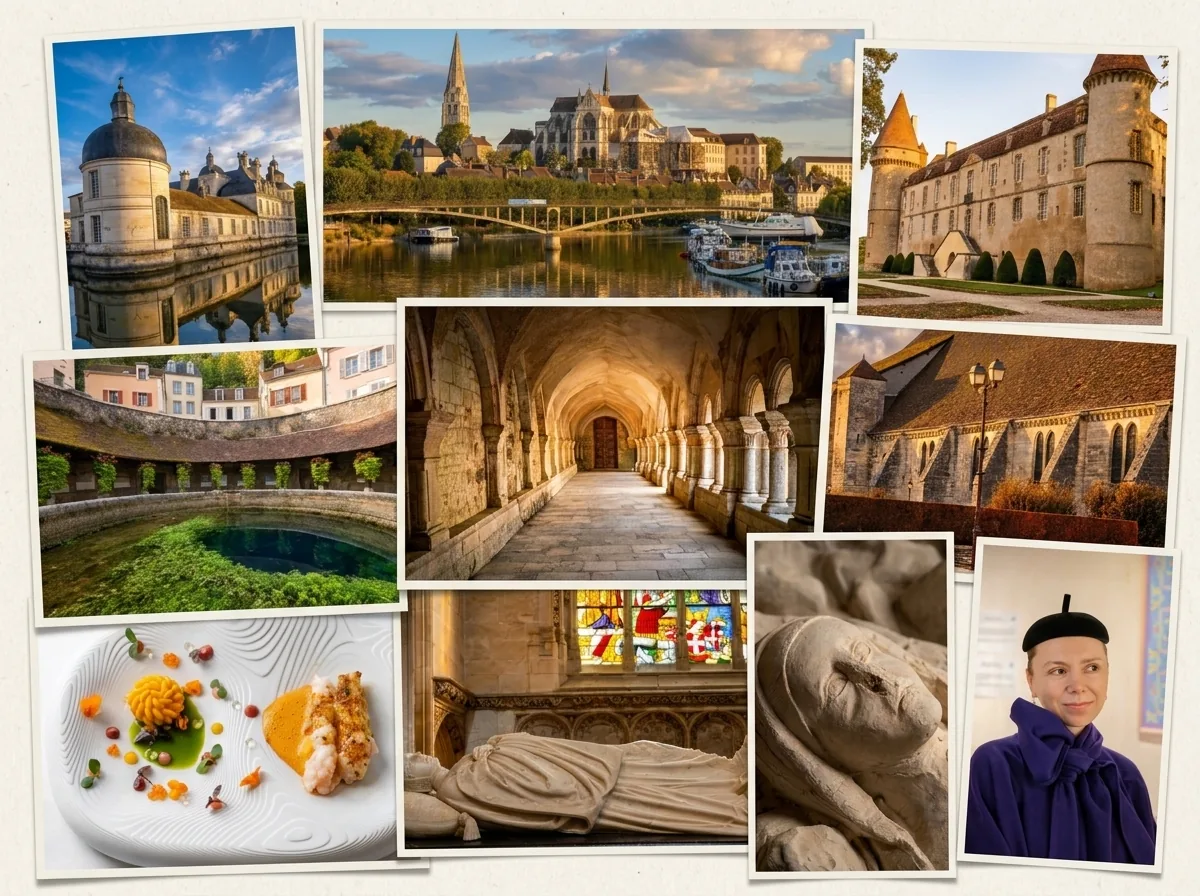
I chose northern Burgundy for a week-long trip with my parents in October 2026. I rented a car in Paris, split the lodging between two home bases, and built an eight-day itinerary that combines châteaux, abbeys, medieval towns and a few excellent meals (this is Burgundy, after all).
Not everything went according to plan. I skipped a day in Beaune, visited two châteaux I hadn’t planned to see, and by the end of the trip I came to a clear conclusion about where to stay, which will save you from my mistake. Each day of the itinerary links to the full article about that spot, so you can dig deeper into whatever interests you. Let’s get started.
Where did I stay during my trip through Burgundy?
I split the seven nights between two home bases: three nights in Auxerre and four nights in Semur-en-Auxois.
My recommendation: if I were planning the trip again, I’d spend the last four nights at Hôtel de la Poste in Avallon, the historic inn where Napoleon slept on March 16, 1815, on his way from the island of Elba to Paris. Avallon is about a 35-minute drive from Semur, so you can dedicate one day to Semur and see it at leisure, and it’s also close to Vézelay and the Château de Bazoches (you can read about the hotel and its restaurant on day seven of the itinerary).
How did I get around? Renting a car in Burgundy
Most of the places on this itinerary are very hard, sometimes impossible, to reach by public transportation, so I rented a car. I picked it up at Gare Montparnasse in Paris and dropped it off at the same station at the end of the trip.
I booked through Booking.com’s car rental page, where you can also compare prices. For what to know about picking up a car in Paris and driving out of the city, see my article on renting a car in Paris.
The Burgundy Itinerary: Day by Day
Day 1: From Paris to Auxerre
I picked up the car in Paris, and after about two hours of driving we arrived in Auxerre, the town that served as our base for the first three nights. I ended the first evening with dinner at Le Sarment, a restaurant with a Michelin Bib Gourmand where two chefs cook modern dishes from local ingredients. Two dishes stood out in particular: the octopus in pepper and grapefruit sauce, and the veal sweetbreads in a creamy polenta sauce.
Day 2: Tonnerre and the Château de Tanlay
In the morning we drove east, about 45 minutes, to Tonnerre, a town whose name means “thunder” in French. It has a turquoise-colored spring whose bottom no one has ever managed to find, as well as a medieval hospital nearly ninety meters long. On the map it looks like just another small town on the way to Chablis, but I came away feeling I had seen one of the strangest and most fascinating places in Burgundy.
In the afternoon we continued to the Château de Tanlay, a Renaissance château surrounded by water whose interior can only be seen on a guided tour. The main reason to go inside is the gallery entirely covered in trompe-l’œil paintings, and the ceiling of the Tour de la Ligue, which depicts the great figures of the French court as gods of Olympus. I visited in October and it was right on the edge of the season, so check the tour schedule on the château’s website in advance.
Day 3: A Morning in Auxerre and the Château de Saint-Fargeau
I dedicated the morning to Auxerre itself. The Cathédrale Saint-Étienne, the Abbaye Saint-Germain and the half-timbered houses of the old town are all within walking distance of the hotel, and if you want to dig deeper, I also recommend reading about the history of Auxerre, from Roman times all the way to France’s football championship.
In the afternoon we drove west, about 45 kilometers from Auxerre, to the Château de Saint-Fargeau in the Puisaye region. It is a pink-brick château with six towers, where the Grande Mademoiselle (Anne-Marie-Louise d’Orléans, 1627-1693), first cousin of Louis XIV, lived in exile. Her story also includes a tragic love affair with the duc de Lauzun (Antoine Nompar de Caumont, duc de Lauzun, 1633-1723), whose Paris residence you can read about in my article on the Hôtel de Lauzun.
The original plan for this day also included Guédelon, a site where a 13th-century château is being built using the tools and materials of the period. In the end I decided to skip it in favor of a morning in Auxerre, because Guédelon is a visit in its own right, not an hour-long add-on. If you’re willing to devote a full day to both, you can read about Guédelon in Yossi Drory’s article on lesser-known Burgundy.
Day 4: From Auxerre to Semur-en-Auxois
On the fourth day we said goodbye to Auxerre and drove straight, about an hour and 15 minutes, to Semur-en-Auxois, a medieval fortified town on a pink cliff above the Armançon river, and I devoted the second half of the day to the town. I experienced the moment when it really hit me where I was in the evening, on the Pont Pinard. In Semur I ate at Aux Vieux Pavés, a restaurant serving traditional local cuisine in the old town, and the standout dish was the escargots, served in a pastry shell instead of the usual shell.
If you follow my recommendation and stay in Avallon, Semur is perfect for a full day on its own: the Gothic collegiate church, the ramparts walk and the bridges over the Armançon are enough for a calm, pleasant day.
Day 5: Bourg-en-Bresse and the Monastery of Brou
I devoted the fifth day to a long drive: about two hours each way, to Bourg-en-Bresse, which is no longer in Burgundy but in the Ain department. The town itself was actually a disappointment, and apart from a few half-timbered houses from the 15th and 16th centuries and the co-cathedral, there isn’t much to do there. But this turned out to be one of the best days of the trip, thanks to two things: the monastery and lunch.
The Monastery of Brou is a masterpiece of flamboyant Gothic (gothique flamboyant), built by Marguerite of Austria (1480-1530), and its church holds three carved tombs that are among the most beautiful in Europe (you’ll find the full story in my article on the history of Bourg-en-Bresse and the Monastery of Brou). I highly recommend booking a ticket in advance through this link.
For lunch we sat at L’Auberge Bressane, right across from the monastery. My parents ordered Bresse chicken in cream and mushroom sauce, and I ordered quenelle de brochet, a pike dumpling that was the best I’ve ever had, even compared to Lyon. Up to that point, this was the best meal of the trip (and you’ll soon find out what topped it). You can read about the region’s famous chicken in my article on Bresse chicken.
Day 6: Château de Bussy-Rabutin and the Abbaye de Fontenay
In the morning we drove to the Château de Bussy-Rabutin, where Roger de Bussy-Rabutin (1618-1693), cousin of Madame de Sévigné (Marie de Rabutin-Chantal, marquise de Sévigné, 1626-1696), lived in exile. He covered the château’s walls with more than three hundred portraits of courtiers, each with a biting caption underneath.
For lunch we sat at La Pause Rabutin, right across from the château’s gate. I ate a Burgundian flamiche there, escargots and a bouchée à la reine, a puff pastry filled with mushrooms in cream sauce, and the prices were very reasonable. In short, this was one of the best unpretentious restaurants I’ve eaten at, both for the food and for the charming owner and his wonderful service.
In the afternoon, about a twenty-minute drive from there, we reached the Abbaye de Fontenay, the oldest Cistercian abbey in the world that has survived completely intact and a UNESCO World Heritage Site. I arrived when the light was low and turning the stone golden, and in October I got both color and quiet.
Day 7: Château de Bazoches, Lunch in Avallon and Vézelay
This day wasn’t in the original plan either. In the morning we drove to the Château de Bazoches, the home and planning office of Marshal Vauban (Sébastien Le Prestre de Vauban, 1633-1707), from which plans for fortresses across the kingdom were drawn up. The château remains in the hands of his descendants to this day, and for history lovers it’s a must in my opinion (by the way, in Paris I stayed in Udi’s apartment on Rue Saint-Roch, right near the spot where Vauban died).
For lunch we drove to Avallon, to Le 1815, the restaurant at the Hôtel de la Poste. This was the best meal of the entire trip, and I say that after already eating wonderfully in Auxerre and Bourg-en-Bresse. On that occasion I also met Julien Cohen, the owner of the hotel, who was very interested in the blog and agreed to let me photograph it.
In the afternoon, about a twenty-minute drive from Avallon, we climbed up to Vézelay, a small, enchanting hilltop village topped by the Basilica of St. Mary Magdalene, a UNESCO World Heritage Site. At the start of Rue Saint-Étienne I happened upon Julien Cohen’s shop, housed in a former church, and I left with a bottle of raspberry liqueur.
Day 8: Back to Paris
On the last morning we left Semur and drove north on the A6 highway, and in Paris I returned the car at the Montparnasse station. That’s where the Burgundy road trip ended and the Parisian vacation began. If you’re also continuing on to the City of Light, you’ll find everything you need to know in my complete Paris guide.
If you’re planning a road trip in another region of France too, read my itinerary for Normandy, where I spent two weeks with my parents.
FAQ About a Trip to Burgundy
How many days do you need for a trip to northern Burgundy?
Where should you stay on a trip to northern Burgundy?
Do you need a car to explore Burgundy?
What was the best meal of the trip?
Is it worth the drive from Burgundy to Bourg-en-Bresse?
So you never miss an article, since the best ones go out every weekend, feel free to sign up for the newsletter here.
Related reading