In short: car rental in Paris
- The key rule: inside Paris a car is a burden. The metro reaches everywhere, parking is expensive and traffic is heavy.
- When to rent: for trips outside the city: Normandy in about two and a half hours, the Loire Valley in two hours and Alsace in about 4.5 hours.
- What you need: a valid driver’s license with an international driving permit, a passport and a credit card for the deposit.
- Where to pick up: at the airport or a train station, not at an office in the center, so you do not drive through the heart of the city on pickup day.
- City center: arrondissements 1 to 4 are a limited traffic zone (ZTL). You enter only with a destination inside it, and driving through carries a fine of €135.
- Crit’Air: the whole area inside the A86 ring road requires a Crit’Air sticker. Rental cars in France usually come with one.
- Toll roads: the A13 and A14 to Normandy have no barriers, and you pay online within 72 hours of passing.
- Parking: on the street from about €6 an hour in the central arrondissements, for up to 6 consecutive hours, and free on Sundays and public holidays.
Renting a car in Paris sounds like a great idea on paper: pick up a car in the morning, drive along the Seine, stop by the Eiffel Tower, and then go on to the shops and a brasserie lunch. But as someone who has driven in Paris and around France dozens of times over the past 15 years, I can tell you that renting a car in Paris can be a wonderful experience only if you know in advance what to watch out for and exactly where not to go.
In recent years the city of Paris has been steadily cutting down traffic: the center has become a limited traffic zone, the whole area inside the A86 ring road is a low-emission zone that requires a Crit’Air sticker, street parking has become very expensive, and the highways to Normandy no longer have toll barriers.
If none of this scares you off, this article has everything you need to rent a car in Paris the right way: whether it is worth it at all, which sites to book through, what to bring to the counter, where to pick up the car, what to know about the rules and about parking, and where it is worth driving to.
Is it worth renting a car in Paris at all?
My answer is clear: if you plan to stay in the city only, do not rent a car. A car pays off only when you want to leave Paris, for the Île-de-France region, for farther regions such as the Loire Valley and Normandy, or to continue on to Belgium.
Inside the city I strongly recommend (I would even beg you) that you use the metro and the RER. The network reaches every arrondissement and every monument, without wasting half a day looking for parking in the Marais and without a mild heart attack on the traffic circles. The Vélib’ shared bike system covers the whole city and also offers e-bikes, and you will find all the options in the guide to public transportation in Paris.
Recommended car rental sites in Paris
Before I go over the sites, here are two tips worth clipping and keeping. The first: book the car as early as possible, especially if you need an automatic. Most rental cars in France have a manual gearbox, and automatics are in demand and cost more.
The second comes from painful personal experience (and one small scratch at the Place de l’Étoile that cost me dearly): look for car rental in Paris with full coverage (Super CDW, zero deductible). The streets are narrow, and this coverage often saves you hundreds of euros when you return the car.
These are the car rental sites I recommend in the Francophile’s Toolkit:
Booking.com
Booking’s car rental engine brings the big rental companies together in one place. If you already book your lodging there, everything sits in the same account.
Discover Cars
A search engine that compares prices from hundreds of car rental companies on one screen, and lets you filter by automatic gearbox and pickup point.
I recommend checking both before you close the deal, because price gaps for the same car on the same dates can be surprising.
What do you need to rent a car in Paris?
On a short visit to France you can drive with your home driver’s license, as long as it is valid. Under French law, though, a foreign license that is not written in French must come with an international driving permit or an official translation, so it is worth getting an international permit before you leave home. Before you reach the rental desk, make sure you have:
- A valid driver’s license, together with an international driving permit.
- A valid passport.
- A credit card for the deposit, according to the rental company’s terms.
- Your flight number or train ticket, if you pick up the car at the airport or at a station. Some companies require it, and it also helps them hold the car if your flight is delayed.
Watch the fine print too: some companies require at least one year of holding a license (more for large and luxury cars), and drivers under 25 pay a daily surcharge.
Car rental in Paris: prices in 2026
Car rental prices in Paris vary with the season, the type of car and demand, so it pays to book ahead. To keep things simple, I gathered the price ranges in a table:
| Car type | Average price per day | Who is it for? |
|---|---|---|
| Mini or economy car | €30–40 | Couples or solo travelers; good for short drives and easy parking |
| Family car (standard) | €60–80 | Families and longer trips outside the city that need a big trunk |
| Luxury car or convertible | €100 and up | Romantic getaways and stylish drives on the French Riviera or in the Loire Valley |
Where to pick up a rental car in Paris?
Where you pick up the car decides whether your first day starts on a highway or in a traffic jam on a narrow street. For most tourists the airport is the convenient option, but it is worth knowing all the alternatives:
Charles de Gaulle and Orly airports

Picking up at the airport suits anyone who leaves Paris straight for the highways. At Charles de Gaulle airport (Roissy-Charles-de-Gaulle) the rental desks are in Terminal 1 on the arrivals level, and in Terminal 2 you follow the signs to the rental area (Location de voitures). At Orly airport the desks are in Orly 3 on the arrivals level, and from there you go down to the parking lot.
- Pro: direct access to the highways, long opening hours and a large choice of cars, including automatics.
- Con: rental companies charge an airport surcharge, which makes the deal a little more expensive.
- Returning at night: if you return the car at Orly late at night, you may have to walk from the parking lot to the terminal.
Train stations
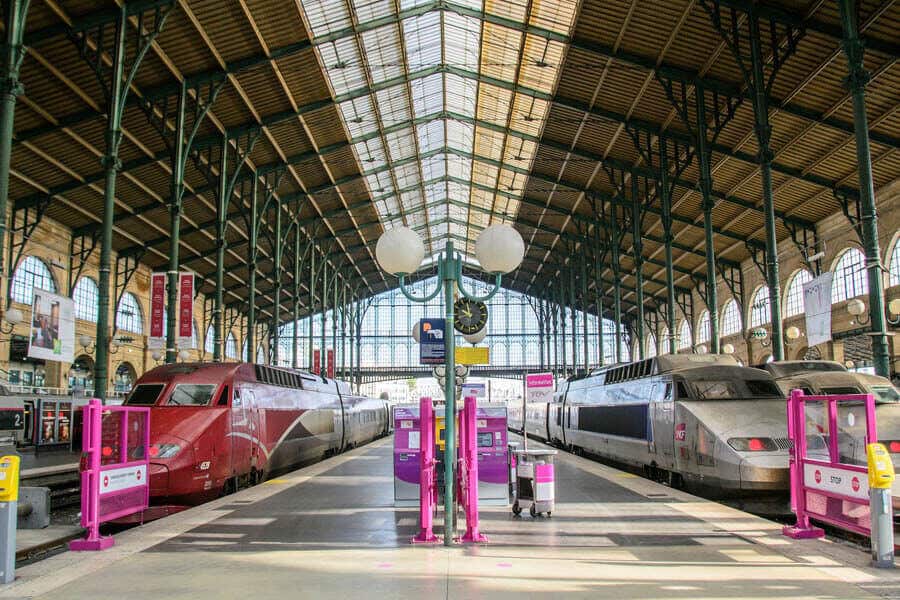
If you have already spent a few days in the city and want to move on, renting from a train station is an excellent option. Choose the station closest to your direction: for Normandy you leave from Gare Saint-Lazare, and for the south and Provence from Gare de Lyon. Keep in mind that the areas around the big stations are not always pleasant for a walk late at night.
For an example of a full road trip, in which I picked up the car at Montparnasse station, see my Burgundy itinerary.
Train to your base town, and only then a car
If you are heading to the Loire Valley or Normandy, you can skip driving out of Paris altogether: take a fast train to a base town such as Tours or Rouen and pick up the car there (check on the rental site that there is a branch at the station). This saves you the Périphérique, the traffic jams on the way out of the city and the rental days when the car just sits in a parking lot. Train tickets are easy to book ahead through Omio, which shows all the rail operators on one screen, and you can read about the trains themselves in the article on trains in France.
Offices inside the city
This only suits those staying within walking distance of a city branch. Keep in mind that getting out of the city can mean tough navigation through narrow streets until you reach the ring road.
Driving into Paris with a rental car
If you decided after all to rent a car at the airport and drive it into the city (for example, to drop your suitcases at the hotel), the navigation app will take you onto the ring road around the city, the Boulevard Périphérique.
It has one iron rule you must remember: on the Périphérique, priority goes to the car merging from the right. Unlike most highways you know, drivers in the right lane have to slow down and let cars coming up the ramp merge (and those cars will simply push in, so be careful).
Driving in Paris in 2026: the rules you need to know
The limited traffic zone (ZTL) in the city center
Since November 2024, arrondissements 1 to 4, now merged under the name Paris Centre, have been a limited traffic zone (Zone à Trafic Limité). You may enter it only if you have a destination inside it, and you may not drive through it.
- Who may enter: residents and people who work in the area, taxis and buses, and anyone with a destination inside the zone, such as a hotel, a restaurant, a theater or a parking garage.
- What is not part of the zone: the Grands Boulevards in the north, the Île de la Cité and the Île Saint-Louis, and the quays along the Right Bank when you drive from west to east.
- The fine: driving through without stopping carries a fine of €135. The start of enforcement was postponed several times, but the ban is in force, so keep your hotel or parking reservation confirmation at hand.
The low-emission zone (ZFE) and the Crit’Air sticker
The whole area inside the A86 ring road, including all of Paris, is a low-emission zone (Zone à Faibles Émissions). Every vehicle that enters it must display on the windshield a Crit’Air sticker showing its pollution level, and vehicles rated Crit’Air 3 and above may not enter on weekdays. In spring 2026 the French parliament voted to abolish these zones, but the Constitutional Council struck down the repeal, and the zone still applies.
The good news for renters: rental cars in France are usually new and come with the sticker, so you only need to make sure it is actually on the windshield. If you arrive in a car rented in another country (for example, in Belgium), order the sticker in advance, but only on the official site certificat-air.gouv.fr, for a few euros.
Tolls without barriers: Flux Libre
Heading west toward Normandy? The A13 and A14 highways no longer have toll barriers. Instead there are camera gantries that read your license plate.
- How to pay: if the car has an electronic toll tag, the rental company charges you. If there is no tag, you pay yourself on the Sanef website within 72 hours of passing, or at tobacco shops that offer the Nirio service.
- What happens if you do not pay: the bill goes to the rental company, which passes it on to you with a handling fee and charges your credit card.
Places better avoided
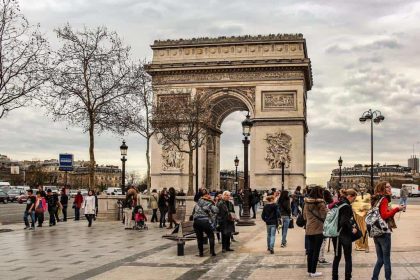
- Place de l’Étoile: the huge traffic circle around the Arc de Triomphe. Priority goes to cars entering the circle, and it is total chaos.
- Place de la Concorde: a busy central junction, packed with pedestrians and scooters darting in from every side.
Parking in Paris: zones, prices and how to pay
Street parking in Paris is an expensive luxury. To avoid fines, this is what you need to know:
- When you pay: Monday to Saturday, between 9:00 and 20:00. At night, on Sundays and on public holidays, street parking is free.
- How much it costs: in zone 1 (arrondissements 1 to 11) the rate starts at about €6 an hour, and in zone 2 (arrondissements 12 to 20) at about €4 an hour. Visitors may park for up to 6 consecutive hours in the same spot.
- How to pay: at the electronic parking meter (Horodateur) or in parking apps, by credit card only.
- Heavy cars: a gasoline or hybrid car over 1.6 tons, or an electric car over 2 tons, pays a triple rate, up to €18 an hour in zone 1. Keep this in mind when you choose an SUV.
- If you forget to pay: you get a parking charge (forfait post-stationnement) of €75 in zone 1 and €50 in zone 2, and three times that for a heavy car.
The solution I recommend: skip street parking and use underground parking garages (marked with a blue P), where the daily rate is usually a few dozen euros. You can book a spot in advance in apps such as Parclick or Zenpark and know the price up front.
Rented a car in Paris? 3 road trips worth the drive
The moment you leave Paris, the real France opens up before you, and you will find that driving on France’s highways and country roads is simply a pleasure. If you are looking for ideas for routes that need a car, here are 3 classics that always work:
1. The Normandy coast and around (about two and a half hours’ drive)
One of the favorite routes for travelers leaving Paris is Normandy. With a rental car you easily reach the white cliffs of Étretat, Rouen, where Joan of Arc (Jeanne d’Arc, 1412–1431) was burned at the stake, and of course the D-Day beaches of the Allies, such as Omaha Beach and Utah Beach. The car is essential here, because the historic sites and memorials are spread along a long strip of coast that public transportation does not cover well.
2. The châteaux of the Loire Valley (about two hours’ drive)
A rental car is the really convenient way to travel around the Loire Valley. Trains will take you to the main towns such as Tours or Blois, but the châteaux themselves, such as Château de Chenonceau, built over the Cher river, or Château de Chambord, require driving on country roads. In an open car on a sunny day, the drive between the vineyards and the spontaneous stops at local wineries are an experience the Paris metro can never compete with. You will find a full route in the article Loire Valley itinerary.
3. Alsace and the wine route (about 4.5 hours’ drive)
If you have a few free days and are ready for a longer drive east, toward the German border, take the car to Alsace. The Alsace Wine Route, about 170 kilometers long, passes through picturesque villages that look as if they came out of a book of fairy tales, such as Riquewihr and Ribeauvillé, and through the town of Colmar. The advantage of a car here is the freedom to stop in every little village, buy cheese and wine straight from the farmers, and fill the trunk to the brim.
Decided to skip the car?
A perfectly sensible decision. From the airport to your hotel you can book a private transfer in advance through Get Transfer, and for day trips outside the city there are fast trains in every direction, whose tickets are easy to book through Omio.
Frequently asked questions about car rental in Paris
Is it worth renting a car in Paris, or is the metro enough?
What do you need to rent a car in Paris with a foreign driver’s license?
Can you drive a rental car into central Paris?
Do you need a Crit’Air sticker on a rental car in Paris?
How do you pay tolls on the barrier-free highway to Normandy?
How much does parking in Paris cost?
Where is the best place to pick up a rental car in Paris?
How much does it cost to rent a car in Paris?
Want to rent a car in another city in France?
You will find everything you need to know about driving in France in the article Car rental in France, and there are also separate guides to renting a car in Nice, Lyon, Marseille, Bordeaux and Nantes.
Related reading