

The city of Valletta, the capital of Malta, is one of the island’s top attractions thanks to its beautiful buildings, the view from the Barrakka Gardens over the Three Cities, its museums, and its streets, almost every one of which tells a different story. This is a city with a fascinating history that begins with a Turkish siege, moves through the story of the Knights of Malta, and ends with fierce battles in World War II.
Anyone who knows me and my site knows my motto: knowing the history of the place you’re visiting makes your trip that much better. So today I want to bring you a summary of the fascinating history of Malta’s capital, one that will help you understand what you’re seeing and experiencing in the city.
The Ottoman Siege That Gave Birth to Valletta
When you walk through Valletta and see its many palaces and baroque churches, it’s easy to assume this is an ancient city like Mdina. But this city was built “only” in the 16th century, and by Maltese standards, where history stretches back some 4,000 years (maybe more), that makes it practically a toddler that hasn’t even finished kindergarten yet.
A Career Change: From Doctors to Pirates
To understand how Valletta came to be, we need to go back to the time of the Crusades. During that period, several orders were formed to defend the Crusader Kingdom of Jerusalem. One of these was the Knights Hospitaller, whose original role was to provide medical care to pilgrims and to residents of the cities taken by the Crusaders.
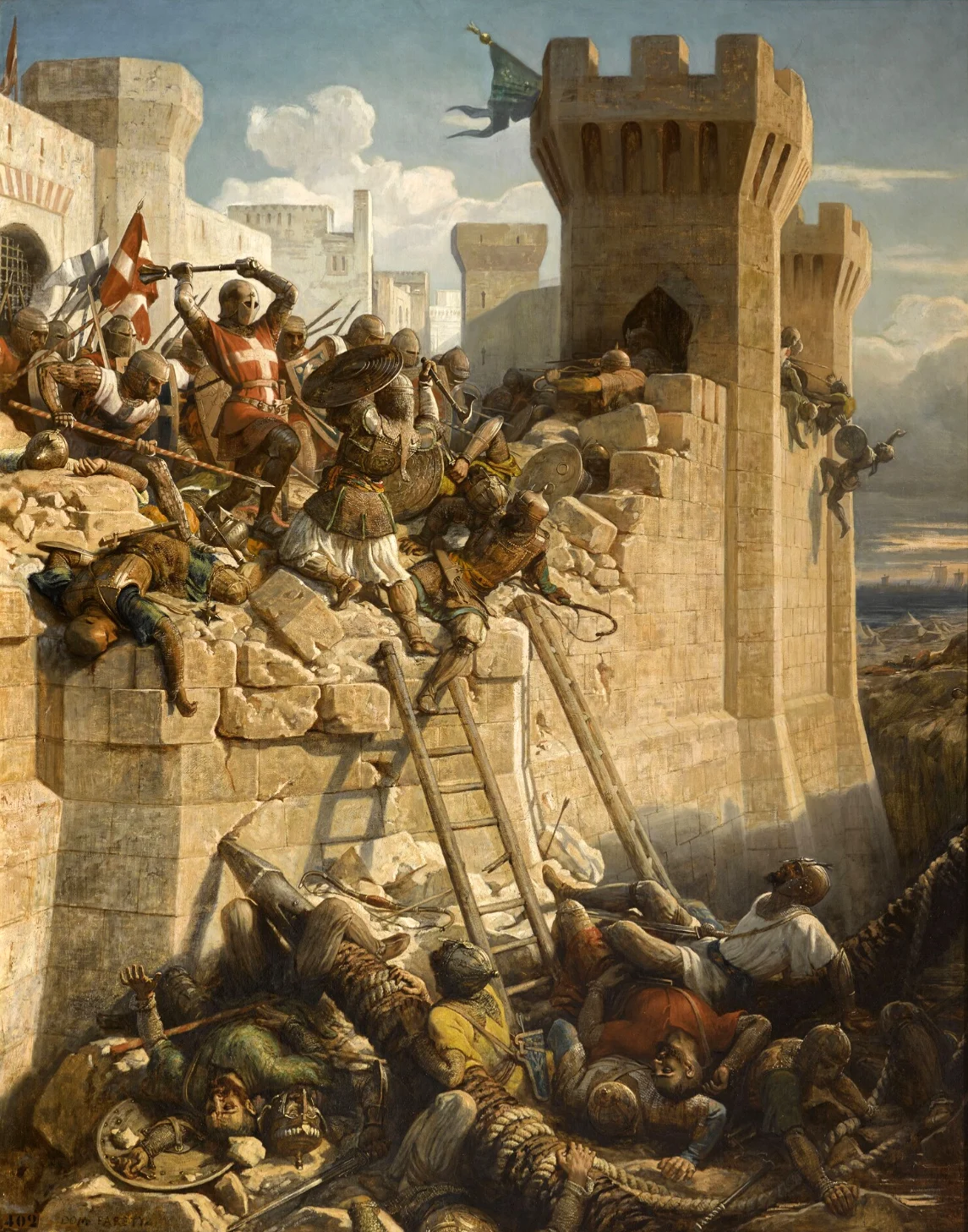
But in 1187 Jerusalem was captured by Saladin, and over the following century the Crusaders lost one stronghold after another in the Holy Land, until in 1291 they were driven out of Acre, the last city in the region still under their control. The Hospitallers were forced to leave for Cyprus, and from there, in 1310, they moved to Rhodes, where they built themselves a great fortress and underwent a “career change.”
As I mentioned, the order’s members had originally practiced medicine, defended fortresses, and fought unbelievers in the Holy Land. Now they decided to become pirates and carry the fight against Muslims into the Mediterranean, raiding Muslim ships. This new career caught the attention of the Ottomans, who were at the time building themselves a mighty empire, and in 1453 they even captured Byzantium, putting an end to an empire more than 1,000 years old.
In 1480, hoping to deal once and for all with the pirate knights, the Turks invaded the island of Rhodes and laid siege to the Hospitallers’ fortress. After harsh, bloody fighting, the siege failed and the Turks retreated, but they did not give up on removing the Hospitallers from Rhodes. In 1522 an Ottoman army of about 100,000 men invaded, armed with heavy siege cannons. This time the knights had no chance, and after a siege accompanied by fierce fighting, they agreed to surrender in January 1523. In exchange, they were allowed to leave Rhodes rather than become prisoners of war.
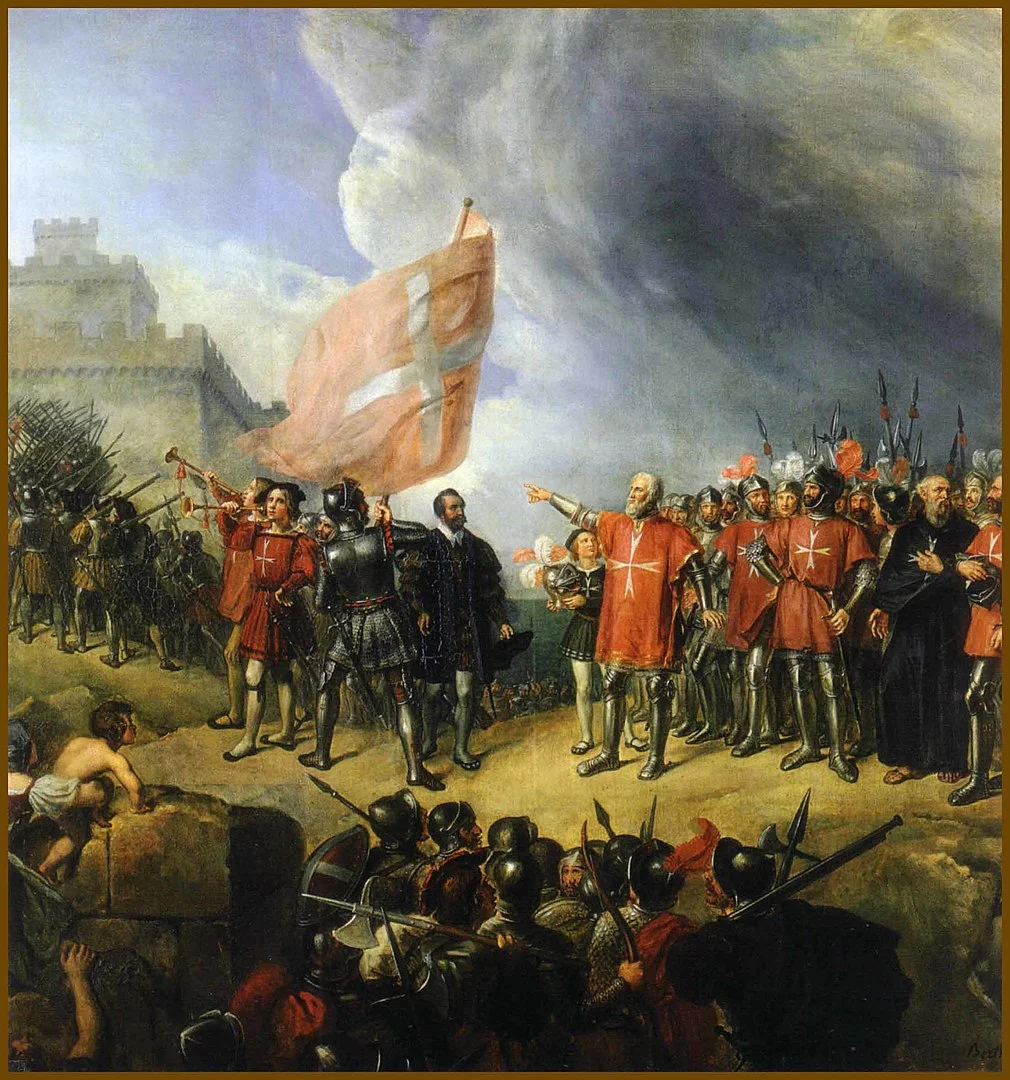
The Hospitaller knights wandered around Europe looking for a new base from which to continue operating, until in 1530 Emperor Charles V (1500-1558) granted them the island of Malta, in exchange for one falcon a year.
Since Malta was a dry and poor place, and farming didn’t bring in much money, the Knights of Malta went back to piracy, raiding Muslim ships across the Mediterranean. Unsurprisingly, this enraged the Ottoman Sultan Suleiman the Magnificent, and in 1565 he sent a massive fleet and army to Malta to drive out the Hospitallers, just as they had been driven out of Rhodes.
But this time, the outcome of the siege would be completely different…
Malta Yok!
The Turkish fleet, carrying an army of about 40,000 men, arrived in Malta in May 1565, and on May 18 of that month laid siege to the towns of Birgu, Senglea, and Fort Saint Elmo, defended by about 500 Knights of Malta joined by roughly 6,000 additional soldiers. The Knights of Malta were led at the time by the order’s Grand Master, a French knight named Jean Parisot de Valette (1494-1568).
Despite his advanced age, the Grand Master was at the peak of his abilities, and he managed to organize a highly effective defense of the fortresses held by the knights, which let them repel the Ottoman army despite being vastly outnumbered.
The Turks first tried to capture Fort Saint Elmo, which controlled Marsamxett Harbour and from which they could easily bombard the Knights of Malta in Senglea and Birgu. Though hugely outnumbered, the Knights of Malta held out against the siege, the bombardment, and the relentless attacks of the Turkish elite unit, the Janissaries, for nearly a month, until the fort finally fell.
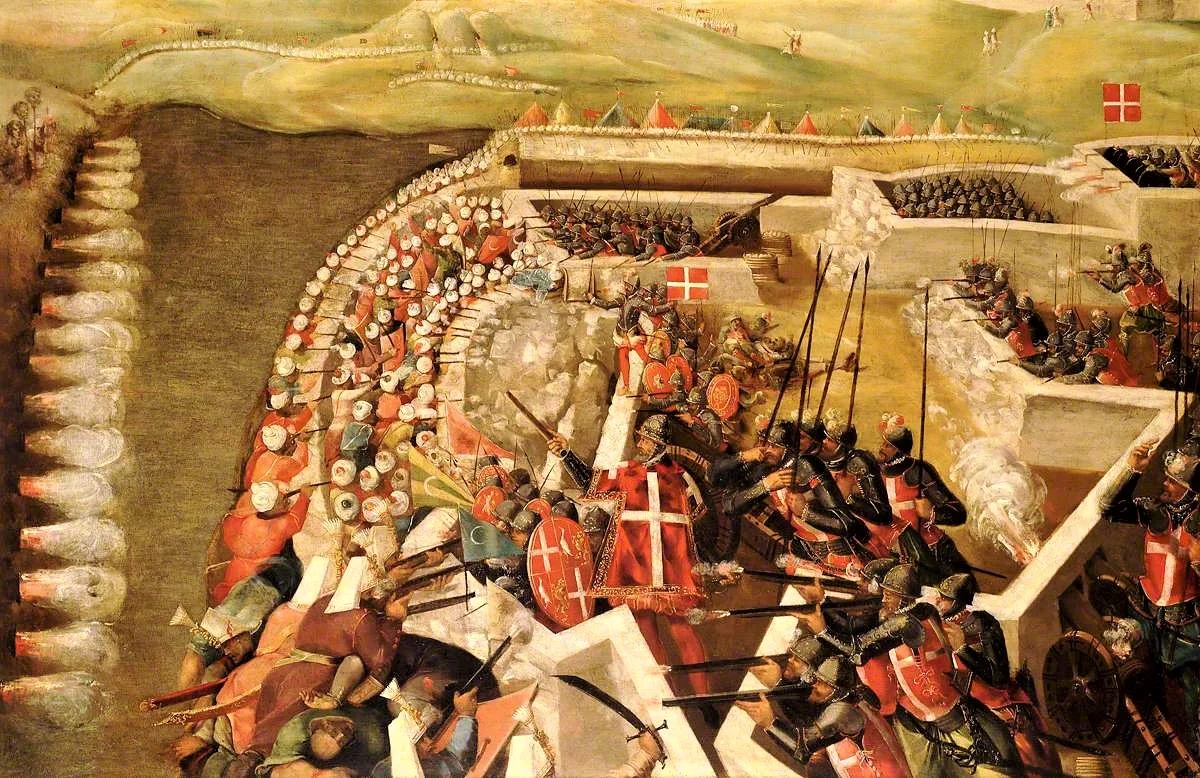
But the price of capturing the fort was very heavy. The Turks lost about 6,000 men, nearly half their Janissary unit. The heaviest price the Turks paid was the death of one of their most important commanders, Admiral Dragut (1485-1565).
On July 15, Mustafa Pasha, commander of the Turkish army, ordered a double attack against the Senglea peninsula, but the knights managed to repel it. Further attempts to capture Fort Saint Michael and Birgu also failed. On September 7, a large relief force of about 8,000 men finally arrived from Sicily.
Mustafa Pasha believed the relief force was far larger than it actually was, and so ordered a retreat. In the fighting that followed, the Turks were utterly defeated. The Turks left Malta on September 13. When what remained of the Turkish fleet reached Istanbul, the sultan asked Mustafa Pasha how the siege had ended, and he replied with the now famous line: “Malta Yok!” (there is no Malta).
The victory in the Great Siege of Malta is considered one of the most famous events in 16th-century Europe. Voltaire (1694-1778), the famous French philosopher, even said: “Nothing is better known than the siege of Malta.”
Valletta: A New Capital for the Knights of Malta
The Knights of Malta survived the Turkish siege, but they knew the Turks might well return someday to finish the job. So they decided to build a fortified city on Mount Sciberras, the very hill from which the Turks had positioned their siege cannons.
The task was given to the military architect Francesco Laparelli (1521-1570), and after his death the work was continued by Girolamo Cassar (1520-1592). Jean de Valette laid the cornerstone about a year after the siege, and in 1571 the city officially became Malta’s capital. Valette died in 1568 and never saw the construction completed, but he did get to have the new city named after him, in recognition of his heroic leadership during the siege.
Unlike Malta’s previous capital, Mdina, there are no winding alleys here, just straight streets laid out in a grid, as was common in Renaissance-era city planning. Now that the Knights of Malta had built a nearly impenetrable fortress, they turned back to raiding Turkish and other ships, and also to “fundraising” among Europe’s rulers, who were happy to give money to an order that had managed to stop the Turkish army, until then considered almost unbeatable.
The Knights of Malta’s healthy finances through the 17th and early 18th centuries let them build a series of grand buildings and palaces, which gave Valletta its magnificent look. These buildings can be divided into a few categories.
Headquarters
The Order of the Knights of Malta is an international order, and since the 14th century it has been divided into 8 “tongues” (langues):
- Provence
- Auvergne
- France
- Italy
- Aragon
- England (including knights from Scotland and Ireland)
- Germany
- Castile and Portugal
This is why the emblem of the Knights of Malta is an eight-pointed cross, with each point representing a different “tongue.” Each of these “tongues” was responsible for a specific function within the order. The French, for example, ran the order’s hospital, while the head of the Italian “tongue” was responsible for the knights’ fleet.
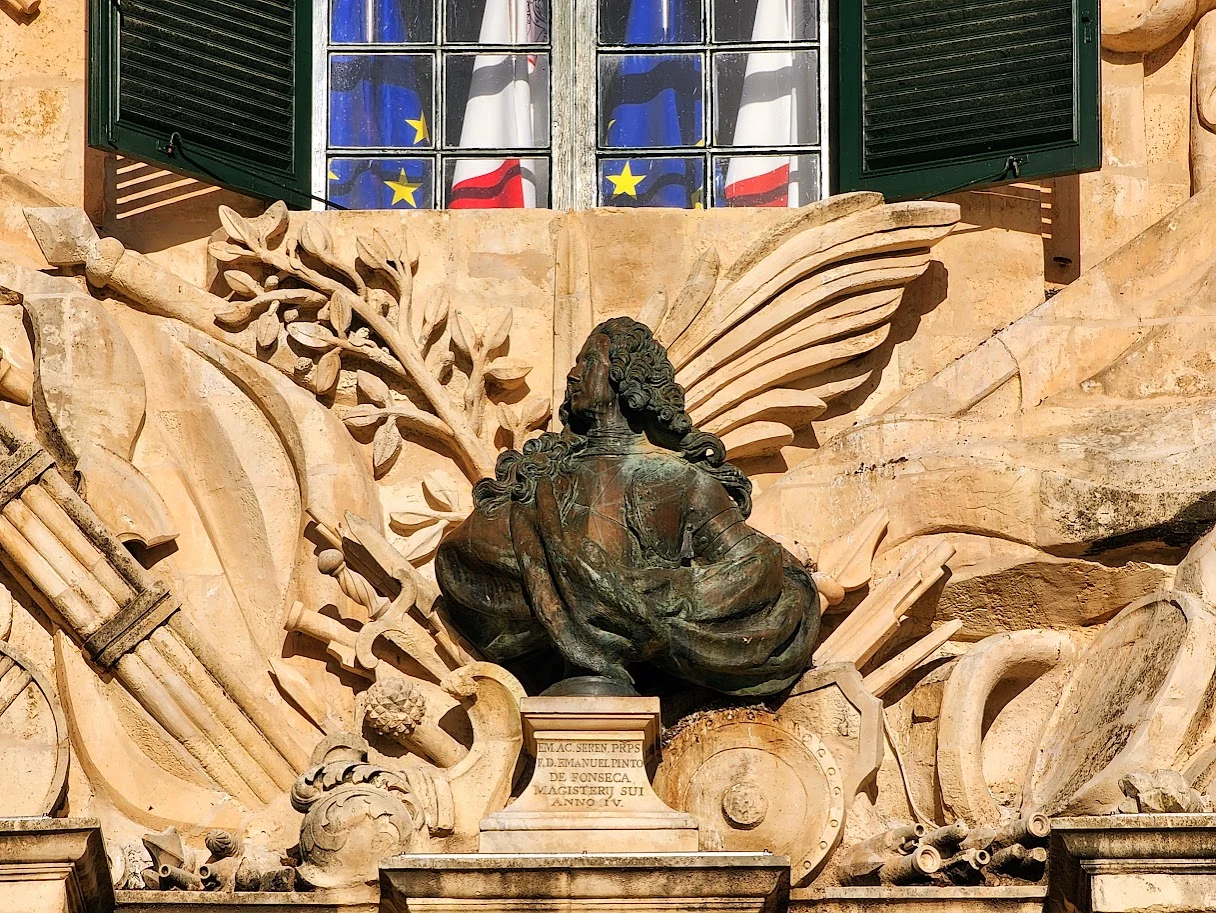
Each of the “tongues” had its own headquarters, called an Auberge (French for “inn”), where it conducted its affairs. These auberges are scattered across Valletta and are some of the most magnificent buildings in the city. The most splendid of them, in my opinion, is the Auberge de Castille et Portugal, built by Manuel Pinto da Fonseca (1681-1773), which today houses the office of the Maltese prime minister.
Churches
Malta may well be the most Catholic country in Europe, and it is said to have 365 churches (yes, one for every day of the year). Some of the most magnificent churches in Valletta belong to specific “tongues” (for example, the Church of Santa Caterina, which belongs to the Italian “tongue” and is named for Saint Catherine of Siena).
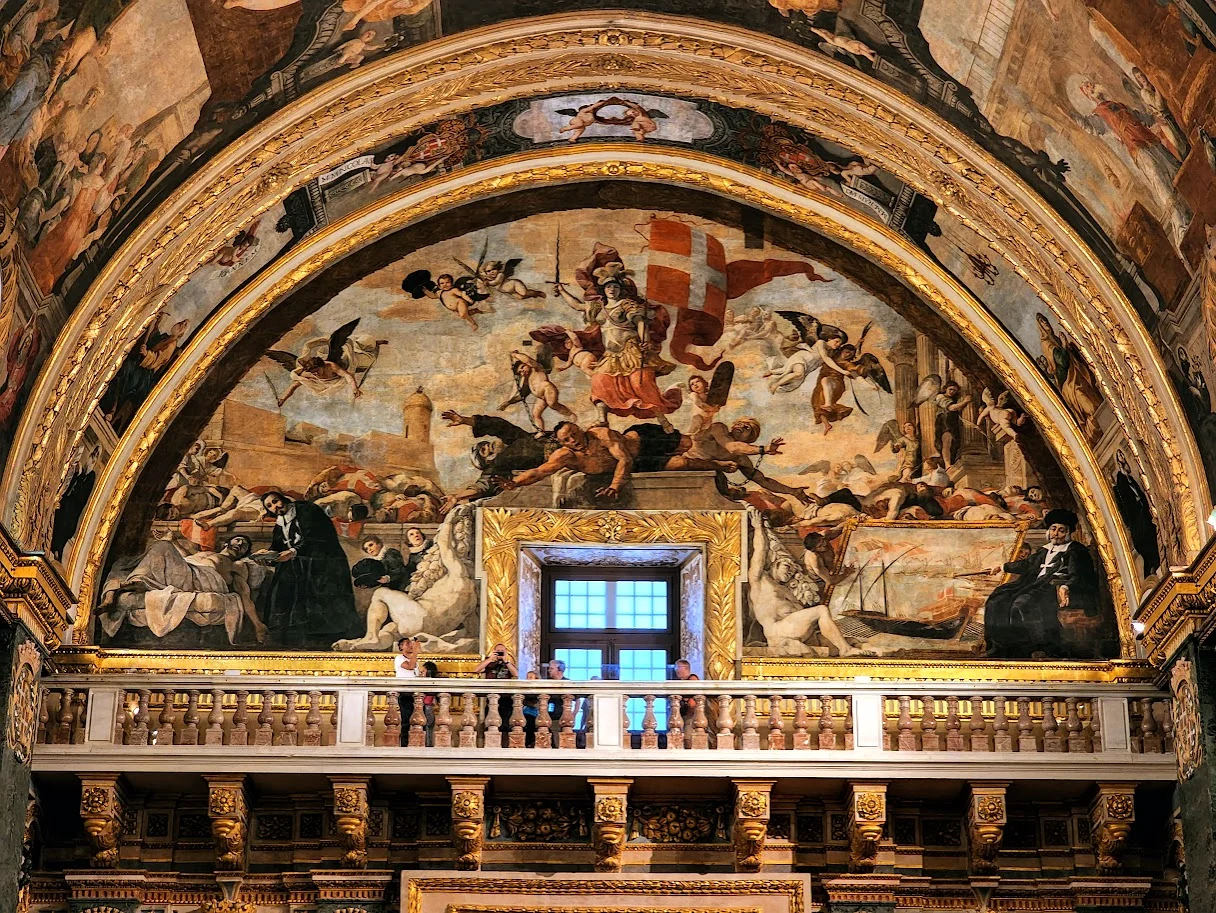
The most magnificent church in Valletta and in all of Malta (and in my view one of the most magnificent in Europe) is St. John’s Co-Cathedral, named for the patron saint of the Knights of Malta. The cathedral was built between 1573 and 1578 and consists of several chapels, each belonging to a different “tongue” of the order. This isn’t the place to go into detail about this breathtaking church, where every inch is covered in ornaments, paintings, and sculptures, but if you visit, don’t miss the famous painting by Caravaggio, who was himself a Knight of Malta for a short time, until he ran into trouble with the law and had to flee.
Valletta from the Expulsion of the Knights of Malta to the Present Day
Starting in the late 17th century, the Order of the Knights of Malta began to decline. Military and religious discipline loosened, and the Knights of Malta started chasing mistresses and prostitutes more than Turkish ships. “Straight Street,” once used by the Knights for duels, became Valletta’s main red-light district (today it is actually a street of restaurants and pubs).
During the 18th century, another enemy appeared to challenge the order: the Enlightenment. More than a few Knights of Malta, who came from established noble families, were exposed to the ideas of Voltaire, Diderot and Rousseau in the literary salons of Europe, and gradually drifted away from religion and from the order’s principles. When the French Revolution broke out in 1789, more than a few of those Knights (especially the French ones) came to sympathize with its principles.
As a result, by 1798 the Order of the Knights of Malta was like a tree eaten through by termites: from the outside everything looked fine, but inside it was completely rotten. That is why, when Napoleon arrived in Malta, it took him exactly four days to conquer the island (from June 9 to June 13, 1798). The order, which had defended Malta so fiercely in 1565, was forced to leave the island in disgrace. After wandering across Europe, it transformed from a military order into a religious one, which today runs hospitals in developing countries.
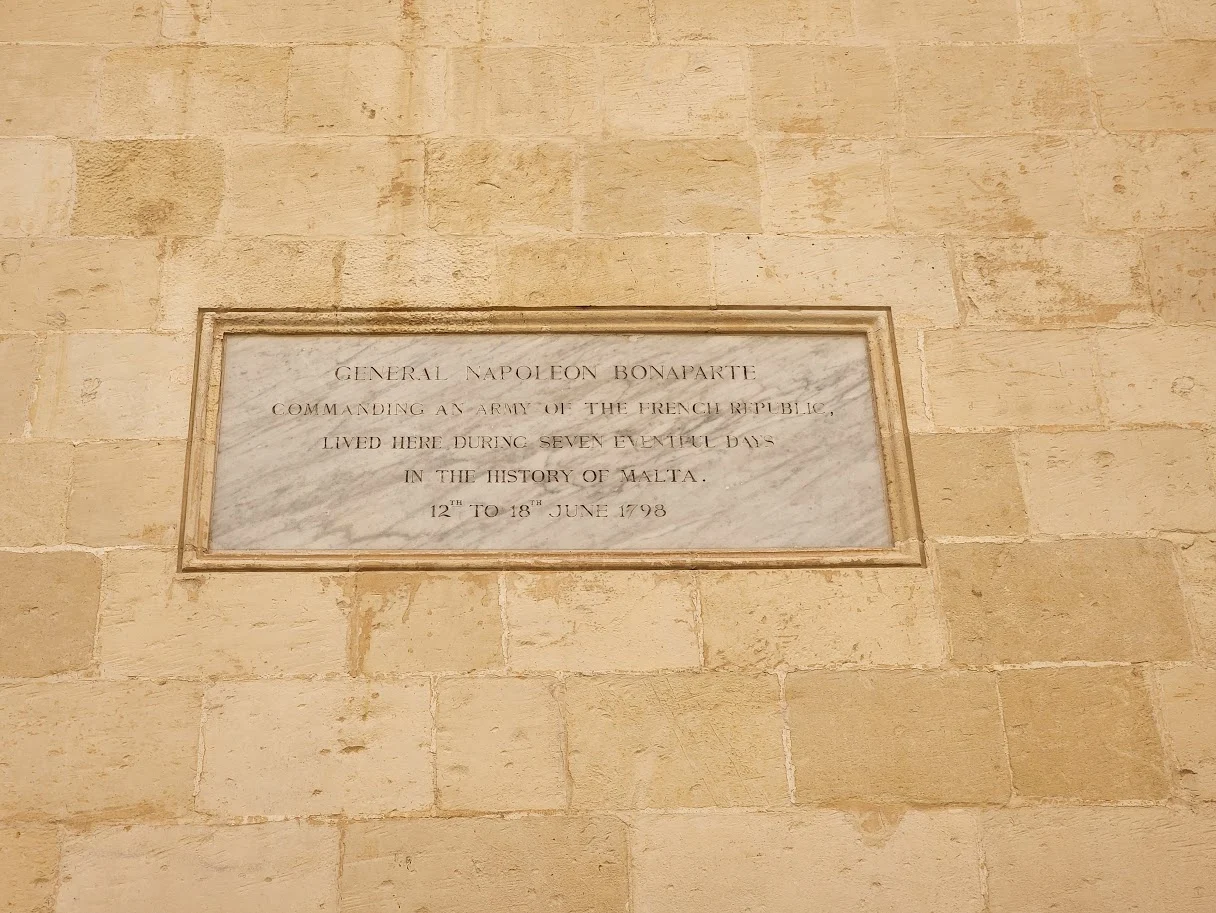
After conquering Malta, Napoleon moved on to Egypt and from there to the Holy Land, but that is a story for another article. A small French garrison remained in Malta, and after a siege lasting about two years, it lost the island to the British.
Until 1813 the island was a British protectorate, and from that year it became a crown colony. Throughout those years Valletta continued to serve as the island’s capital, and one souvenir from that era is a statue of Queen Victoria, found on the city’s main street.
Malta Earns a Medal of Honor
Valletta’s history remained fairly quiet until the outbreak of World War II in 1939. Malta’s strategic location, not far from Italy and North Africa, made it an important military target that the Axis powers tried to capture.
For about two years, Valletta endured a siege and absorbed a long series of air raids that destroyed many of its grand buildings. One example of a building that was destroyed is the opera house, located not far from the entrance to Valletta, which was never rebuilt (today performances are held there in the open air). Quite a few churches were also damaged, and although they were restored, in my opinion the quality of the restoration was not particularly high, so some of them now look like a mere imitation of the grand Baroque style that once defined the city.

Despite the heavy bombing and the cost in human lives, the people of Valletta never surrendered, and Malta was never conquered by the Germans or the Italians. In recognition of this, Britain decided to award Malta the George Cross, the highest decoration given for bravery on the battlefield. You can still see this cross today on the flag of Malta.
In 1964 Malta gained independence, at first partial independence as a British crown colony, and from 1974 full independence. Valletta continued to serve as the capital of the new nation. On the outside, Valletta has remained more or less as it was in the days of the Knights of Malta, but in 2015 a building (a very ugly one, in my opinion) was added to the cityscape: the Parliament building, designed by the Italian architect Renzo Piano (born 1937), whom lovers of Paris will recognize as the designer of another unattractive building, the Centre Pompidou.
Visiting the City of Valletta
If Valletta’s fascinating history is reason enough to visit, consider this too: in 2018 the city won the title of European Capital of Culture, in recognition of its historical, cultural and aesthetic importance. In the near future, I plan to put together a full walking route covering Valletta’s main attractions, but until that route is ready, I recommend reading the following articles:
- Recommended hotels in Valletta: I really love Valletta, so I highly recommend staying there and enjoying its unique atmosphere and central location. This article, which includes a range of recommended hotels at various price points, will help you find the one that suits you best.
- Malta: a travel guide: packed with useful travel information, including Valletta’s main attractions, which I recommend you don’t miss.
- Recommended restaurants in Malta: in my view, food is one of the most important parts of any successful trip. To save you from culinary disappointments, I put together on one page all the restaurants I regularly eat at in Malta, and as you’ll see, several recommended ones are right there in Valletta.
Related reading