In short
- What’s there: the statue of the Republic, the smallest house in Paris, the neo-Renaissance town hall, the Hôtel Gouthière, the church of Saint-Laurent, the Récollets convent, the Hôpital Saint-Louis, the site of the Montfaucon gallows, the Hôtel du Nord and the Du Pain et des Idées bakery.
- How many stops: ten, in one continuous walk of a little over three kilometers.
- How to get there: République metro station, lines 3, 5, 8, 9 and 11. The end point is near Jacques Bonsergent station.
- How long: about three and a half hours with stops, and half a day with a coffee at the start and a seat on the canal bank at the end.
- When: on a weekday, Monday to Friday, when the historic courtyard of the Hôpital Saint-Louis is accessible (the safe window: 10:00–17:00) and the bakery at the end of the walk is open.
- Note: on Saturdays and Sundays the bakery is closed, and you cannot count on the courtyard opening at weekends.
- Bonus: opéra comique was born on the stages of the Saint-Laurent fair, where the Gare de l’Est stands today.
I really love the area around Place de la République (despite the demonstrations that take place there every now and then), and I have stayed nearby several times (sometimes in the northern Marais, sometimes around the Canal Saint-Martin). Since I have spent quite a lot of time walking around here, I have discovered a good number of secret and interesting places within walking distance, and today we will explore some of them.
This time we are going for a walk in the 10th arrondissement, which is not particularly touristy but hides plenty of interesting places. Together we will discover the smallest house in the city, less than a meter and a half wide, a town hall built as a small palace of the Republic, the private mansion of a gilder that became a music school, the oldest church that served the executioners of Paris (and Madame du Barry), a 17th-century hospital courtyard that looks like a twin of the Place des Vosges, and many more surprises.
So, just before we set off, let’s talk about what you will find in this article. First the practical information: how to get there, which days to go and how much time to set aside. Then the ten stops in walking order, each with its story. At the end there is a section on where to stay in the area, and answers to the questions I get about this arrondissement.
Practical information for the 10th arrondissement walk
How to get there
The starting point is République metro station, one of the biggest hubs in the city, where lines 3, 5, 8, 9 and 11 meet. You come out of the metro straight onto the square, and that’s it. The end point, 102 Quai de Jemmapes, is about a seven-minute walk from Jacques Bonsergent station on line 5, and about a fifteen-minute walk back to République along the canal.
If you are still not sure which ticket to buy and how the Paris underground works, all the details are in my Paris metro guide.
If you happen to be staying in Udi’s apartment on Rue Béranger or elsewhere in the northern Marais, you will be happy to know that all you have to do is walk a few meters to reach the starting point of the walk.
Which days to go
There is one constraint that decides everything. The historic courtyard of the Hôpital Saint-Louis, which in my opinion is the most beautiful stop on the walk, is open on weekdays, Monday to Friday, through the working hospital. It has no published official opening hours, and the sources I checked give different times, from 8 or 10 a.m. until 6 p.m., so the safe window is between 10 a.m. and 5 p.m. On paper, the city is supposed to open the courtyard on Saturdays and Sundays too between April and October, but a reader who did the walk on a Saturday at the end of September 2026 found it closed, so I don’t recommend counting on the weekend.
The other stops are easier. The church of Saint-Laurent is open every day: according to the parish website, Monday to Friday from 7:15 a.m. to 8 p.m., and on Saturdays and Sundays from 8:30 a.m. to 8 p.m. You can peek into the courtyard of the Hôtel Gouthière from the gate any day, but you get inside the house and into the halls of the town hall mainly during the European Heritage Days, at the end of September. The Jardin Villemin and the banks of the canal are open all year round.
There is a bonus here too. The bakery that closes the walk, Du Pain et des Idées, is open on weekdays only and closed on Saturdays and Sundays, so on a weekday you get both the hospital courtyard and the bread. Anyone who does all this on a weekend may only see the hospital from outside and miss the bakery, but will find a row of open cafés along the canal.
How long it takes, and when to come
The walk itself is short, a little over three kilometers (about two miles), but with real stops at every station it takes about three and a half hours. Add a coffee on the square at the start and a glass of wine on the canal bank at the end, and you have a full half day. The best time to set off is around ten in the morning on a weekday, so that you reach the hospital around midday and finish at the bakery well before it closes.
According to the sources I checked, access to the courtyard on weekdays is not seasonal, so the walk works in winter too. Still, the best season is between April and October, because the 10th is an arrondissement that looks much better when you sit outside, on the grass of the courtyard or on the canal bank.
The 10th arrondissement walk, stop by stop
Instead of a map: under the heading of each stop you will find its address, and every address is a link. Click it, and the place opens straight away in Google Maps.
Place de la République
Address: Place de la République.

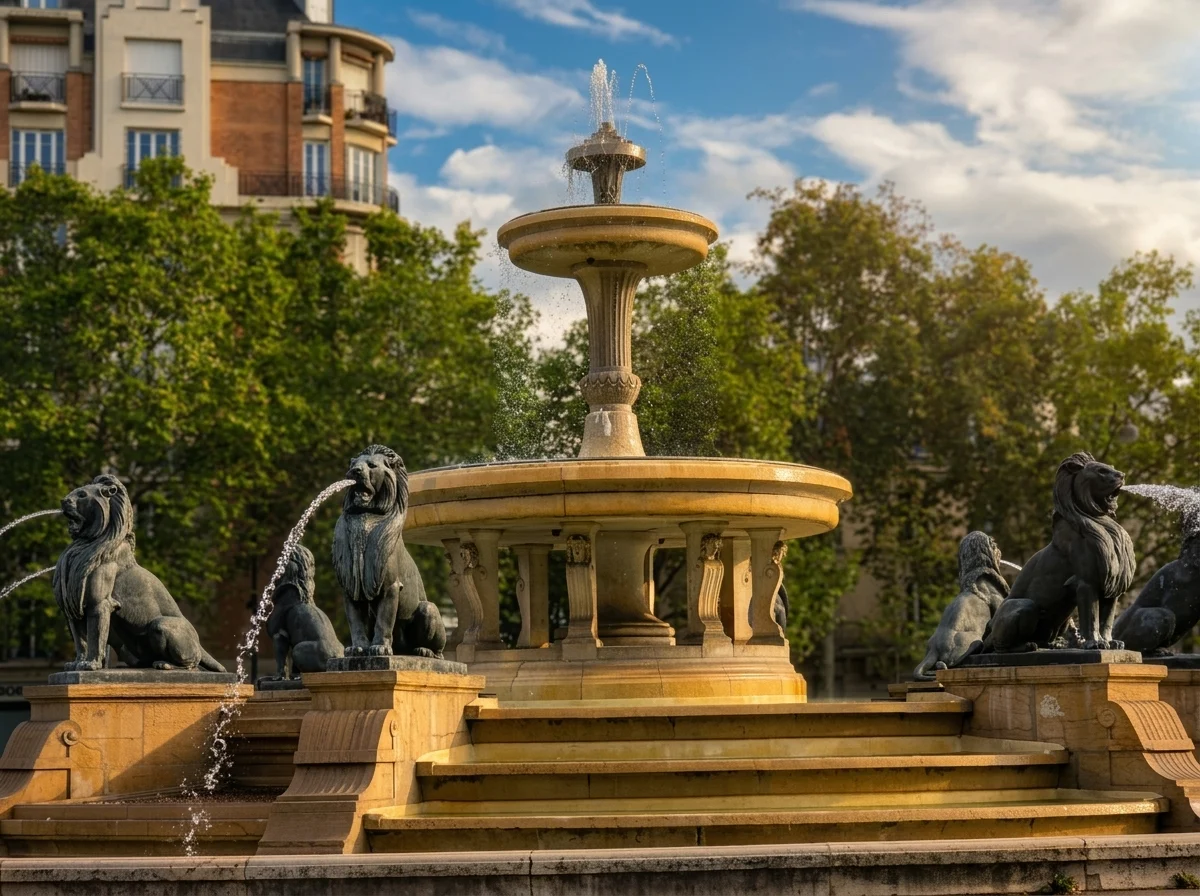
Until 1879 the square was called Place du Château d’Eau, after a large fountain built here in 1811 by the engineer Pierre-Simon Girard (1765–1836), whose water came from La Villette. In 1867 Gabriel Davioud (1824–1881) put up a more impressive fountain decorated with lions in its place. In the end both made way for the statue: Girard’s fountain, with its Egyptian lions, went to the cattle market at La Villette, and Davioud’s fountain was moved in the 1880s to Place Félix Éboué in the 12th arrondissement.
In 1878 the city council decided to put up a statue of the Republic on the square, and in March 1879 it set its height at seven meters, with a Phrygian cap, the symbol of liberty, on its head. On May 4 of that year the square was renamed Place de la République. The competition was held in two rounds, and in May 1880 it was won by the sculptor Léopold Morice (1846–1919), who worked with his brother, the architect Charles Morice (1848–1918). On July 14, 1880, a plaster model of the monument was unveiled on the square, and only three years later, on July 14, 1883, the final bronze version was put up.
The man who lost this competition was Jules Dalou (1838–1902), who came back that same year from nine years of exile in England. His proposal impressed the jury so much that the city commissioned it anyway and put it up on Place de la Nation, where it still stands today. Remember his name, he comes back two stops from now.
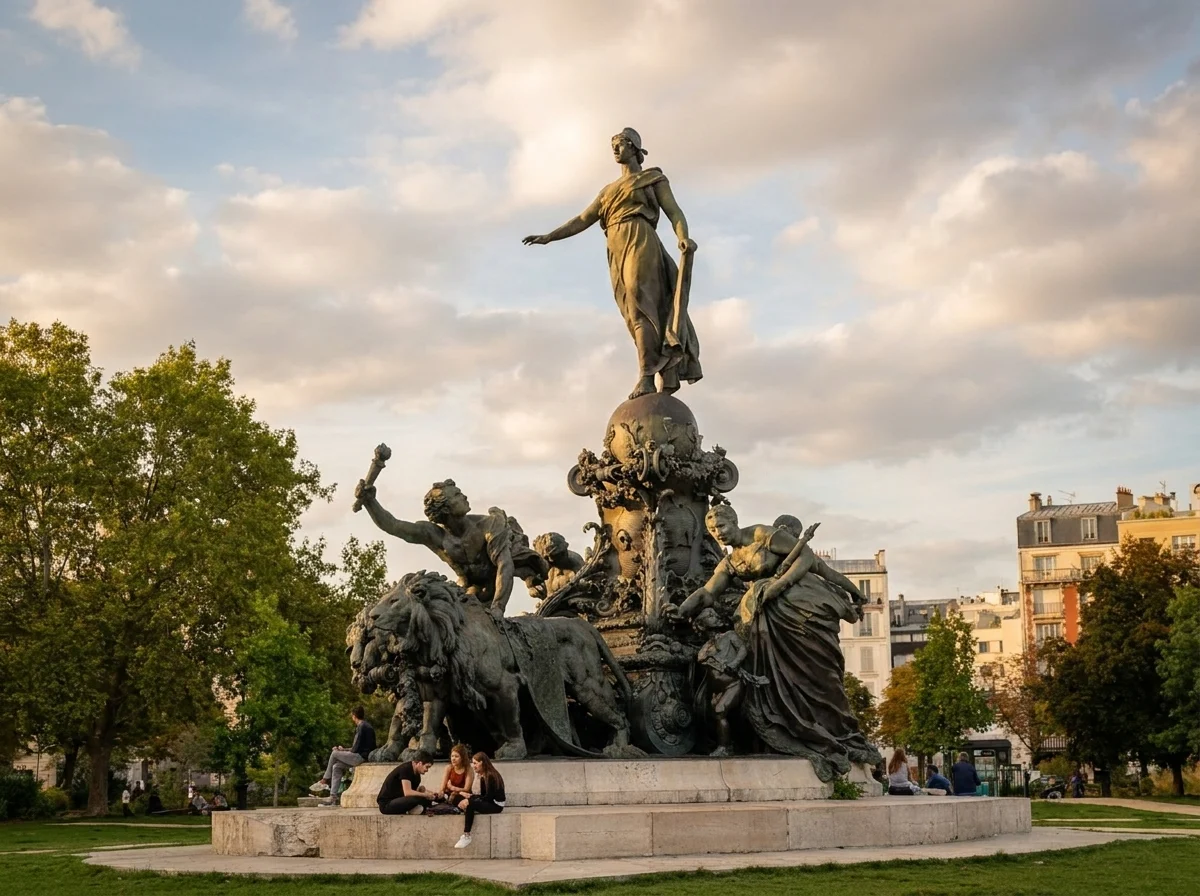
What you are actually looking at: Marianne stands on a high pedestal, an olive branch in her right hand, while her left hand rests on a tablet inscribed Droits de l’Homme (Rights of Man). Around the pedestal are twelve bronze reliefs that tell the events between 1789 and 1880, and at her feet lies a lion guarding a ballot box. This is a complete political statement cast in stone and bronze, not just a decoration for a traffic circle.
By the way, if you start here in the morning, there are some of the best addresses in Paris for croissants and chocolate around the square, and they are all in my article on the culinary corners of Place de la République.
The smallest house in Paris
Address: 39 Rue du Château d’Eau.
From the square you turn into Rue du Château d’Eau, and after a few hundred meters, between two six-story buildings, an astonishingly narrow façade squeezes in: a door on the ground floor, one window above it, and that’s it. The façade is less than a meter and a half wide (under five feet), about five meters high and about three meters deep, which makes about four square meters in all. It has its own house number, and that is what makes it officially a house and not a niche in the wall.
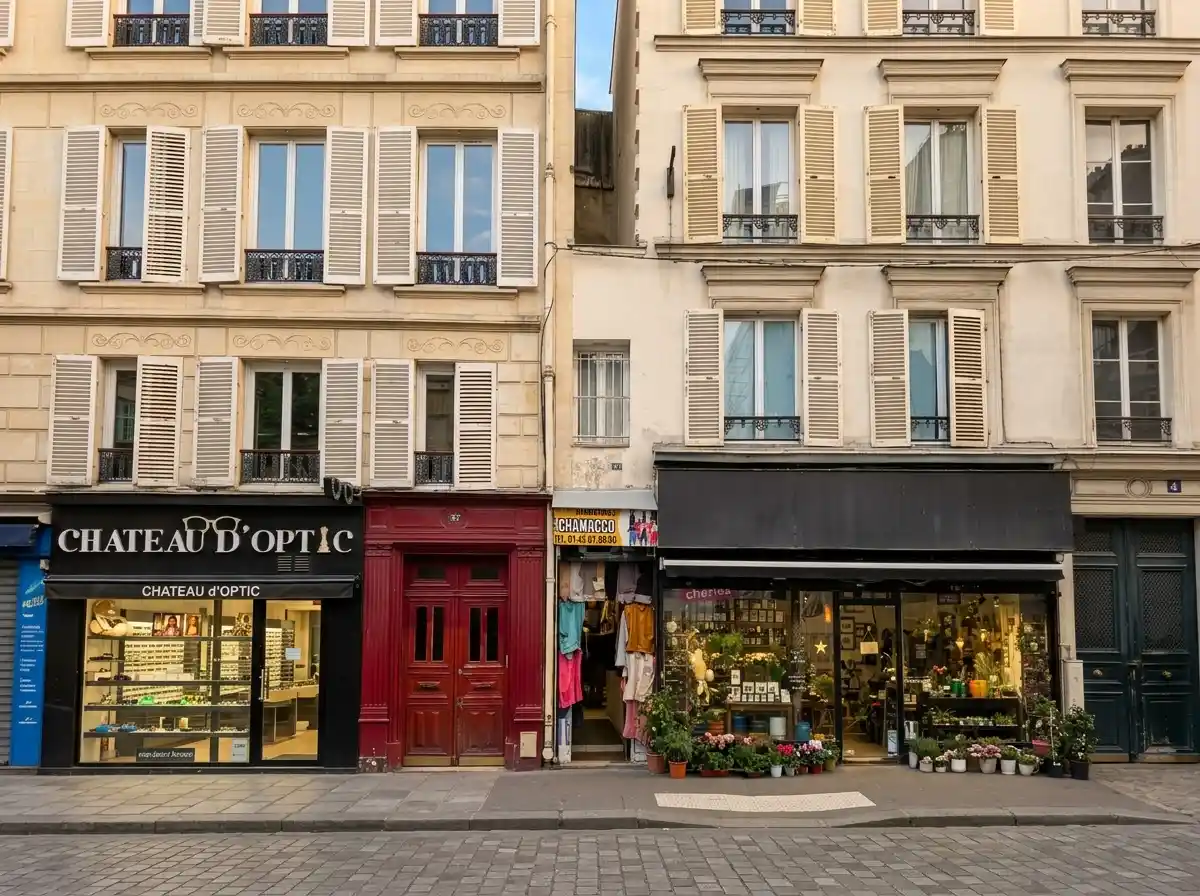
How did such a thing come about? A passage once ran here, connecting Rue du Château d’Eau to Rue du Faubourg Saint-Martin. In the 19th century the heirs of the landowner got into a dispute over the division of the estate, and the solution they found was radical: they blocked the passage with a building between the two party walls of the buildings on either side. The dispute ended, the passage disappeared, and the tiny house stayed.
According to a report published in the newspaper Le Gaulois on January 6, 1897, in the second half of the 19th century a cobbler’s shop stood here, and on the floor above was a room of the same size that was not connected to the shop at all but to the apartment at number 41 next door. Today a clothing shop on the ground floor makes use of every centimeter of the four square meters. Don’t expect to go in anywhere: this is a two-minute stop, and most passers-by don’t even notice it.
The town hall of the 10th arrondissement
Address: 72 Rue du Faubourg Saint-Martin.
The barracks of the National Guard stood on this spot, and on July 1, 1849, the offices of the arrondissement moved into them. Forty years later, in 1889, the city council chose a design by the architect Eugène Rouyer (1827–1901), a student of Charles Garnier (1825–1898). Rouyer was not unknown: after the Hôtel de Ville burned down during the Commune in 1871, he came second in the competition to rebuild it, which was won by Théodore Ballu (1817–1885).
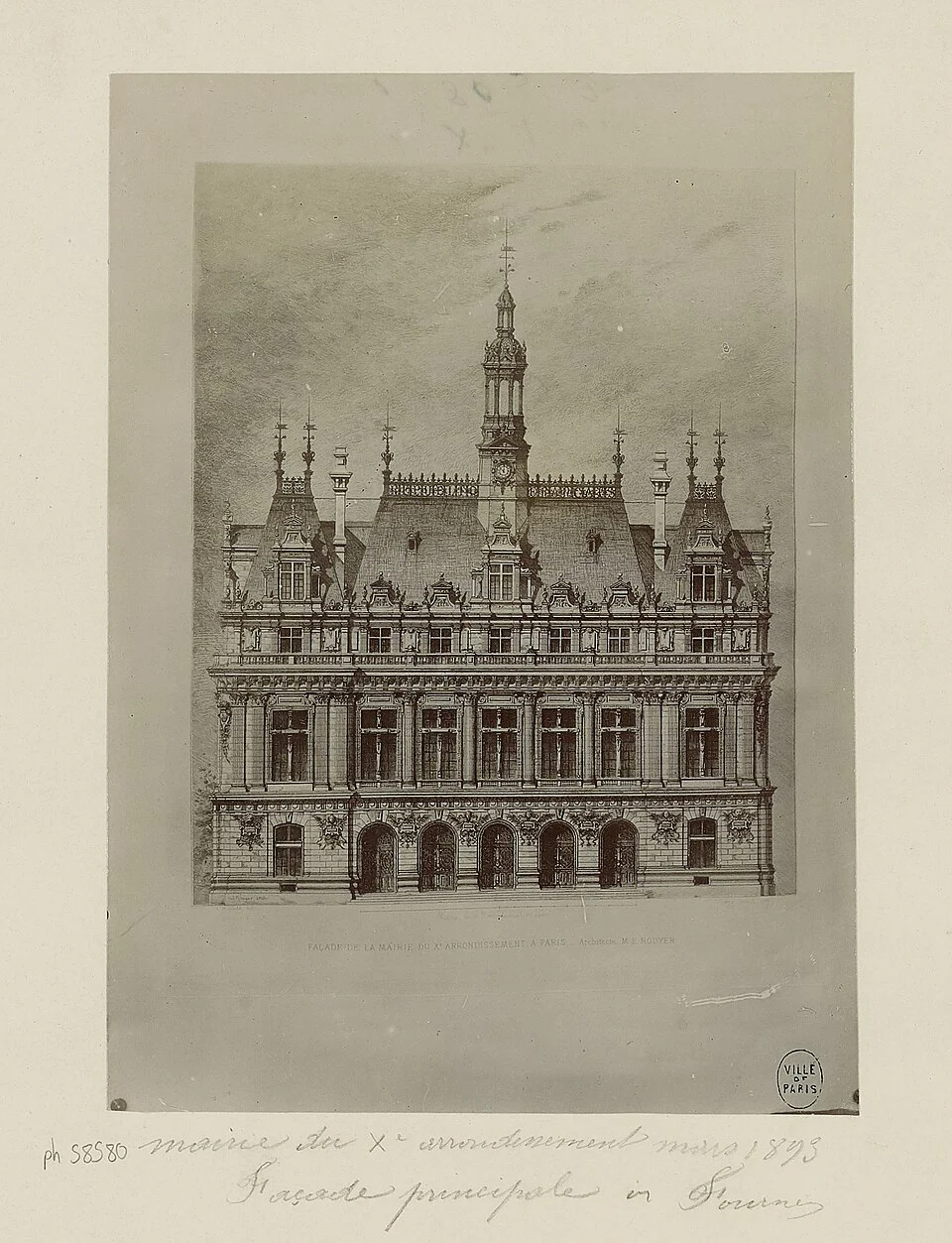
He simply took his losing design out of the drawer, took its central part, and enlarged it. Construction lasted from January 10, 1892, to the inauguration on February 28, 1896, in the presence of the President of the Republic, Félix Faure (1841–1899). It cost 2,750,000 francs and made this building the most expensive of all the arrondissement town halls in Paris.
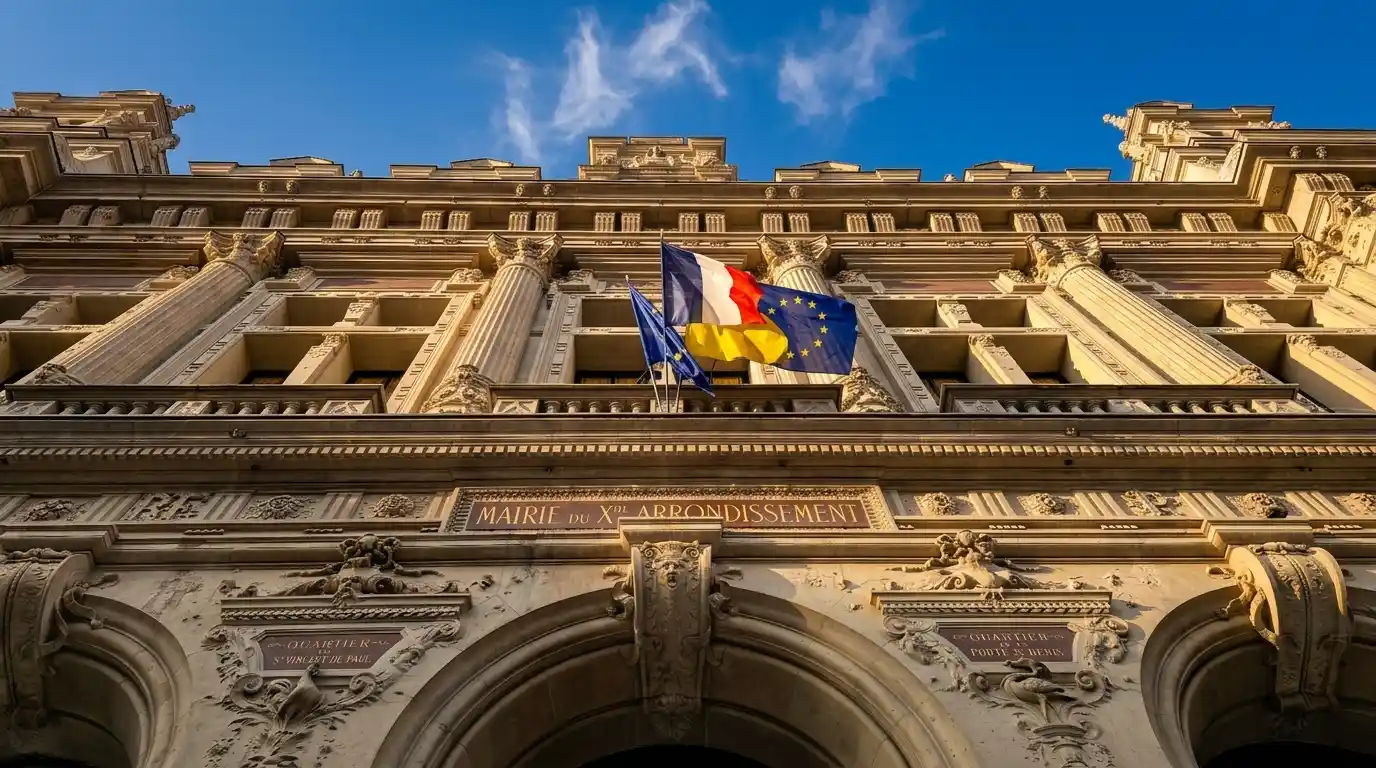
Look out for a detail that is easy to miss. The two façades facing Rue du Faubourg Saint-Martin and Rue du Château d’Eau are loaded with sculpture, while the two back façades, on Rue Pierre Bullet and Rue Hittorff, are almost completely plain. The reason is not aesthetic: the building went up in three stages, and several surfaces prepared in advance for sculpture are still bare today, waiting for a budget that never came. The façades were restored between 2019 and 2022.
Inside, in the wedding hall, there is a large relief called La Fraternité des peuples (The Brotherhood of Peoples). The sculptor who signed it is Jules Dalou, the same man who lost the statue competition for the square down the street. In the end he got both Place de la Nation and the central wall of the 10th arrondissement, which is not a bad result for someone who came second.
The Hôtel Gouthière and the conservatory
Address: 6 Rue Pierre Bullet.
Right behind the town hall, at the end of a small, quiet street where most passers-by never look up, stands a private mansion built in 1780 for Pierre Gouthière (1732–1813), the great bronze chaser and gilder of the time of Louis XVI (reigned 1774–1792). The architect was Joseph Métivier.
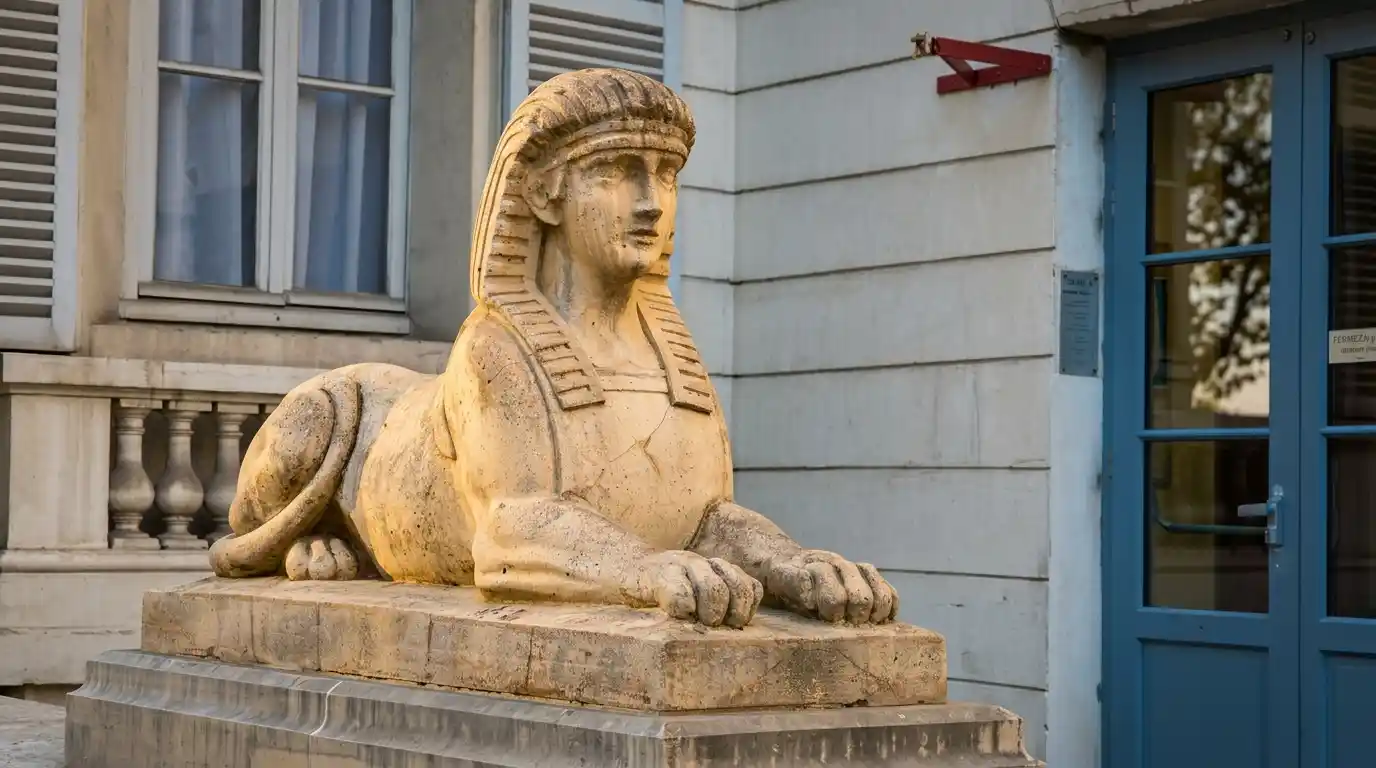
The style is neoclassical at its best: walls of dressed stone, a projecting central block with an arched gateway, and above it a relief of Apollo crowned by the Muses. Two sphinxes guard the entrance steps. Nothing here is overdone, and that is exactly the point: by 1780 the new style had already pushed aside the ornaments of the middle of the century.
This house ruined its owner. Gouthière built it with money he did not have, the project bankrupted him, and he had to sell the house, before it was even finished, to his notary, Arnoult. It was the notary who completed the interior decoration after 1800, so what survives inside is a mix of the Louis XVI style and the First Empire style. The salon, the waiting room and the small salon upstairs have been listed as a monument historique since October 26, 1927.
Gouthière hardly ever signed his work, so the only piece known for certain to be his is a clock now in the Wallace Collection in London. According to tradition, the economist Jean-Baptiste Say (1767–1832) also died in this house. Since 1981 it has housed the municipal conservatory of the 10th arrondissement, named after Hector Berlioz (1803–1869). From the gate you can peek into the courtyard and see the façade, and you get inside during the Heritage Days, when the students play there too.
The church of Saint-Laurent
Address: 68 bis Boulevard de Magenta.
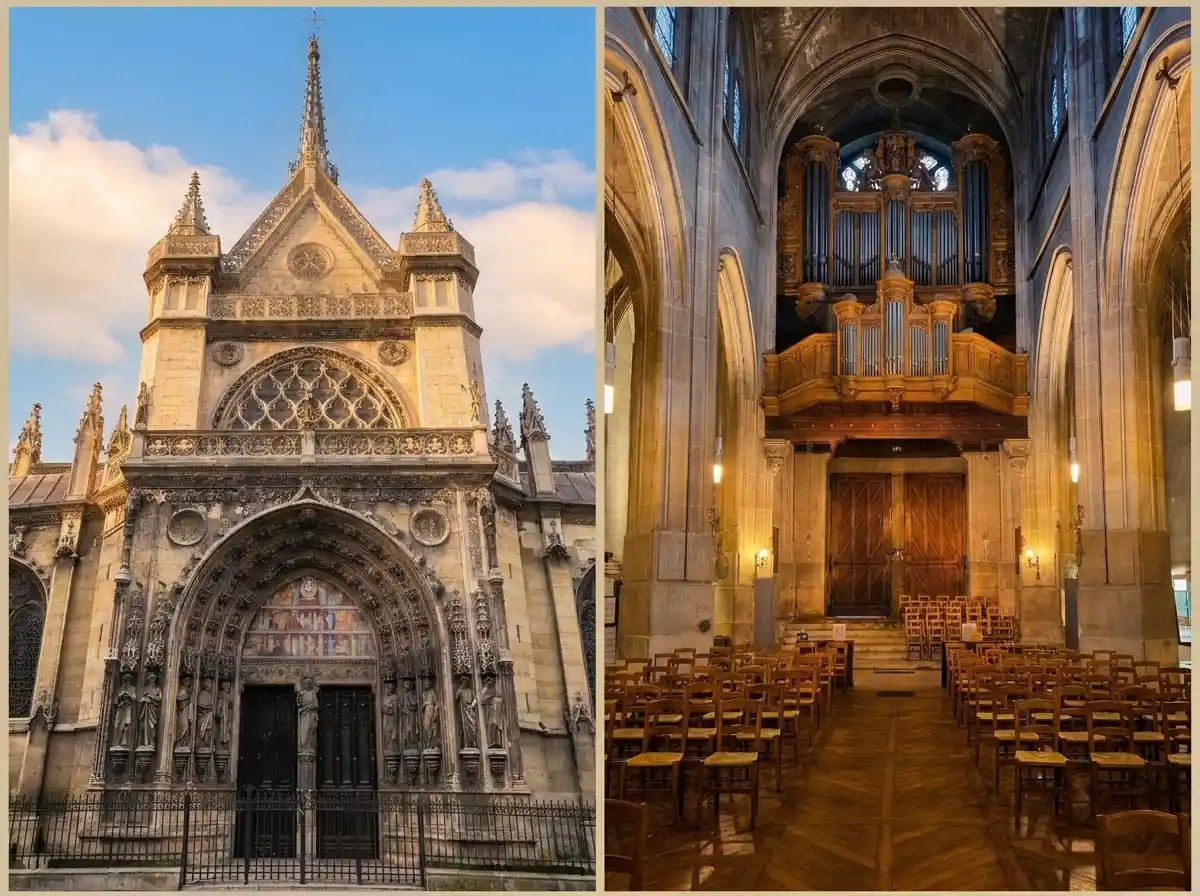
This is the oldest church in the 10th arrondissement, and its history begins at the end of the fifth century, when a first church stood here next to a monastery that housed pilgrims, on the Roman road that led north from Paris toward Saint-Denis. Gregory of Tours (538–594) mentioned it as an active basilica in the sixth century. The Normans destroyed it in 885, and in the 12th century it was rebuilt as a parish church. The bell tower survives from that period, and it was raised in the 18th century.
The building you see today is mostly from the 15th century. The choir (chœur), the eastern part behind the altar, was consecrated in 1429, and from that time come the ribbed vaults, the carved keystones and the high windows. Construction went on painfully slowly: for two centuries the church had no façade, and the nave was not roofed. Only in 1621 did the church get a classical façade, and it stood until the great 19th-century transformation of Paris.
At the beginning of the 18th century Saint-Laurent became the church of the Sanson family, who held the title of chief executioner of Paris between 1688 and 1847. Here they prayed, married and were buried. Speaking of the Sanson family, one of their most famous “clients” was married here. I mean Madame du Barry (then still called Jeanne Bécu), who married Count Guillaume du Barry here so that she could join the high society of France and serve as the royal mistress of Louis XV. Twenty-five years later Charles-Henri Sanson would cut off her head with the guillotine on Place de la Concorde…
Then came the boulevards. Boulevard de Strasbourg was cut through in 1852 and Boulevard de Magenta in 1855, and it turned out that the church was set back from the line of the new street. Between 1863 and 1867 the architect Simon-Claude Constant-Dufeux (1801–1871) demolished the façade of 1621, extended the body of the church forward and built a new façade in the neo-Gothic style, topped by a spire.
In 1870 a large painting on enameled lava by Paul Balze (1815–1884), with scenes from the life of Saint Lawrence, was added above the portal. So the façade that looks especially old to you is in fact the youngest part of the whole building. The church was listed as a monument historique in 2016.
North of the church, exactly where the Gare de l’Est stands today, the Saint-Laurent fair (foire Saint-Laurent) spread out for centuries. It had existed since the 12th century on the estate of the leper house of Saint-Lazare, thanks to a privilege granted by Louis VI (reigned 1108–1137). In 1662 the Lazarists moved it next to the church and expanded it into a fenced area of 260 stalls between rows of chestnut trees. From 1661 it opened on August 9, the eve of the feast of Saint Lawrence, and closed on September 29.
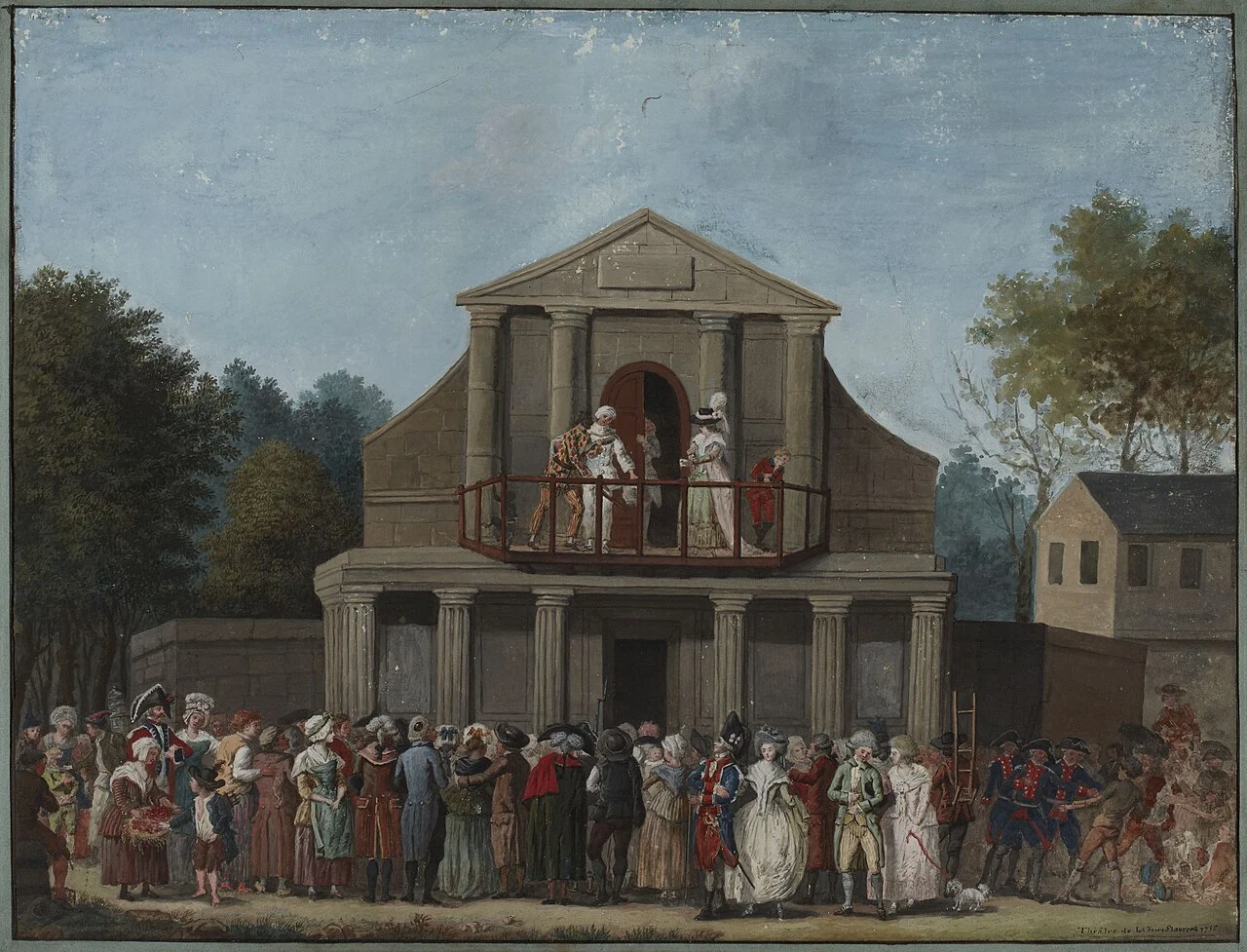
What was there? Merchants, tightrope walkers, acrobats and magicians, and above all theater. The Comédie-Française and the Opéra held exclusive privileges, so the fair companies had to invent a genre that would get around the bans. That is how opéra comique was born, on the stages of the Saint-Laurent fair and the Saint-Germain fair. In 1752 Jean Monnet built a proper theater inside the fair, and its interior decoration was painted by François Boucher (1703–1770). From 1777 the fair faded in competition with the Saint-Ovide fair on Place Vendôme, and it closed for good in 1786.
The Récollets convent and the Jardin Villemin
Address: 14 Rue des Récollets.
On January 6, 1604, Henri IV (reigned 1589–1610) gave the friars of the Récollets order, a strict branch of the Franciscans, permission to build a convent on a plot of land donated to them by an upholsterer named Jacques Cottard. The foundation stone of the convent and of a larger church was laid on August 30, 1614, by Marie de Médicis (1575–1642). These friars took a vow of real poverty: a sackcloth robe and sandals with wooden soles.
At the beginning of the 18th century about two hundred friars lived here, and the convent library was considered one of the most important in Paris. But on the eve of the Revolution only about thirty were left. The convent was closed in 1790, served as barracks for grenadiers and later as a weaving workshop until 1794. In 1802 it became an almshouse called the hospice des Incurables-Hommes, an institution for men with no hope of a cure.
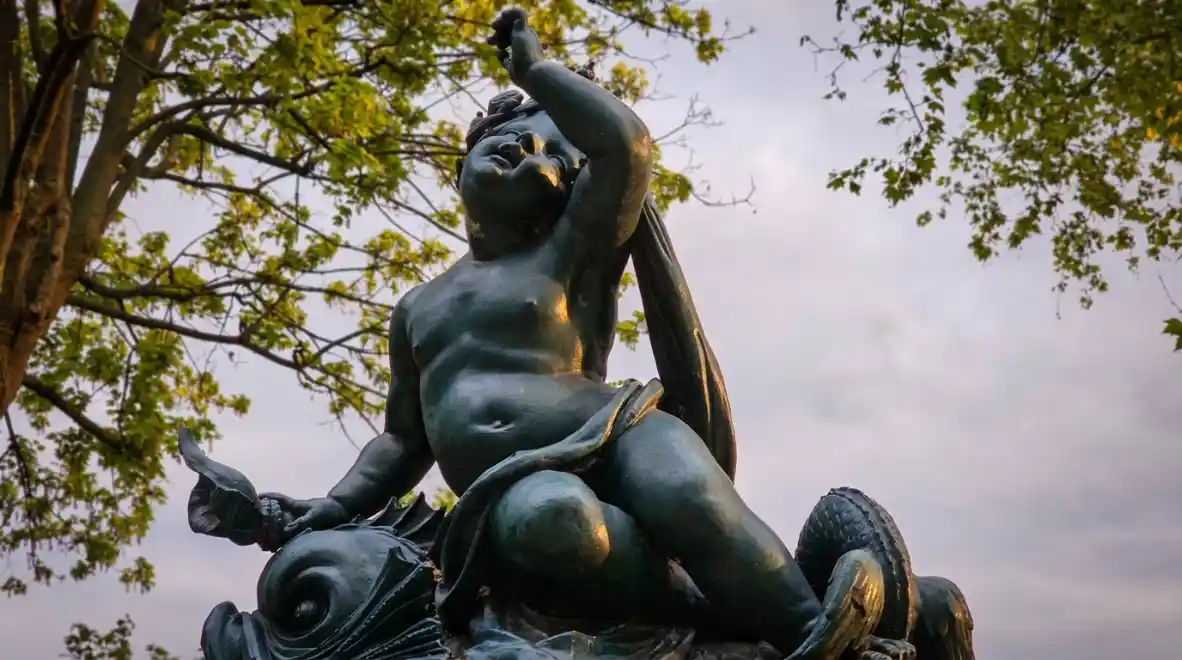
In 1861 the site passed to the Ministry of War and became a military hospital called Saint-Martin, and in 1913 it was named after Jean-Antoine Villemin (1827–1892), an army doctor who proved by experiments on animals that tuberculosis is a contagious disease, about fifteen years before Robert Koch (1843–1910) identified the bacterium in 1882. Its closeness to the two big railway stations, the Gare de l’Est and the Gare du Nord, made this hospital a medical rear base in both World Wars and later in the Algerian War as well.
The hospital closed in 1968 because of its physical condition, was evacuated in 1971, and two of its wings were demolished in 1973. After 1968 the Paris-Villemin school of architecture moved into the building, and in the 1990s it was taken over by artists who called themselves “the Angels of the Récollets” (Les Anges des Récollets). A fire in the attic in 1992 put an end to that, and the state evicted them. The major restoration was completed in 2003, and since then the building has housed the Maison de l’Architecture of the Île-de-France, residences for researchers and artists from outside France, and a café facing the courtyard.
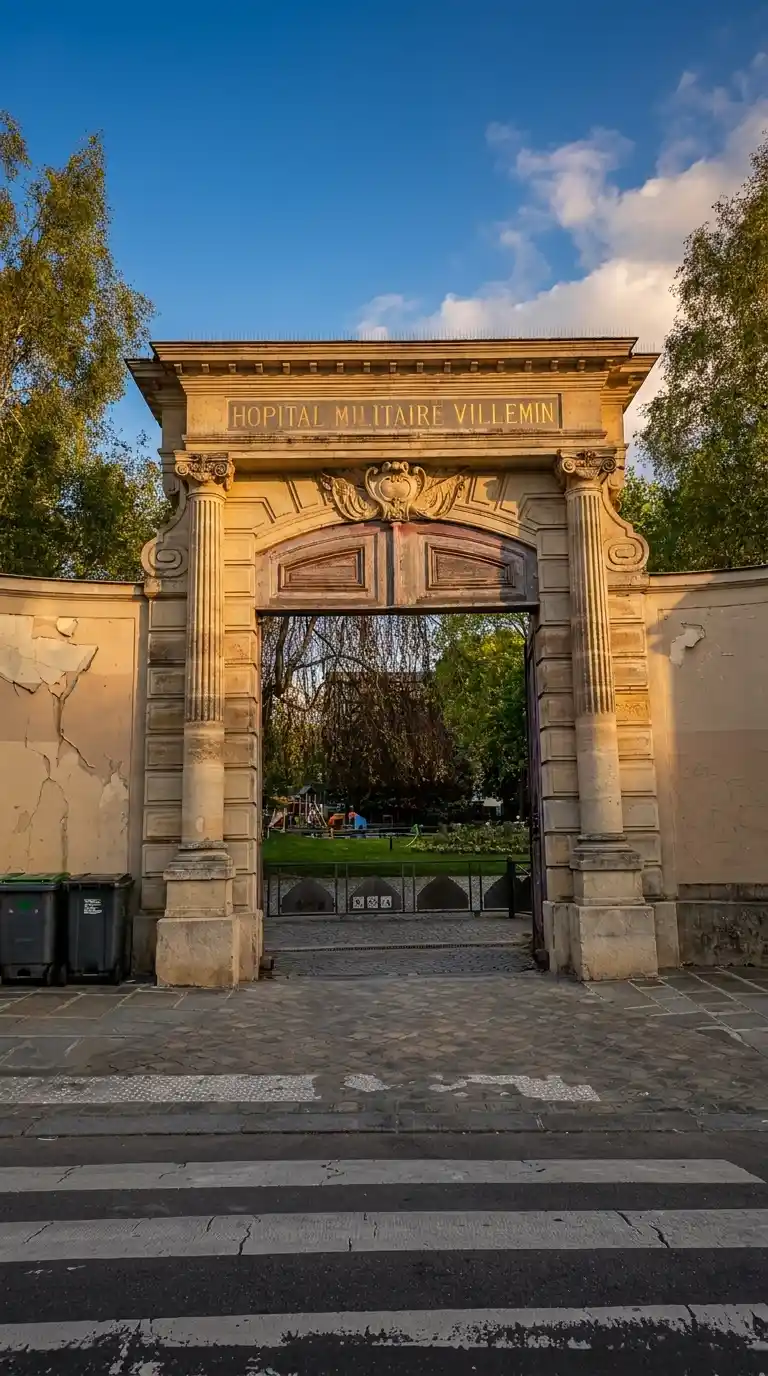
What to look for on the spot: the monumental gate of the hospital, which still bears the name Villemin, stands at 8 Rue des Récollets, at the entrance to the garden.
Of the convent, two of the four cloister galleries survive, and the most beautiful façade of the site is not the one facing Rue du Faubourg Saint-Martin but the one you see from inside the garden, with its arched windows from the end of the 18th century. The garden itself, the Jardin Villemin, is now a neighborhood park open to all, and the natural place to stop for a quarter of an hour in the middle of the walk.
The Hôpital Saint-Louis and the Pavillon Gabrielle
Address: 1 Avenue Claude Vellefaux, with another entrance from Rue Bichat.
Between 1605 and 1606 Paris was struck by plague epidemics, and the Hôtel-Dieu on the Île de la Cité could not cope with the load. On May 17, 1607, Henri IV signed a decree to build a new hospital outside the walls, and on July 13 he laid the foundation stone of the chapel himself. He dedicated the institution to Louis IX, the king who died of the plague in Tunis in 1270, hence the name.
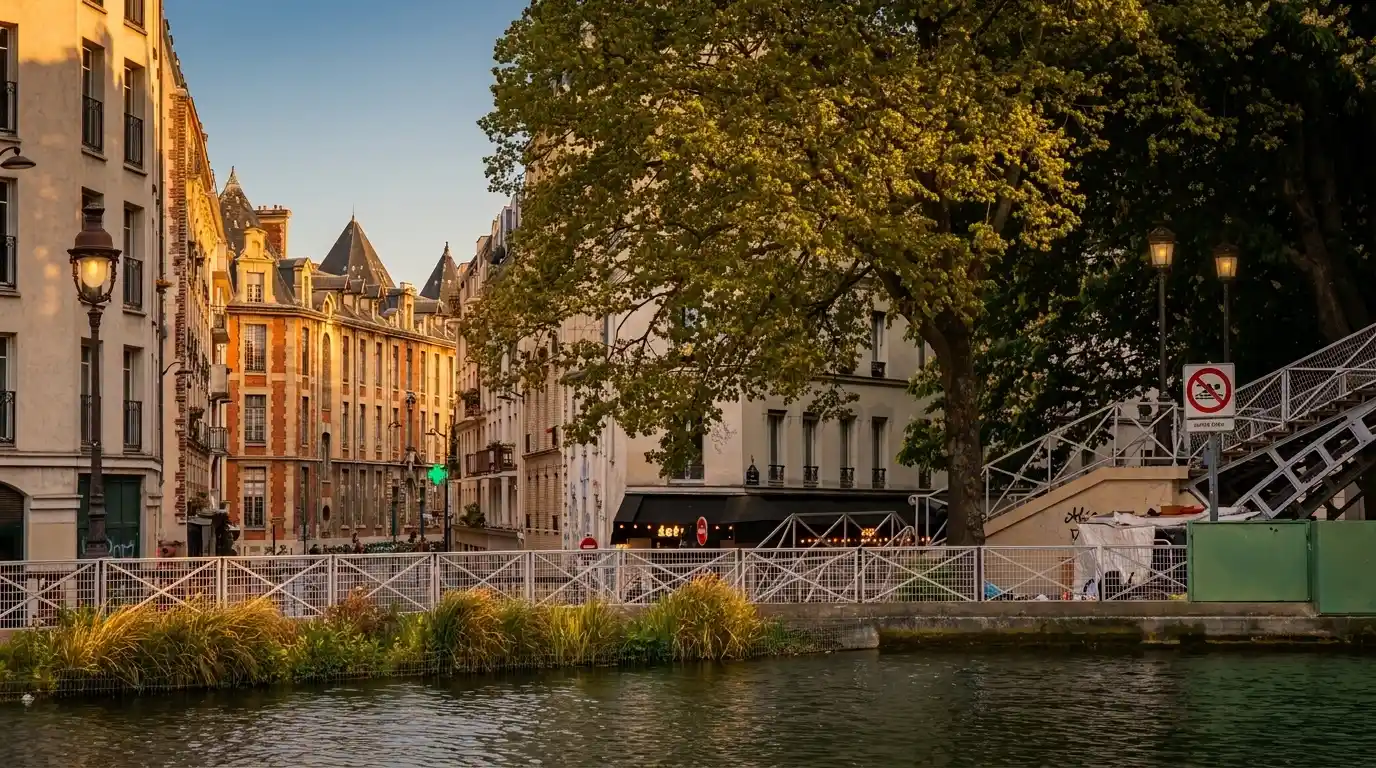
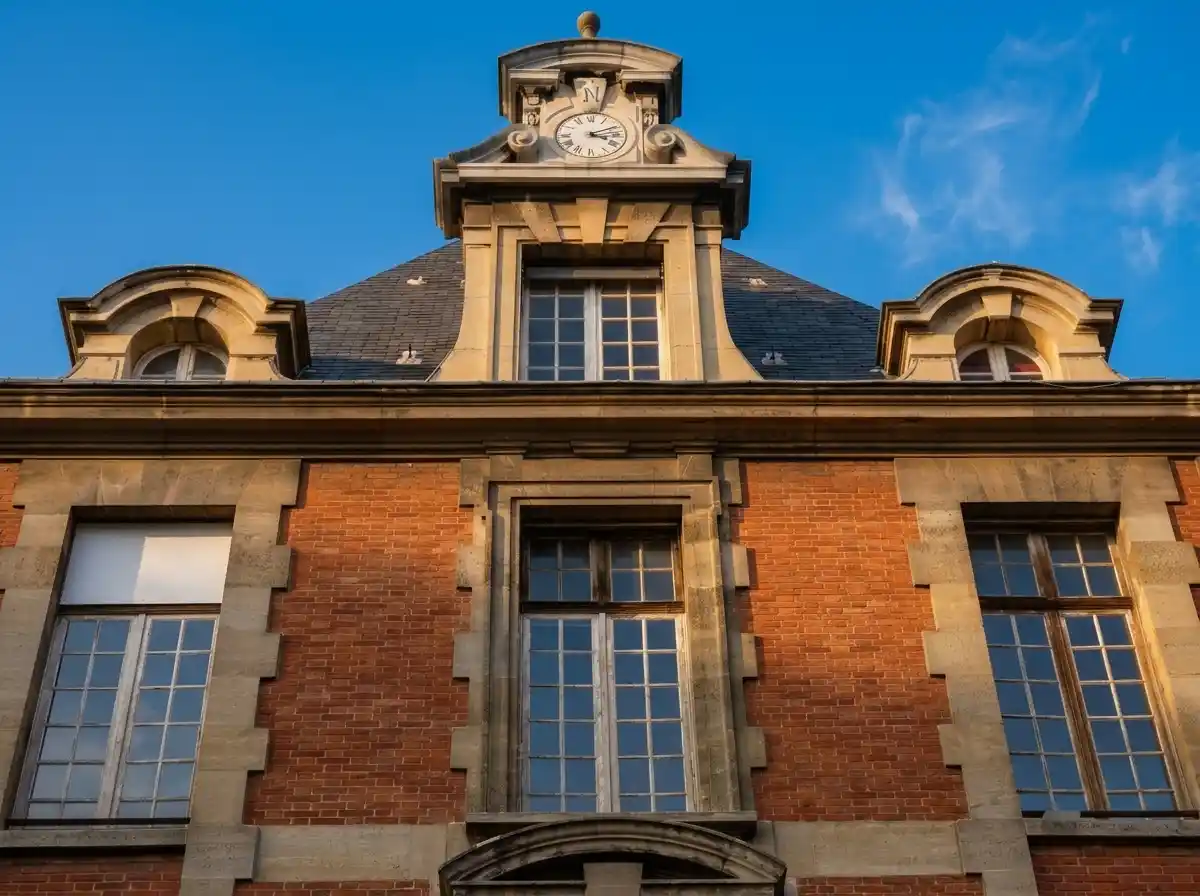
The plan was drawn by Claude Chastillon (1559–1616), and the construction was managed by Claude Vellefaux, after whom the avenue where the main entrance stands today is named. Chastillon is also the man behind the Place des Vosges, and once you know that, you can’t miss the resemblance: the same red brick, the same chains of white stone, the same steep slate roofs. The difference is that on the Place des Vosges the arcades are open to shops and tourists, while here they are still the corridors of a working hospital.
The historic quadrangle is 120 meters on each side, with a tall pavilion at each of the four corners and in the middle of each façade. On the upper floor there were four huge wards, each meant for two hundred patients, two for men and two for women. The quadrangle closed in on itself completely, because the whole idea was isolation: a patient who came in was not supposed to leave until he recovered or died, and the covered walkway under the arches was used to keep watch on anyone who tried to escape.
The site was chosen for the same reason. The area was hard to reach and lay right next to the gallows of Montfaucon, which is our next stop, and that was enough to keep the curious away. The first patients arrived in 1616, the hospital ran continuously until 1636, and after that it opened only when an epidemic required it: in 1651, 1670, 1709 and 1729. Under Louis XV (reigned 1715–1774) the wards served as grain stores and later as a place to lock up beggars and vagrants. Only after the fire at the Hôtel-Dieu in 1772 did Saint-Louis become a permanent hospital, and during the Revolution it was called for a while the hospice du Nord.
In the 19th century it became the center of the French school of dermatology, and the Musée des Moulages was built there, a collection of wax casts of skin diseases. In 1818 the first gasworks in Paris was set up here; it first lit the streets of the neighborhood and later also heated the hospital wards.
The Pavillon Gabrielle, which stands at the southeast corner opposite the chapel, was originally called the royal pavilion, because every major public building at the time had to be able to host the king. It got the name Gabrielle after Gabrielle d’Estrées (1573–1599), the mistress of Henri IV. The king never slept there, and in practice it housed patients who paid for their stay. Since 1911 it has served as the duty room of the interns, and it has been listed as a monument historique since 1937. According to tradition, the poet Paul Verlaine (1844–1896) was among the patients hospitalized in this pavilion.
By the way, if the name rings a bell, you can read about his turbulent life in Orna Liberman’s article on Paul Verlaine, the accursed poet.
The inner courtyard has been open to the public since 2005 and covers 9,400 square meters (about 2.3 acres). On weekdays you enter it through the hospital and follow the signs for the Quadrilatère. Bring a coffee and sit on the grass for half an hour. It is one of the quietest courtyards in Paris, and you will find mostly patients who have come out for a rest and families from the neighborhood. Don’t count on weekends: the city is supposed to open the courtyard on Saturdays and Sundays between April and October, but in practice it has been found closed even during that season.
The gallows of Montfaucon
Address: 53 Rue de la Grange-aux-Belles.
First of all, the name, because it is misleading. Rue de la Grange-aux-Belles was not named after beautiful women but after an old farm called the Grange aux Pelles, whose name had nothing to do with beauty. Over time the pelles turned into belles, and one version has it that at some stage the farm became an inn that also offered female company, which helped the new name stick. The road was originally part of the king’s road from Paris to Meaux, and it became a street in 1782.

On the hill that rose here, between the fields where the canal was later dug and the spot that would become Place du Colonel-Fabien, stood the gallows of Montfaucon, the main gallows of royal justice in France. The structure was made of sixteen pillars of dressed stone about ten meters high, connected by wooden beams from which iron chains hung. Up to fifty bodies could be displayed on it at once. Under the pillars was a pit closed off by a grille, into which the remains were thrown to make room for those who came after them.
The important point is that this was not mainly a place of execution but a place of display. Most of the condemned were executed elsewhere in the city and brought here to be hung up, sometimes left for years. The hill could be seen from more than a league away, and everyone who came to Paris from the north passed by it.
Tradition credits the transformation of the wooden gallows into a stone structure to Enguerrand de Marigny (1260–1315), treasurer and right-hand man of Philip IV the Fair (reigned 1285–1314). After the king’s death, Charles de Valois (1270–1325) called him to account, accused him of counterfeiting, embezzlement and witchcraft, and on April 30, 1315, Marigny was hanged on the very gallows he had built, on the orders of Louis X (reigned 1314–1316). His body stayed hanging for two years, until he was cleared of the charges. Before him Pierre de La Brosse (died 1278) was hanged there, and after him Giraud Gayte, another treasurer who died under torture in 1322 and whose body was displayed here.
By the way, if these names sound familiar from television or from books, it is because of The Accursed Kings (Les Rois maudits), and Raz Greenberg’s article on the series that inspired Game of Thrones explains how this story became one of the best-known royal sagas in France.
The last executions took place here around 1630, the gallows was abandoned and removed in the 18th century, and the site became a dump where the cesspits of Paris were emptied. The detail that makes this stop a little chilling came much later: in 1954, during excavations for a garage in the courtyard of 53 Rue de la Grange-aux-Belles, remains of pillars, paving and human bones were uncovered. There is nothing to see today except the façade of a perfectly ordinary building on a quiet Paris street, and that is exactly what makes it worth stopping in front of it for a moment.
A few dozen meters away, at 33 Rue de la Grange-aux-Belles, stood the Maison des Syndicats, the trade union hall that housed the CGT from June 1907. The hall on the ground floor held up to three thousand people, and it was the center of activity of the Paris workers. On January 11, 1924, a brawl broke out there during a Communist Party meeting, shots were fired, and two anarchists, Nicolas Clos and Adrien Poncet, were killed on the spot. One street, two layers of political violence, six hundred years apart.
Hôtel du Nord
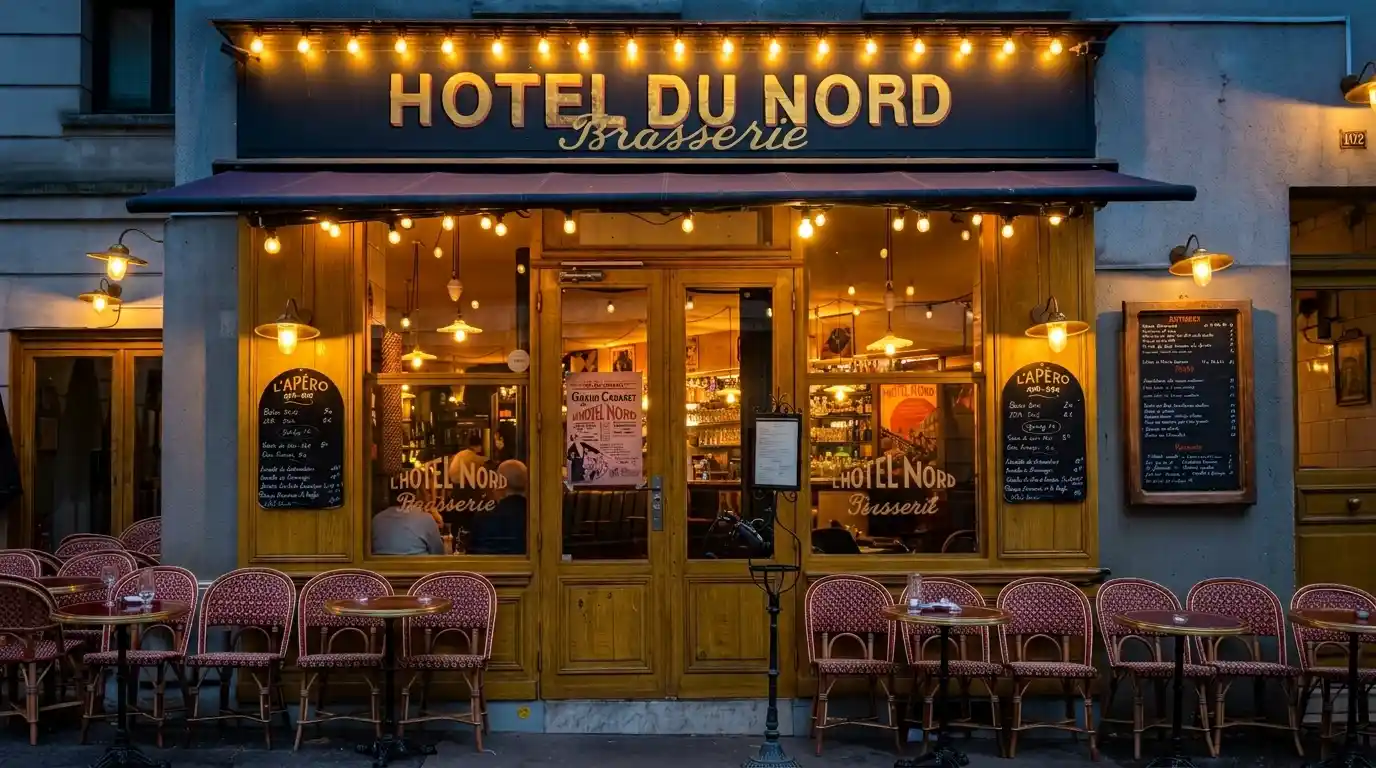
Address: 102 Quai de Jemmapes.
From here you go down to the canal and reach the most photographed façade in the 10th arrondissement. The Hôtel du Nord was a perfectly ordinary working-class hotel, forty rooms rented by the week to laborers, lock keepers and the unemployed. The parents of Eugène Dabit (1898–1936) bought it, and their son worked there as night porter. It was the best observation post in the world for a budding writer.
Dabit, who was also a painter, published the novel L’Hôtel du Nord in 1929, a book with almost no plot, made entirely of portraits of the residents. In 1931 it won the first Prix du roman populiste ever awarded. In 1936 Dabit set off on a trip to the Soviet Union at the invitation of André Gide (1869–1951), fell ill on the way, and died in Sevastopol at the age of thirty-seven. His ashes are buried in Père Lachaise.
Two years after his death the book became a film. Marcel Carné (1906–1996) directed, Jean Aurenche (1903–1992) wrote the screenplay and Henri Jeanson (1900–1970) wrote the dialogue, which is the real reason the film is still remembered today. Louis Jouvet (1887–1951) and Arletty (1898–1992) play a couple living in the hotel, and her outburst, one of the most famous lines in French cinema, asks whether she has a face of atmosphere (une gueule d’atmosphère). It does not appear in the book at all: it belongs to Jeanson.
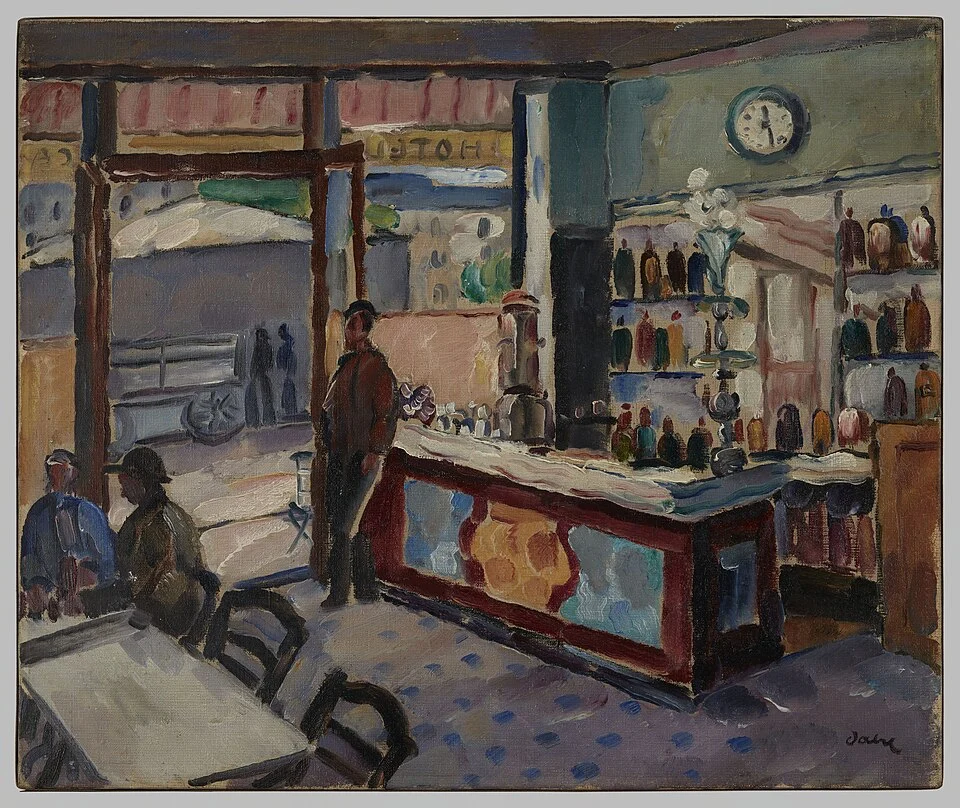
Here is the big joke of this place. Not a single second of the film was shot here. Everything was filmed in the studios of Boulogne-Billancourt, where the designer Alexandre Trauner (1906–1993) built a reconstruction of the canal, the footbridge and the hotel façade, at a slightly smaller scale than the original. In other words, the façade every French person recognizes is actually a set, and the original stood here all along and quietly grew old.
In the early 1980s a new building plan was supposed to demolish the shabby building. An association was formed to save it, with Arletty herself at its head, and it managed to save the façade, which was listed as a monument historique in 1989. Since then it cannot be touched. A restaurant and bistro now run on the ground floor, designed by a film person in the style of the period.
It is worth sitting here for a moment on the canal bank, by the lock, and taking one last look back. At the start of the walk we stood in front of a giant statue of Marianne, and here there is only water, an iron footbridge and the façade of a hotel that the films only ever imitated.
Du Pain et des Idées
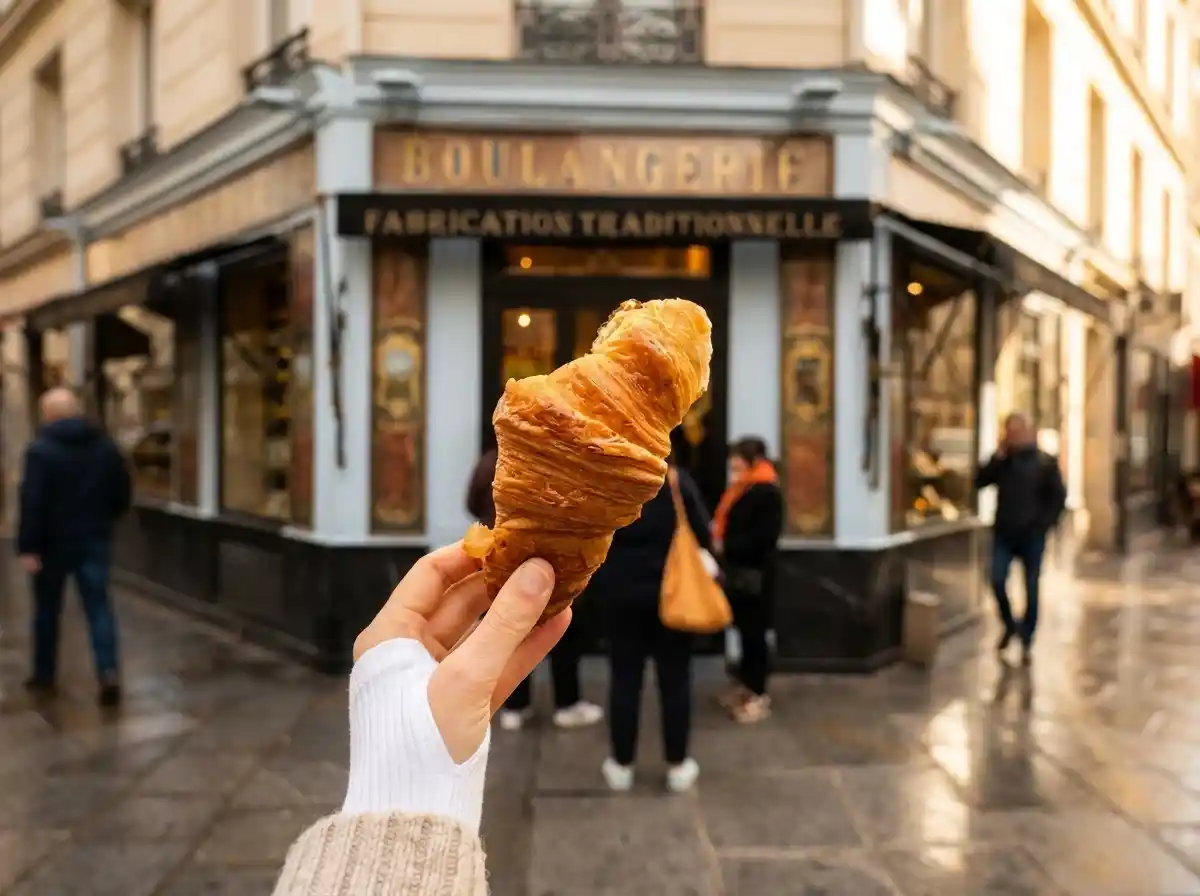
Address: 34 Rue Yves Toudic, at the corner of Rue de Marseille.
From Quai de Jemmapes you walk about three minutes west, and at the corner of Rue de Marseille a late 19th-century shopfront waits for you, looking as if nobody has touched it since: gold lettering on the glass, beveled mirrors and a painted ceiling. This is the bakery that put the 10th arrondissement on the tourists’ map of lines, and it still justifies the line.
The man behind it is Christophe Vasseur, who left a career in the fashion industry in his early thirties, learned baking, and in 2002 bought this old shop precisely because of its design. Since then he has worked with stone-ground flour and slow fermentation, and the line that starts outside has become part of the place.
What to buy: the bread that made his name is the pain des amis, a flat, dark-crusted loaf sold by weight, and the pastry everyone photographs is the escargot, a rolled pastry in changing flavors, the most famous of which is pistachio and chocolate. The croissant here is worth the line too, and you can read about the other good addresses in the city in my article on the croissants of Paris.
Note one detail that changes plans: the bakery is open on weekdays only, from about seven in the morning until eight in the evening, and closed on Saturdays and Sundays. Luckily, the courtyard of the Hôpital Saint-Louis is also open on weekdays, so on one weekday you get both. Current hours are published on the bakery’s official website, and the long bench outside is the only place to sit, and it is almost always taken.
Where to stay near the 10th arrondissement walk
When I did this walk I stayed, as I mentioned, in Udi’s apartment on Rue Béranger, in the northern Marais, a seven-minute walk from the starting point. It is an excellent option for anyone who wants to be between the 3rd and the 10th arrondissements, with an elevator and the Marché des Enfants Rouges nearby. If you prefer a hotel, these are the three addresses I would choose on the route itself.
-

Le Citizen Hôtel
A boutique hotel with just twelve rooms on Quai de Jemmapes, a few dozen meters from the end point of the walk, and every room looks out on the water. The design is Scandinavian and restrained, and the rooms are small to match. If you end the day here anyway, you won’t find a better location.
-
Le Robinet d’Or
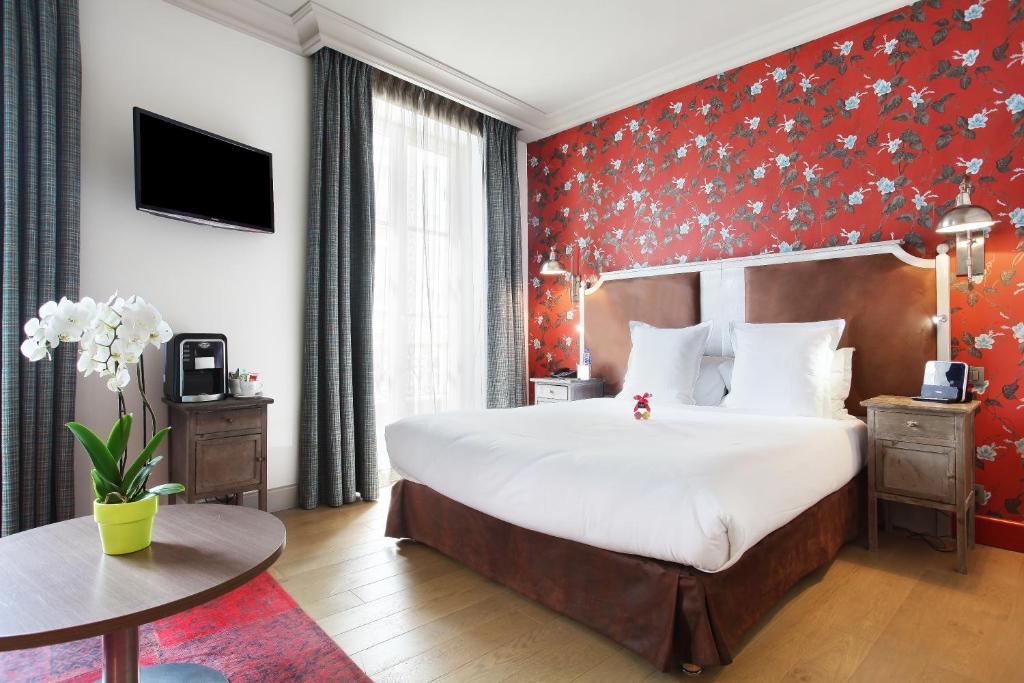
The name means the golden faucet, and that is what was made here until the 1930s: a faucet factory on Rue Robert Blache that was converted into a hotel with 21 rooms. The industrial spirit survives in the common areas, the rooms are actually warm, and the hotel sits between the gallows stop and the canal bank, right on the route.
-

Renaissance Paris Republique Hotel & Spa
The only five-star hotel in the arrondissement, in a former office building on Rue René Boulanger, with 121 rooms and a spa in the basement. It is less than a minute from the starting point of the walk, and République metro station is right next to it, so you can leave in the morning and start walking without using any transport at all.
If you want the full picture, I have a page of recommended hotels in the 10th arrondissement and next to it a page of recommended apartments in the 10th arrondissement, covering every price range.
Questions and answers about the 10th arrondissement walk
These are the questions I get most often about this area.
How long does the 10th arrondissement walk take?
Which day is best for the walk?
Can you go into the Hôpital Saint-Louis, and is it strange to walk around there?
Where exactly did the gallows of Montfaucon stand?
Was the film Hôtel du Nord shot in the real building?
Is the walk suitable for children?
Can you combine this walk with another one on the same day?
Related reading