Rue Le Regrattier on Île Saint-Louis in Paris is named after one of the contractors in charge of dividing up the island’s land in the first half of the 17th century. It was one of the most successful urban projects of its day. Pastureland for cows became building lots for Paris’s wealthy families, who were looking for room to build their townhouses.
The street was inaugurated in 1627 as Rue Le Regrattier. But in 1710 it changed its name to Rue de la Femme Sans Teste (the street of the headless woman), after a sign advertising a tavern that had opened there. The sign showed a headless woman raising a glass of wine, with the slogan “Everything is fine.” You can still see the old name of the street carved in stone. Above it stands a statue missing its upper body, but don’t confuse it with the headless woman. It’s a statue of Saint Nicholas, patron saint of sailors, commissioned by a wealthy shipowner who lived in the building. In 1793 a local resident who was a revolutionary cut off the statue’s head with a sword, and in 1870 the street got its old name back: Le Regrattier.

The origin of the headless woman and the précieuses movement
The tavern’s advertising sign, showing a headless woman alongside the caption “Everything is fine,” had its roots in a sexist proverb well known in 17th-century France: Femme sans teste, tout en est bon (a woman without a head, all the better). The proverb inspired a series of engravings by the caricaturist and publisher Jacques Lagnier (1600-1675), which flooded the market starting in 1660. They showed a blacksmith named Lustucru, who sometimes chopped off a woman’s head and sometimes “fixed” it with a hammer. The name comes from the phrase L’eusses-tu cru, meaning “would you have believed it.”
And indeed, who could believe that a woman’s head could be repaired? In this period, the mid-17th century, when young, wealthy women from the educated upper classes were trying to free themselves from men’s control, gain an education, and define and assert their own identities, standing out through refined dress and speech, misogyny was on the rise.
What’s known as Le mouvement précieux, or the précieuses movement, was a brief but significant social phenomenon that lasted less than a decade (1654-1663). The précieuses, or “the refined ones,” placed great emphasis on the art of conversation, manners, behavior, love, and literature. Men, writers, and intellectuals took part in the salons these women held in their grand homes. Guests played parlor games, composed poems, and discussed philosophy, science, grammar, language, friendship, and love.
The précieuses demanded independence and equal rights within marriage, and some even opposed the institution altogether and proposed alternatives, a bold idea for the time. The movement faded quickly, but it drew attention to the status of women, paved the way for a broader debate about their role in society, and laid the groundwork for the various women’s liberation movements that later emerged in France and elsewhere. The précieuses, who sometimes took their dress, speech, and manners to extremes, became an easy target for satirists. Molière’s play “Les Précieuses ridicules” is especially well known.

Lustucru’s engravings: misogyny at its worst
The engravings belonging to the Lustucru tradition express the misogyny of threatened men in blunter terms. In one of them, a crowd of husbands drags their wives by force to the “clinic” of the blacksmith Lustucru. Donkeys loaded with baskets full of women’s heads arrive at Lustucru’s workshop and his assistants’. They promise the husbands that after the “treatment,” the stubborn, deceitful, cunning, and devilish women will return obedient and docile: in a word, good. Total control is guaranteed, for a fee, to the grumbling husbands.
For those who can’t afford it, the treatment is free. In one hand Lustucru, wearing a cap, holds a woman’s head with tongs, and in the other he strikes it with a hammer, exactly like the Roman god Vulcan (Hephaestus in Greek), patron of blacksmiths and god of fire, volcanoes, and metals, who is depicted in a similar pose with a craftsman’s cap on his head. It’s worth noting that Vulcan embodies both the good fire that industry and human culture rely on, and the fire that burns and destroys. He has the power to unleash lightning, storms, and devastating volcanic forces, but he’s also the one who can calm them and bring them to an end. A similar ambivalence shows up later in the evolution of his double, Lustucru.
In other engravings from the same Lustucru series, men who have already cut off their wives’ heads as punishment for their defiance come knocking at Lustucru’s door, where he’s shown acting as judge. Lustucru was originally invented as a humorous, carnival-like figure with a comic name whose appearance was grotesque and ridiculous. But in the engravings, crammed with severed heads, there’s an expression of wild, violent, and cruel impulses. And the women, whose revenge is never long in coming, take part in these “carnivals” too.
In an engraving by Sébastien Leclerc (1637-1714), for example, we see heads being “repaired,” reshaped after decapitation.
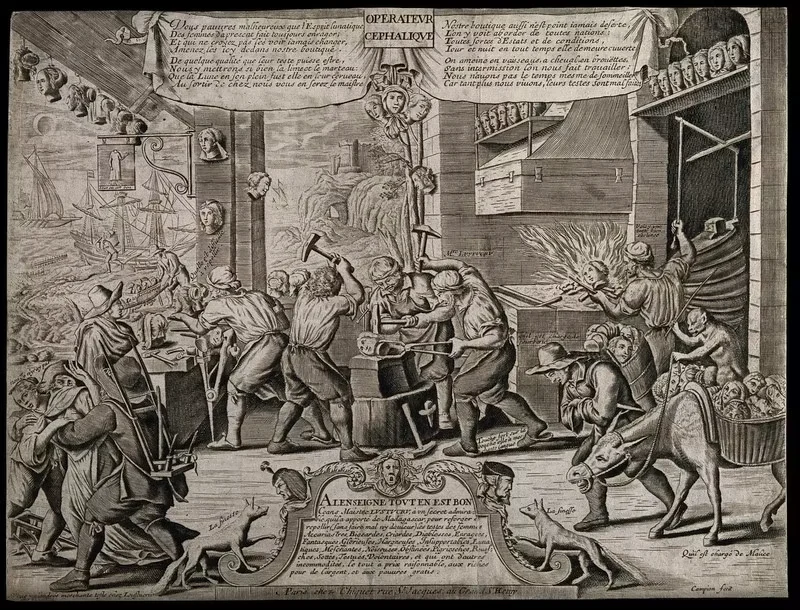
Sébastien Leclerc, The Head Worker. Source: Wikimedia, public domain
A few years later, in 1663, an engraving appeared showing the women striking Lustucru with a hammer and reclaiming their own severed heads, which reattach to their bodies. This engraving is also by Sébastien Leclerc, titled “The Grand Destruction of Lustucru by the Strong and Deserving Women.” A catalog of Leclerc’s work published in 1774 explains that this engraving was a kind of correction Leclerc made for the women he had mocked in his earlier engraving.
The roles had reversed. Where before Lustucru punished women depicted as wicked and devilish, here a woman strikes Lustucru on the head with a hammer, along with one of her friends. Another woman kicks him from behind and hits one of the blacksmiths, sprawled on the floor, with a bunch of keys. Another of Lustucru’s assistants, loaded down with women’s heads, is beaten with a stick, and more women come running to help their friends. In the background, other women find their heads hanging in a shop and take them down to reattach them to their shoulders.
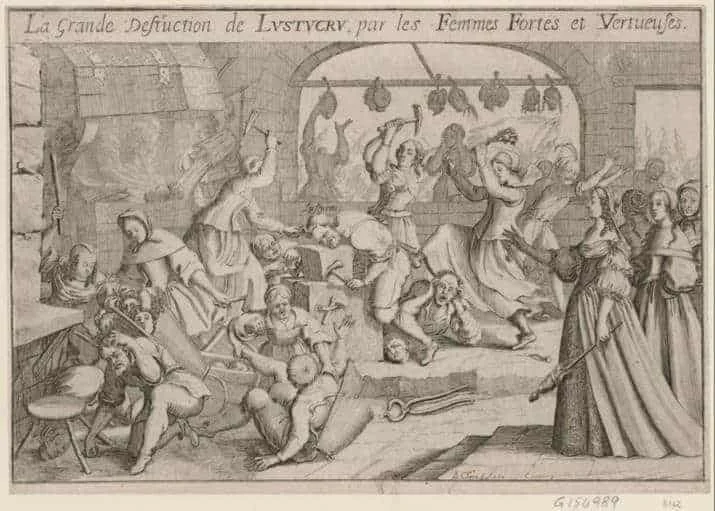
Sébastien Leclerc, The Grand Destruction of Lustucru. Source: Wikimedia, public domain
Many other engravings depicting Lustucru’s execution followed, showing the women removing his head or stoning him. The legendary, folkloric, popular figure of Lustucru went through many transformations over time. Lustucru, who had once served as a tool husbands used to punish their wives, later helped fathers in the following century to threaten their children. Lullabies in Narbonne and Montpellier frightened children with tales of a monstrous Lustucru carrying a sack, passing by their windows to snatch away bad children who wouldn’t sleep, his voice a growl and his footsteps like the sound of a storm, echoes of his resemblance to the fire god Vulcan, who was also deformed and lame.
Lustucru reinvents himself
But over time, the figure lost its dark edges and became a cheerful, kind-hearted, funny giant. In 1911, after an illustrators’ competition, Lustucru’s image was chosen as the commercial trademark of a French pasta company founded as a family business in Grenoble. From a child-eating giant, Lustucru became a giant who feeds children, fills their bellies, helps their mothers, and became a favorite of housewives.
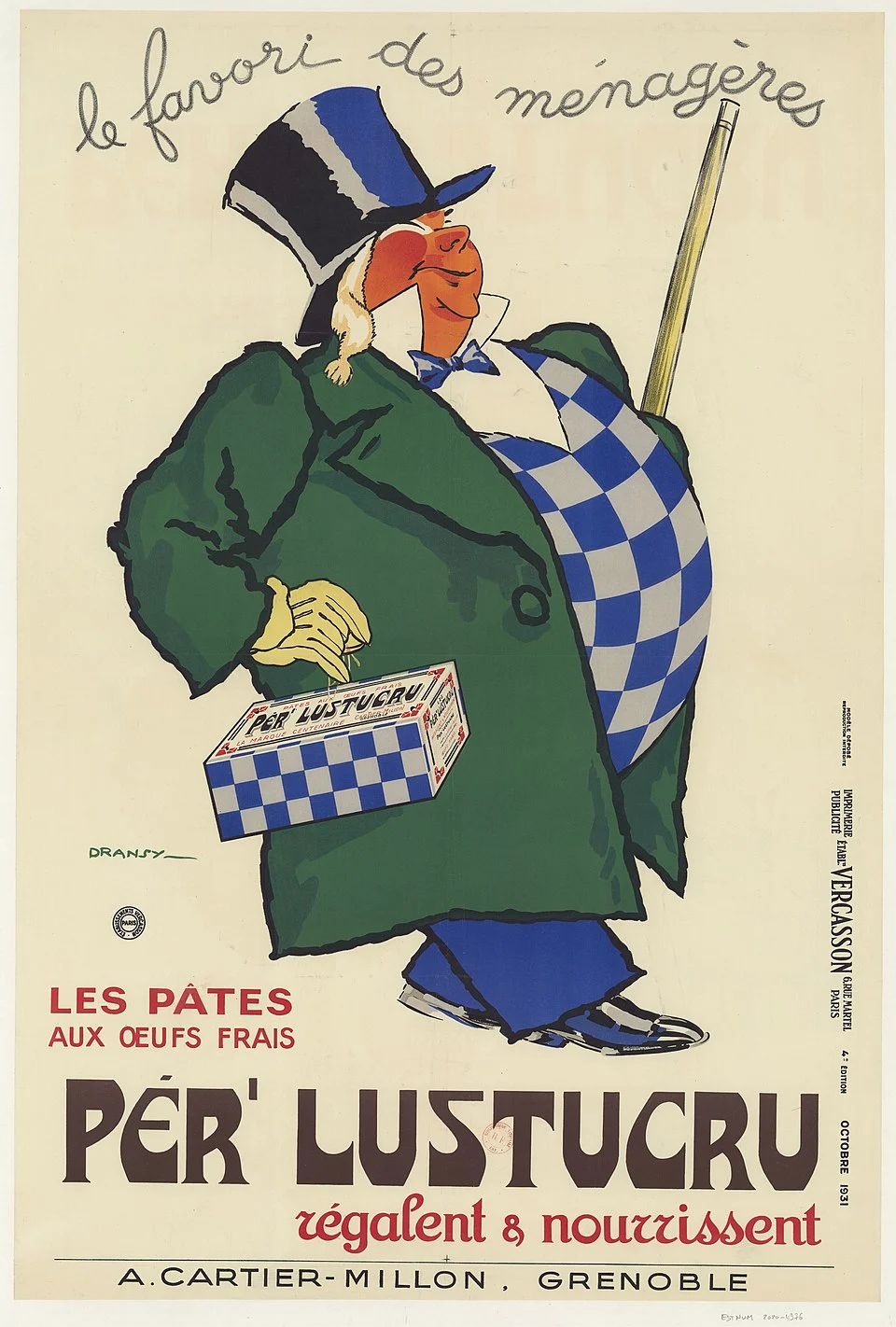
A 1931 advertising poster for the brand. Source: Wikimedia, public domain
In 1982, the company, which had grown and been bought by an international giant, launched the Lustucru brand of fresh pasta. In 2002, Panzani bought Lustucru. The brand still exists and thrives, and now also sells rice of every kind. Would you have believed it.
La preuve par l’oeuf, a video showing a 2020 exhibition of the brand’s posters, advertisements, and related products
Related reading