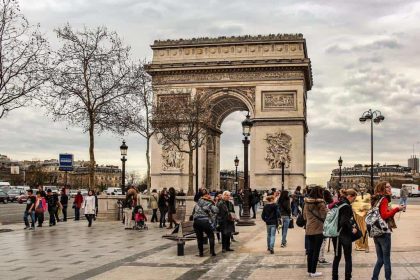
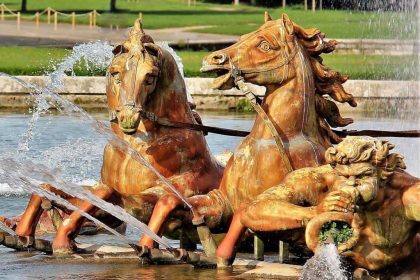
In June 1867, all of Paris was talking about the dazzling event. The cream of the capital’s society, its aristocrats and its celebrities, were invited to the inauguration of the mansion built by the countess Blanche de Donnersmarck (Blanche de Donnersmarck), known as La Païva (La Païva), wife of the German count Guido Henckel von Donnersmarck (Guido Henckel von Donnersmarck), at the prestigious address: 25 Avenue des Champs-Élysées.
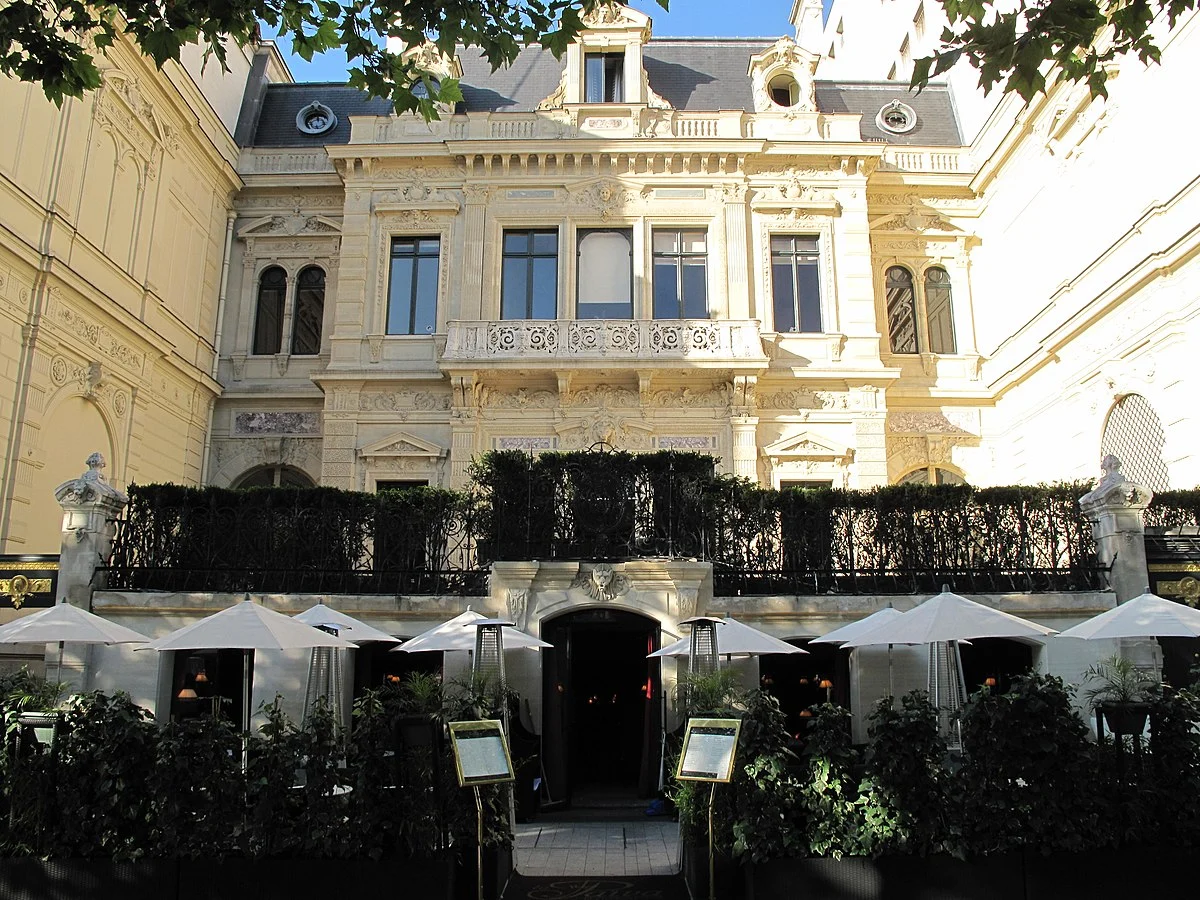
The facade of the Hôtel de la Païva. Source: Wikimedia
La Païva, a penniless adventuress from the Moscow ghetto, daughter of Jewish refugees from Poland, born Esther Lachmann, a onetime streetwalker and later a high-society courtesan, but now the wife of a multimillionaire count and cousin of Otto von Bismarck, had fulfilled her dream of owning a mansion on the Champs-Élysées.
An urban legend tells that early in her career, when La Païva, who then called herself Thérèse, had to earn her living as an ordinary streetwalker, a rude client once pushed her out of his carriage after the fact, in a hurry to get back to his business. Thérèse, born Esther, fell and was slightly bruised. It happened at number 25 Avenue des Champs-Élysées. “One day, I will build the most beautiful mansion on the Champs-Élysées right here,” she said, humiliated. The revenge of the poor, humiliated Jewish girl, Esther Lachmann, was not long in coming.
A few years later, a wealthy count from a well-known Silesian noble family fell in love with her and bought her the very plot where she had fallen. On that coveted plot on the Champs-Élysées she would build a mansion, one of the grandest in the city, which became a symbol of her rise and social success and remained in history. La Païva’s mansion is the only one from the 19th century still standing on the Champs-Élysées in its original form.
The inauguration of the Hôtel de la Païva
The proud mistress of the house, the countess de Donnersmarck, stood at the top of the enormous staircase, made entirely of yellow onyx, unique in Paris and perhaps in the whole world, to welcome her guests: aristocrats, statesmen, artists, writers and journalists, alongside marble statues of Virgil, Dante and Petrarch. Let’s take a look ourselves:
The countess put on display not only her wealth but also her artistic and literary taste. Some marveled at the dazzling splendor, which included works by the finest artists of the period. Others mocked the eye-straining ornamentation, the Second Empire style taken to its most extreme, pushed past the bounds of good taste. To some, La Païva’s magnificent mansion is a brilliant combination of bad taste.
In the Moorish-style bathroom stood a bathtub carved from a single block of yellow onyx (that same quarry near Oran was fully exhausted!), weighing 900 kilograms and fitted with gold-plated faucets set with precious stones. A second bathtub, made of silver-plated bronze, had a third faucet whose purpose remains a mystery. Some say it ran with Champagne, or more likely, donkey’s milk or linden tea: La Païva was a great believer in the use of plants.
The countess bathed four times a day, after which her maids massaged her vigorously with a mixture of milk, salt and lemon juice, with the windows open (the countess had always loved the cold, which she believed was good for body and soul). Every room was packed with furniture, statues, paintings, candlesticks, torches, chandeliers, carpets and more. The ceiling of the main salon, “the Grand Salon,” was decorated with a stunning painting, “Day Chasing Away Night,” by Paul Baudry, painter of the Palais Garnier. Playing the role of day: Apollo, the sun god, drawing his bow. Playing the role of night: a nude beauty with generous curves, waking from her sleep, for whom the countess herself had served as the model.

The former courtesan is immortalized in no small number of works, paintings, reliefs and statues across the grounds of her mansion, inside and outside it, depicting Venus, Diana and other goddesses and mythological figures in her likeness. At the entrance to the mansion, above the gate, following the custom of the period, sits a medallion of the lady of the house’s face, designed in the style of a Renaissance noblewoman’s portrait.

A huge fireplace of red marble adorns the “Grand Salon,” while two allegorical female statues in white marble, Music and Harmony, the latter in the likeness of the lady of the house, sit on the cornice on either side. The architect Pierre Manguin, who designed the mansion in a neo-Renaissance style, also included a winter garden in Pompeian style. The carriage house and the stables were spacious, as befit the hostess’s standing.

The Goncourt brothers, who were among La Païva’s guests at that very event, spared no criticism of the mansion, overloaded with excess, and of the dramatic entrance of the queen of the evening, in their famous journal:
Her dress, with its deep plunging back, reveals shoulders and arms that are pale, still lovely, but her white face, covered in a thick layer of powder, is etched with wrinkles that appear black in the light. Her eyes are green and lovely but somewhat round, and her nose, pear-shaped, is flattened at the tip. On either side of her thin mouth, horseshoe-shaped hollows descend toward the chin, merging there into a deep wrinkle of old age. The courtesan, still of an age when she might play her part, appears at moments to be a hundred years old, a frightening, made-up mummy.
So end the words of the Goncourt brothers, in free translation.
It should be noted that La Païva did not like her own face once it had aged before its time, and she avoided being photographed or painted as she truly looked. The portraits labeled “La Païva” mostly show other women. Her mockers described her face as though covered in a plaster mask, so heavy was her makeup.
The Goncourt brothers’ sharpened pen recalls a joke that spread by word of mouth, though no one knows who first came up with the ironic wordplay behind it: La Païva, qui paye, y va. “La Païva, whoever pays, gets in.” But whatever the spiteful and the envious might say, after her marriage to the count, La Païva’s life changed completely.
She no longer needed to chase after money, to fight like a lioness and a snake to escape a lowly fate. Not anymore. Her goals now were entirely different: to further cement her standing as an influential figure in Parisian society, to lead, to impress, to build, to promote artists. That was her purpose from then on. Her marriage was a happy one. In the grand salons of her home, the countess Blanche de Donnersmarck, the former Esther Lachmann, received a representative sample of the leading figures of the day: Léon Gambetta, Émile de Girardin, Eugène Delacroix, Paul Baudry, Pierre Manguin, Hector Lefuel, Théophile Gautier, Paul de Saint-Victor, Charles-Augustin Sainte-Beuve, Jean-Léon Gérôme, Paul Lacroix, Émile Augier, Léon Gozlan, Arsène Houssaye, François Ponsard. Ernest Renan and Hippolyte Taine preferred to stay away.

The courtesan was not universally welcomed, but among her guests were some who also frequented the salon of Princess Mathilde, who of course did not look kindly on her rival’s success. Several of La Païva’s enemies, like the Goncourt brothers, slandered both the mansion and its owner, mocking her origins and her past.
Well known is the reply of the sharp-tongued satirical journalist and playwright Aurélien Scholl, who, returning from a stroll along the Champs-Élysées, was asked by colleagues how the construction of the mansion was progressing: “Everything’s fine,” he said. “The main thing is already done: the sidewalk has been paved.” Or, according to another version, it was Alexandre Dumas fils who said: “The mansion is almost finished. Only the sidewalk is missing.” Two opposites expressing the same idea. And in an article from the newspaper Le Figaro of the time, one can find confirmation of Aurélien Scholl’s reply: “Although the mansion is not yet complete, Madame la Marquise de Païva can already take up residence there: the paving of the sidewalk has just been finished.” Every stage of construction was covered extensively from every possible angle, in private conversation and in the press.
The countess hosted dinners for men only (partly to avoid any competition, though it’s also true that no woman of high society agreed to cross the mansion’s threshold): ten guests every Friday, and twenty every Sunday. Guests were allowed to bring recommended acquaintances, friend inviting friend.
The table was set with great splendor, fine wines, delicious food, oysters, fresh fish and asparagus brought in by train, cherries, peaches and grapes arriving straight from the count and countess’s country estate. Canned goods, an exciting novelty for the period, were also served for the guests’ enjoyment.
The service was flawless, the serving pieces elegant, from the finest makers, the staff carefully chosen, and the brilliant, witty conversation revolved around art, literature and finance. The shrewd and practical countess spoke several languages, read newspapers and books, attended the opera regularly, knew how to invest her money, hosted businessmen and bankers and listened closely to their talk. After coffee was served, the guests moved to converse in the winter garden, covered by a glass ceiling. Visitors spoke of the cold that filled the garden, chilling the guests to the bone, but it never bothered the countess, who delighted in showing off in light, revealing outfits.
And how was the mansion divided, then and now? The ground floor was meant for receiving guests. The entrance hall, decorated in colors of wealth and glory: red, black and gold, was where a herald would announce the names of arriving guests before they were led into the salon facing the Champs-Élysées. At one end was a smoking room, marked by a window above a fireplace. The dining room led out from the salon, and today it is the club’s bar. Near the bar is the winter garden, next to a small inner courtyard that did not exist in the countess’s time. This is where the entrance to the mansion used to be.
The private apartments of the count and countess were on the first floor. Today, the club’s restaurant occupies that space. On the top floor were the staff’s quarters. The kitchen was in the basement.
From Moscow to Paris
The great courtesan who would go down in history under the name La Païva was born on May 5, 1819, in Moscow, as Esther Blanche Lachmann, to Jewish parents who were refugees from Poland. Her father was a weaver, according to one theory, or a fabric merchant at the market, according to another. Either way, he was very poor. At 17, she married a Jewish tailor who lived in Moscow but had been born in Paris. His French citizenship was probably the reason the ambitious redhead married him.
To her, men were never more than a stepping stone toward her ambitions. A year after their son was born, once she realized her husband had no intention of bringing her to Paris, Esther left her family, in the company of a casual lover, to conquer her city of choice. There was no room for feelings in the heart of this determined and stubborn young woman, who calculated every move with perfect cold-bloodedness, a trait she would keep for the rest of her life. She knew how to turn every situation to her advantage and move closer to whatever goal she had set for herself.
Esther earned her living as one of the “lorettes”, meaning prostitutes who found their clients, including a few regular lovers, around the Notre-Dame-de-Lorette church, in the 9th arrondissement. By now she no longer went by Esther, but called herself Thérèse. Thérèse quickly climbed the ladder, helped by the reputation she had built, rising from a “lorette”, a simple streetwalker, to the rank of “lioness”, meaning a society woman financed by wealthy patrons.
The crafty Thérèse made friends with former courtesans and elite dressmakers who agreed to “bet on her”, meaning to dress her in the latest fashions and lend her money so she could make her way to hot spring towns like Baden-Baden, and to theaters and opera houses, the meeting places of courtesans and their lovers. With her great cunning, she also managed to get invitations to grand events and to parties in diplomatic circles.
Of her past, she naturally shed no light. Thérèse told stories. The secrets of eroticism, she would say, she had learned in Constantinople. Her first famous lover, the first step in her status as a “lioness”, was the musician Heinrich Herz, known in French as Henri Herz, a German Jew who had emigrated with his family to France at age 13.
The family settled in well in their new country, and Henri later received French citizenship. Like Esther Lachmann, he too was very ambitious and determined to succeed. And indeed, he achieved an international reputation as a pianist, composed many works for piano, founded a family business manufacturing pianos at 48 Rue de la Victoire, opened an elegant concert hall there, and trained famous students. Somehow he was forgotten over time, but a biography published in 2011, which also sheds light on musical life in 19th century France, partly corrects the injustice done to him.

Thérèse, 22 years old, met the 38-year-old Henri in 1841, when he was at the peak of his career as a pianist. Some say that to catch his attention, she fainted during one of his concerts. Either way, the scheme worked. The virtuoso fell head over heels for her, and from then on presented her as his wife, Madame Herz, even though Esther was still married to her first husband, the tailor from Moscow.
The celebrated musician took his companion along on his concert tours across Europe and introduced her to the intellectual and artistic elite of the time: Franz Liszt, Richard Wagner, Théophile Gautier, Émile de Girardin. Madame Herz learned to play the piano and completed her musical education, receiving guests at 48 Rue de la Victoire in the 9th arrondissement, in the concert hall the artist had opened, since he was also a well-connected and much talked about society figure.
In 1842, the couple had a daughter, Henriette, whose upbringing was taken on by Henri’s parents. The girl died at age 12, and Esther’s son from her marriage to the tailor died, likely of tuberculosis, at age 25, while studying medicine in Paris. Many details of Esther’s life remain foggy, and the facts cannot be established with certainty.
The courtesan squandered all of her partner’s money, and he, left penniless, went on a tour of the United States without her. His parents, who had never looked kindly on their successful son’s dubious infatuation, threw her out of the house in 1848, and she promptly set off for London, to cast for new catches. Preferably heavier ones.
An urban legend tells that the courtesan traveled to her next destination with a vial of poison in her pocket, in case she failed to achieve her goal. But no need to worry, the crafty woman never used it. What she wanted came to her easily, and after conducting passionate affairs with wealthy English lords who showered her with gifts, she returned to Paris, at the end of 1848, with full pockets, to begin a romance with the Duc de Guiche, who was also a lover of the actress Rachel and of the courtesan Marie Duplessis, the heroine of “The Lady of the Camellias”.
Esther’s husband, the tailor, father of their son, arrived in Paris hoping to win her back, and after she rejected him with contempt, he died of grief in 1849. In 1851, Thérèse married a Portuguese marquis, de Païva, but the day right after the ceremony, she revealed her true intentions to her naive husband: “You got what you wanted, I got what I wanted, and that’s the end of it.” Naive, perhaps only in matters of women, if we are to believe those who claim the marquis was not actually a nobleman and had taken the title for himself unlawfully.
From then on, she would be called the Marquise de Païva, or, in the name that stuck with her, La Païva. The heartbroken marquis, whose only appeal to the courtesan had been his title and fortune, returned to Portugal. The marquise took up residence in the townhouse she had received from the husband she had cynically abandoned. The address was quite prestigious: 28 Place Saint-Georges.
The townhouse was built in 1840 by the architect Édouard Renaud, its facade decorated with angels, lions and statues in the Neo-Gothic and Neo-Renaissance styles. On the ground floor of the house, the Marquise de Païva hosted prestigious guests for dinners, a preview of the ones she would later serve in her mansion on the Champs-Élysées.

Bismarck’s cousin falls in love
A year after her marriage to the Marquis de Païva, at age 33, La Païva, formerly Esther Lachmann, reached the peak of her life, from which she would not fall again except into the arms of death, thirty-two years later. Bismarck’s cousin, a count who owned coal and zinc mines, an industrialist, entrepreneur, businessman, multimillionaire, one of the richest and most influential men in his country, though still young at just 22, serious, reserved, shy, quiet and inexperienced with women, fell head over heels for her, was helplessly smitten at her feet, and never left her until the day she died, and even after.
He opened to her the gates of wealth and social success; she opened to him the gates of pleasure. Still, there must have been something about her, a courtesan eleven years older than her own husband (!), despite how the Goncourt brothers described her…
Guido Henckel von Donnersmarck, as he was called, was a descendant of the Silesian noble family Henckel von Donnersmarck, the same family that later produced the famous film director Florian Henckel von Donnersmarck (born 1973 in Cologne), director of “The Lives of Others”. It was Guido Henckel von Donnersmarck who financed the construction of his beloved wife’s mansion on the Champs-Élysées, which of course cost a fortune, ten million gold francs.
From then on, she would go by her middle name, Blanche. The couple, Guido Henckel von Donnersmarck, the German count, and his wife Blanche, lived together in Paris, happily (and richly) ever after. In 1870, La Païva’s marriage to the Portuguese marquis who had given her his name was annulled, and two months after the annulment she married the German count at a Lutheran church in Paris. The unfortunate Marquis de Païva, who had returned to Paris, shot himself in the mouth in 1871, after losing all his money gambling (let’s not forget that La Païva herself had ruined him financially even before that). Not everyone knows how to pick the winning horse…

Count Guido Henckel von Donnersmarck. Source: Wikimedia
The Château de Pontchartrain
Henckel von Donnersmarck served as a reserve officer in the Franco-Prussian War of 1870, which ended, as is well known, in a crushing defeat for France. The defeated country was forced to hand over the Alsace-Lorraine region to Germany and pay heavy reparations. It was Henckel von Donnersmarck who advised his cousin Otto von Bismarck to demand swift payment of 5 billion francs, a sum that was indeed paid in full as early as 1873, having fought in the France-Prussia war himself.
In these dealings, he was aided by his wife’s advice, as she knew Léon Gambetta well, a regular guest at her home. Henckel von Donnersmarck was appointed temporary governor of the Alsace-Lorraine region, which had, as noted, passed under German rule. It seems the German temporary governor very much enjoyed life in France, in the arms of his beloved wife, and he showed his gratitude to her in many ways. In addition to the mansion on the Champs-Élysées, he also bought her, in 1857, a château near Paris, in the Yvelines department, the Château de Pontchartrain.
The count renovated the château with the help of the architect Pierre Manguin, while the countess designed the park and planted trees and plants in it, some of them rare varieties. Fresh vegetables and fruit were brought straight from the garden to the lavish dinners at the mansion on the Champs-Élysées. The local farmers were stunned to see the countess riding horseback in men’s clothing and taking part in hunting expeditions. This was the couple’s country home, where they spent many happy days.

It was at this château that the countess received Léon Gambetta to discuss the reparations demanded by Bismarck from France, and to try to bring the hostile sides closer together. The countess tried to persuade Gambetta to travel to Berlin to meet with Bismarck, but the French statesman changed his mind at the last minute. The countess’s efforts achieved only the opposite of what she intended, and her aspirations for a political career ended right there.
Exile to “Little Versailles” in Silesia
In 1877, fate struck. The countess was forced to leave France after being suspected of spying for Prussia. It was the war of 1870 that put an end to La Païva’s happiness, the happiness she had worked so hard to achieve. The couple moved to the family estate that had belonged to the noble Donnersmarck family since the 17th century, Château de Neudeck. After the architect Pierre Manguin, a close friend of the couple, died prematurely, command of the work to glorify the castle passed to the architect who had renovated and expanded the Louvre Museum, Hector Lefuel.
The renowned architect, to whom the count, like his predecessor, provided legendary sums of money, renovated the castle in the style of Louis XIII. He also drew inspiration from the Château de Pontchartrain and from the mansion on the Champs-Élysées. He added a second castle by the great lake in the park, which he designed in the style of the Tuileries Garden.

The count and countess’s grand castle (no longer standing). Source: Wikimedia
The count and his wife employed top-tier French artists and designers in renovating the estate and bought a great deal of furniture and objects made in France, in addition to part of the contents of the mansion on the Champs-Élysées, which they brought to their new home. The countess’s goal was to recreate, on an even grander scale, her beloved Parisian mansion, where she had lived for the twelve good years that were the peak of her life, the mansion she had been forced to leave.
She wanted to recreate both her Parisian paradise and a countryside paradise: in short, a French paradise in exile in Silesia. That’s how the castle earned its nickname, “Versailles Little” or “Versailles of Silesia.” That said, not all the local farmers looked kindly on the castle’s owners, lovers of enemy France and its culture. And even in France, the country they preferred to live in, which they had been forced to leave against their will, the count and countess suffered from the hostility of the local population.
The countess’s husband hoped that life at the Silesian castle would improve his wife’s declining health. But seven years later, in 1884, her heart gave out and she died, at age 65. It’s said that her heartbroken husband kept her embalmed body in a glass casket in the castle’s attic. Was this the episode the Goncourt brothers had in mind when they described La Païva as a frightening, made-up mummy?
It’s said that at his wife’s funeral, the freshly widowed count wept bitterly and swore he would never marry again. Three years later, the count, then 56 years old with thirty more years left to live, married a 25-year-old Russian princess (forty years younger than his first wife), Katharina Slepzow, and had two sons with her. After the count died in 1916 at age 86, the widow continued to live at the castle and died there in 1929 at age 67. Of the couple’s two sons, the younger left no descendants, but the elder carried on the family line.
The story of the mummy has a sequel, with two versions. The first version tells that one day the young wife’s foot struck a hard object in the attic. To her shock, she discovered the body of her husband’s first wife, preserved in an alcohol solution, in a glass casket. Only after discovering this gruesome secret was the husband forced to have her buried.
The second version tells that the count forbade his second wife from entering a certain room in the castle where he used to shut himself in for hours. One day he forgot the key in the lock. Curious, she entered the room, and when she discovered her husband’s secret, she let out a scream of horror and collapsed.
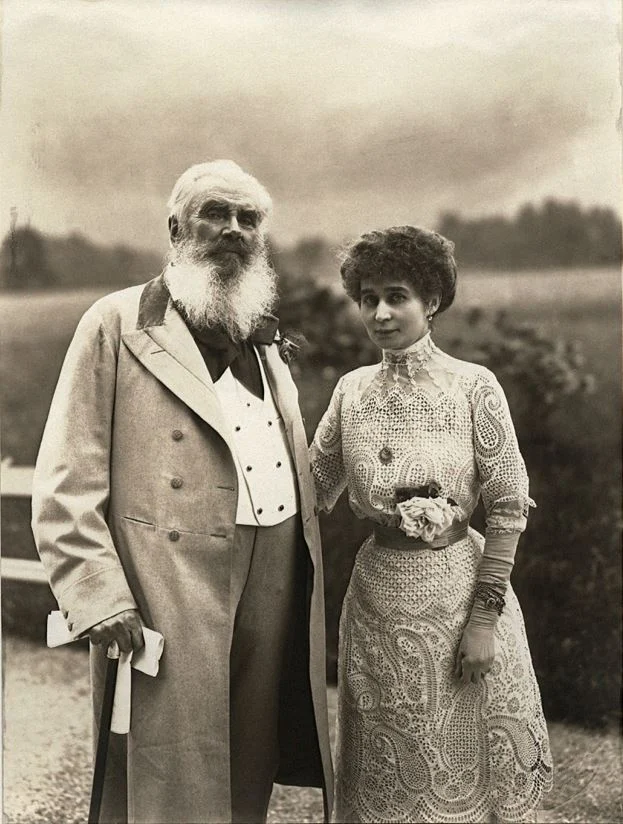
Count Guido Henckel von Donnersmarck with his second wife, Princess Katharina Slepzow. Source: Wikimedia
La Païva’s legacy
“Little Versailles” was La Païva’s last creation. The grand Silesian castle was burned down in 1945 by the Red Army, and some say by Polish communists who beat the Russians to it. A cruel twist of fate: the woman who was born in Russia to Polish parents and fled her origins and the circumstances of her birth was, in a sense, avenged by those very origins after her death.
In 1962, the Poles completely demolished the remains of both castles, wiping their foundations off the face of the earth. Of “Little Versailles,” only the park remains: 154 hectares with ancient trees and a pond, the “Knights’ Palace” added in 1906, the family’s private chapel, a few smaller wings, four giant statues by a French sculptor along with his fountain (which was restored, more on that below), and a few smaller statues by a German sculptor.
The “Knights’ Palace,” built in the Neo-Renaissance style, was originally meant to house guests, and today it’s a hotel-restaurant, much loved by local residents along with the park around it.

The Knights’ Palace. Source: Wikimedia
The four giant animal sculptures, carved in France by Emmanuel Frémiet on the countess’s commission, rival in value the works by Auguste Caïn in the Tuileries Garden. Frémiet’s deer and bear, horse and lioness, ostrich and snake, and pelican and fish were brought to the castle in crates and set up in the park on tall stone pedestals.

Château de Neudeck no longer exists, as mentioned, and some of its past glory has faded, but its park, with its four impressive works of art, has been restored and is now a popular tourist destination in Poland. In the photo below, you can see the entrance to the castle, where the park now stands, with two of Frémiet’s giant sculptures:
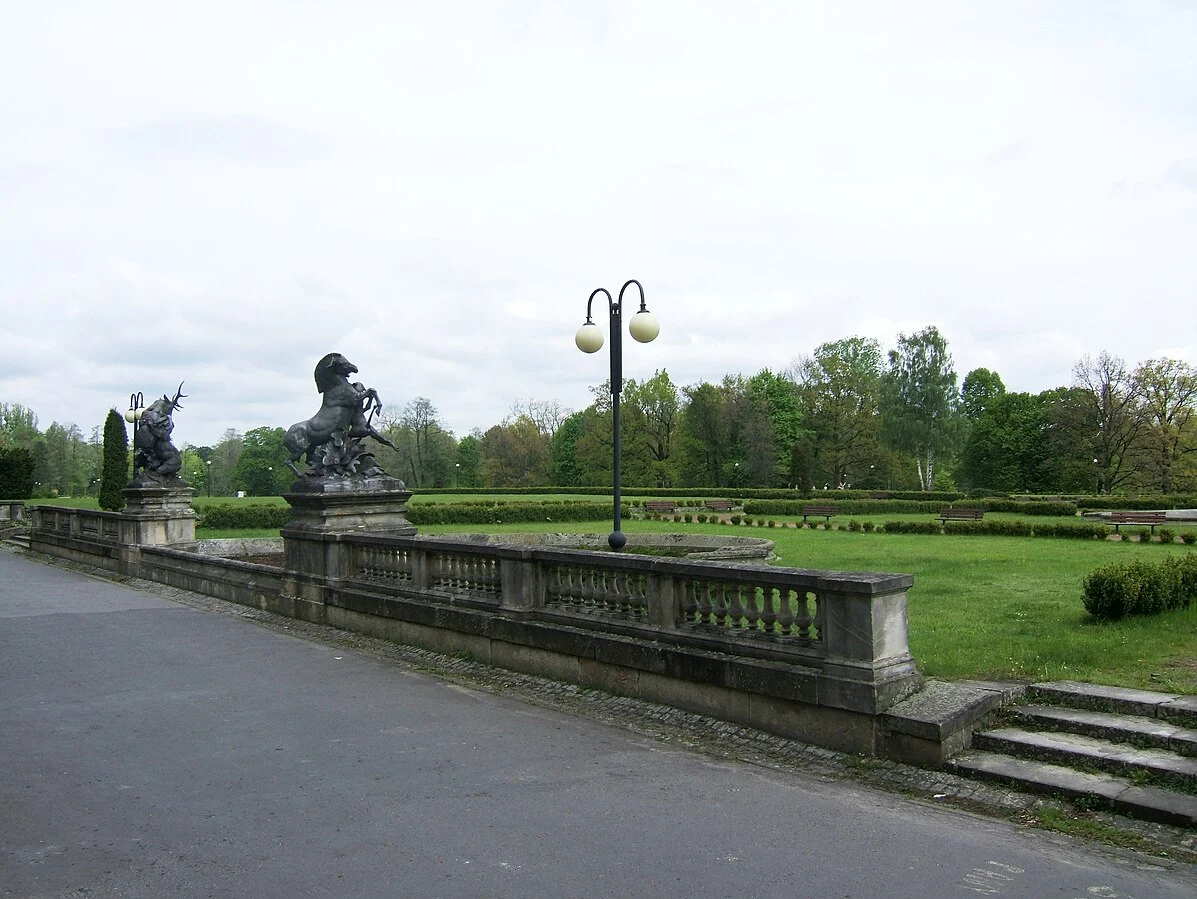
The park of Château de Neudeck, where the grand castle once stood. Source: Wikimedia
You can see all four giant statues at this link. Emmanuel Frémiet’s Three Graces fountain also graces the park after a highly successful restoration:
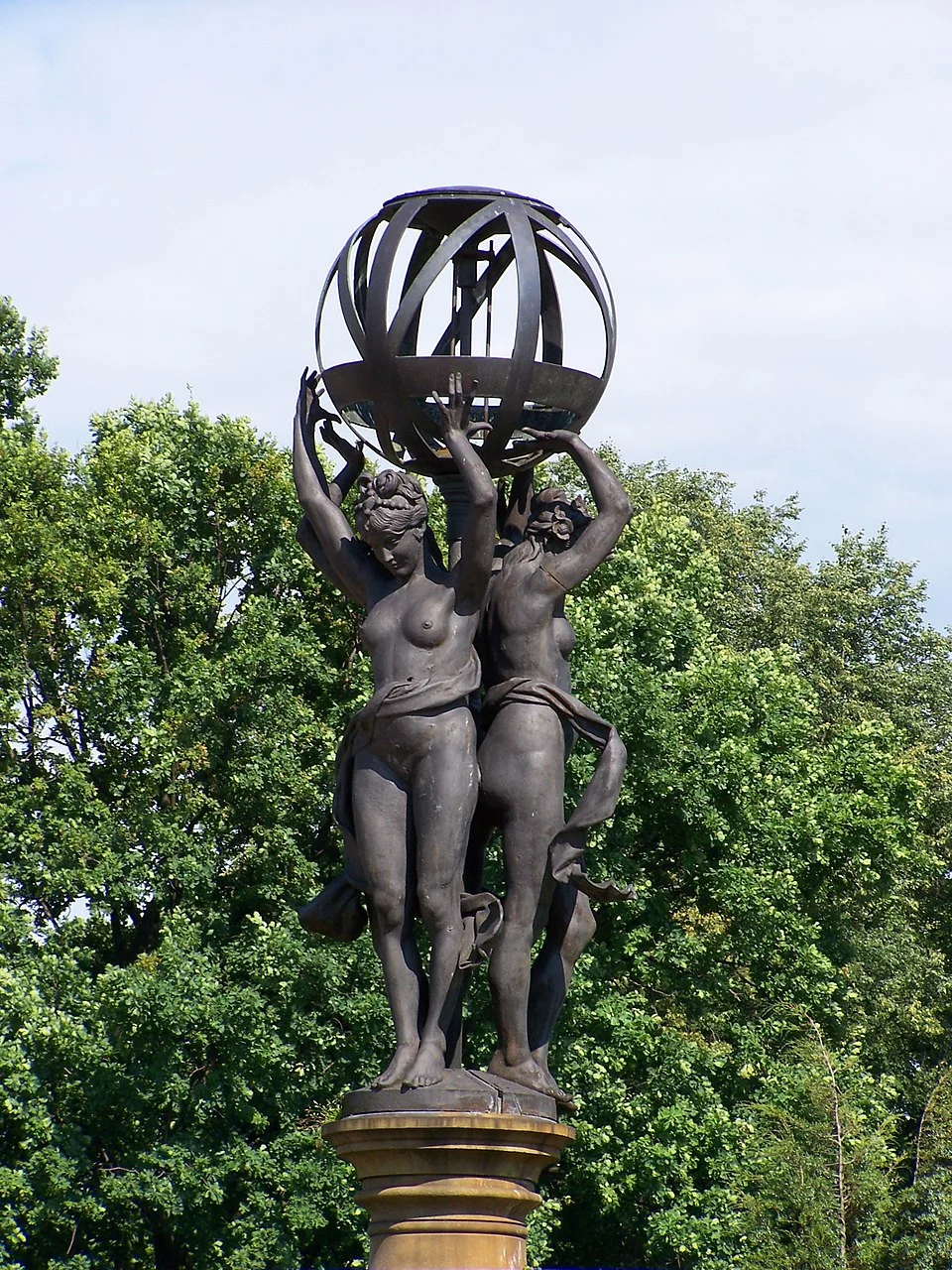
The Three Graces fountain. Source: Wikimedia
In the estate’s chapel, which was fortunately spared during the demolitions, the count and his two wives rest in eternal peace, though not the rest of the family. The chapel was built between 1895 and 1897, in the Neo-Gothic style, for religious services for the castle’s residents and the local population (not for burials). Today, the chapel serves as a Protestant church for the local community.
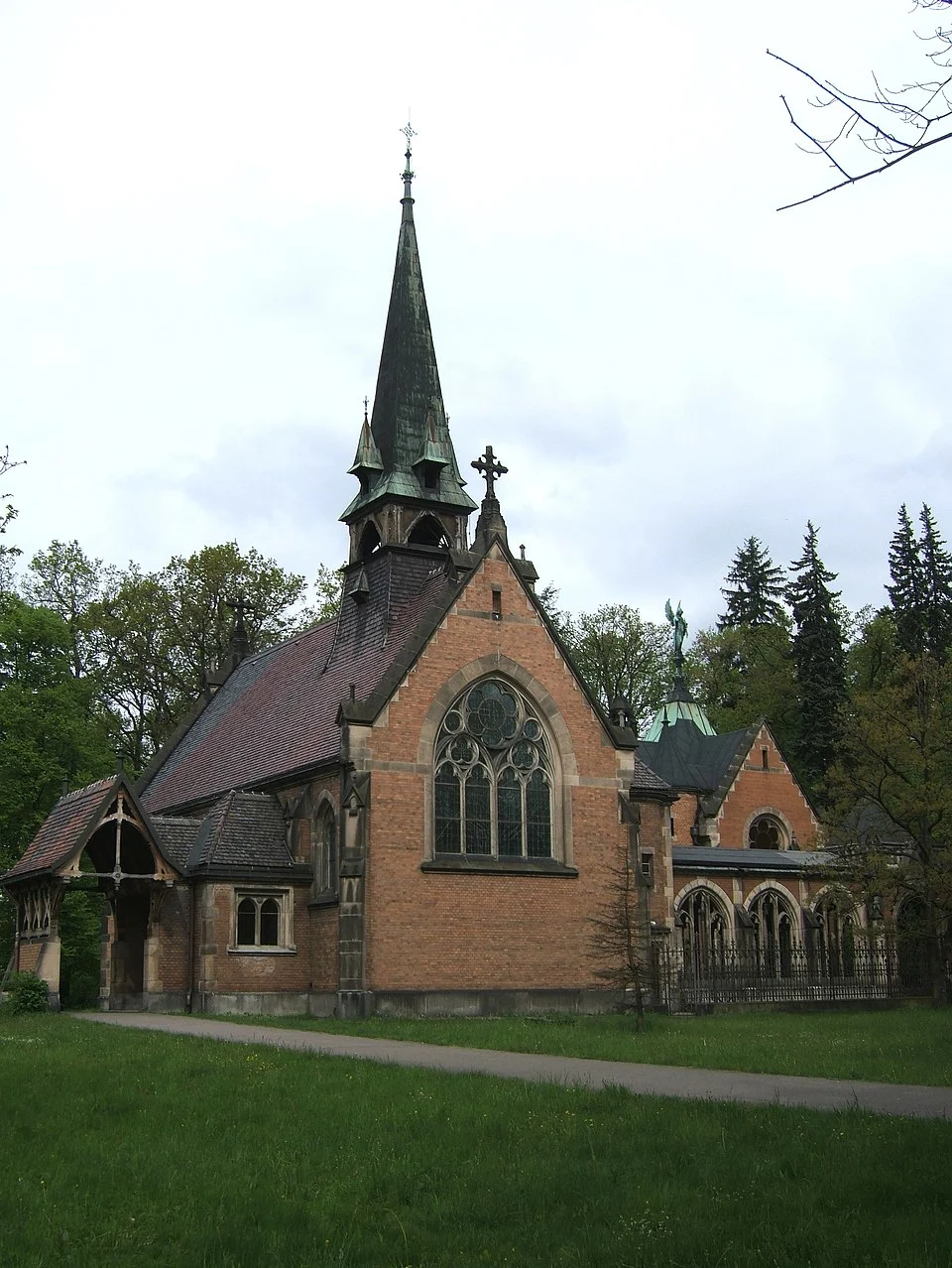
The chapel. Source: Wikimedia
The count sold the Château de Pontchartrain in 1888, four years after his wife’s death, to the businessman Auguste Dreyfus, who was considered the richest man in the world at the time. Auguste Dreyfus made his fortune importing guano from Peru to Europe, and you can read more about that at this link. Auguste Dreyfus’s second wife, a marquise of Peruvian and Spanish descent and granddaughter of one of Peru’s first presidents, ran a lifestyle at the château that seemed to be copied straight from the court of Louis XIV.
The Dreyfus couple’s children, two sons and two daughters, sold the château in 1932 to the Lagasse family of cattle ranchers, who sold it in 2019 to a real estate company specializing in castle restoration. The company kept the exterior unchanged but divided the château into eighty-six high-end apartments, most intended for buyers with substantial means. Eighteen of these apartments, located outside the château itself, are set aside for lower-income buyers. The park was purchased by the local municipality and will serve the general public.
The count sold the mansion on the Champs-Élysées, a symbol of his love for his first wife Blanche and their happy life together, in 1893 to Pierre Cubat, the famous French chef to the tsars Alexander II, Alexander III and Nicholas II. The chef opened a successful restaurant there that all of fashionable Paris frequented. But after the great fire at the Bazar de la Charité in 1897, which claimed the lives of more than 120 people, most of them from high society, he lost most of his clientele and went bankrupt.
In 1898, the mansion passed into the hands of a Swiss banker, and in 1903 to a private British club, Le Travellers Club, which carried out extensive renovations and had the building registered as a historic site in 1980. La Païva’s mansion, the only 19th-century mansion still standing in its original form on the Champs-Élysées, deserves that distinction. The club still holds the mansion today and allows visits.
The club’s 750 members are mostly successful businessmen and refined aristocrats, men only (a bit of irony, given who the mansion once belonged to), admitted through a member-recommends-member system. To join the club, candidates need two letters of recommendation written by hand by their sponsors. An approved candidate, whose application is confirmed by a ten-member admissions committee, must pay a substantial sum. To keep funding the club’s upkeep of the property, guided group tours are organized at the mansion. Given the high demand, you need to book ahead through the mansion’s website or through tour company websites. In the meantime, for those who want to see the inside of the mansion, here’s a short clip from a tour:
La Païva is also remembered in history for her jewelry, which she loved passionately. Two rare yellow diamonds, one pear-shaped weighing 82 carats and the other cushion-shaped weighing 102 carats, which the count gave to his wife Blanche, are known as the “Donnersmarck diamonds.” They were inherited by the count’s second wife, Princess Katharina, and were redesigned for her by the jewelry house Chaumet: she wore the first as a headpiece and the second as a brooch.
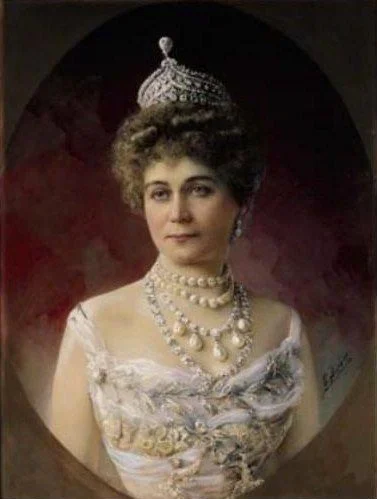
Princess Katharina. Photo in the public domain
In 2007, both diamonds were sold by the auction house Sotheby’s in Geneva, the first for 3.5 million Swiss francs (2 million euros) and the second for 5 million Swiss francs (3 million euros). Here’s a video from Sotheby’s for the occasion of the sale:
That same year, a necklace was also sold in Geneva by the auction house Christie’s for more than 2 million Swiss francs. The necklace featured 15 square, graduated emeralds from Colombia, their deep color set off by cushion-shaped background diamonds of matching size. The necklace was designed in 1882 by the jewelry house Boucheron for the count’s first wife, Baroness Blanche, and was redesigned in 1900 for his second wife, Princess Katharina. The background diamonds were an addition made for the second design and were not part of the original necklace. Here you can see a smaller image of the necklace from Christie’s website when it was offered for sale:

But at this link, you can see it in all its glory, along with full details, on the same website.
La Païva was a truly singular woman. Several biographical books, not to mention countless articles, have been written about her more or less hidden secrets and her turbulent adventures, about how men of high society across Europe fell head over heels for her, and about how, from the moment she left Moscow, she never stopped astonishing people with her relentless, determined and unwavering pursuit of wealth, fame and power.
Esther Blanche Lachmann, daughter of a poor Polish Jew; Thérèse, a Parisian streetwalker from Notre-Dame-de-Lorette; Madame Araújo, companion to a famous pianist now forgotten; the Marquise de Païva, a notorious courtesan with a salon at a mansion on Place Saint-Georges; Countess Henckel von Donnersmarck, wife of Bismarck’s cousin, who built her a mansion on the Champs-Élysées, bought her a country château near Paris, and finally settled her in exile at “Versailles of Silesia.” These are the many titles of the woman remembered in history by the name La Païva, one of the most famous courtesans of the 19th century.

La Païva, a photograph from the Donnersmarck family archive. Source: Musée des Beaux-Arts website, Rue de Rivoli, Paris
Visiting La Païva’s mansion
You can only visit the mansion on Saturday or Sunday mornings, when the private club is closed. Licensed guides regularly offer tours. Book a spot as soon as a tour is announced: demand is high and spots fill up immediately. Be quick! Look for tours online or in the Paris listings guide (Spectacles et Sorties à Paris, L’Officiel des spectacles), which also has a website.
Alternatively, I recommend checking out this website (Billetreduc), which posts notices about upcoming tours. Or also this website (PARIS CAPITALE HISTORIQUE).
FAQ
Who was La Païva?
Who built La Païva’s mansion?
What can you see today in La Païva’s mansion?
Related reading