
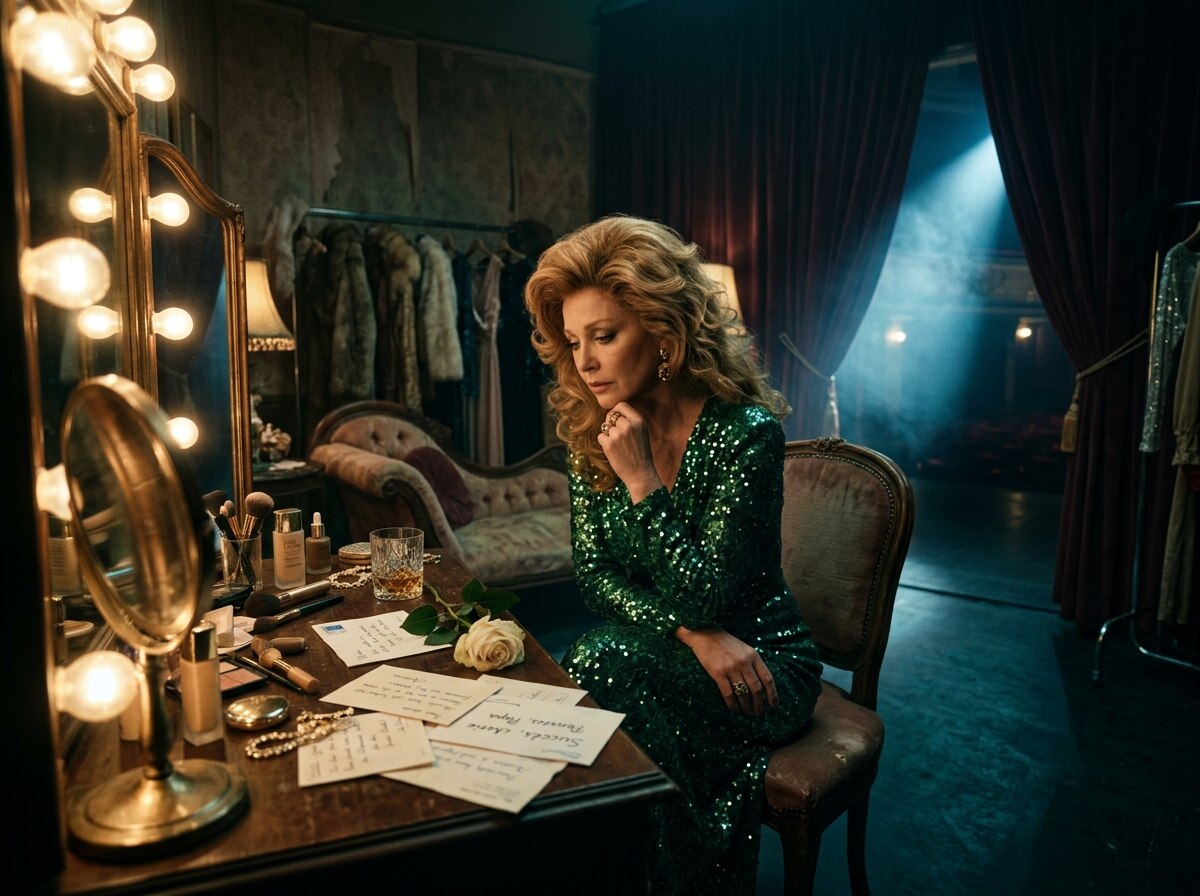
“You only had to hear her once to want her as a companion, both hidden and present, for your days and your evenings,” wrote the musicologist, poet and sailor Henri-Jacques, who twice circled the globe by way of Cape Horn, about Dalida. The little sister of Maria Callas (1923-1977), the cousin of Édith Piaf (1915-1963), the singing twin of Brigitte Bardot (born 1934): Yolanda Gigliotti, known by her stage name Dalida (1933-1987), chose to leave this life at the age of 54, as if to live on forever.
Her name is still on everyone’s lips. Books, plays, films and television programs are made about her all the time. New albums keep coming out, as though she were still here. Her grave, with its life-size statue, is always covered in flowers, gifts and letters. Place Dalida in Montmartre, with its bust of her at the center, has become a place of pilgrimage (touching the statue, “Sainte Dalida,” is said to bring luck). The dialogue with the star, Yolanda, Dalida, Dali, continues well beyond her physical disappearance.

The Life Story of Dalida
Childhood
Yolanda Gigliotti was born in 1933 in Cairo to an Italian family that traced its roots to a small, poor and isolated Calabrian village called Serrastretta. Her mother was a homemaker and seamstress, and her father was first violinist at the Cairo Opera. Yolanda was the only daughter among three children, with an older brother, Orlando, and a younger brother, Bruno. She was born cyanotic after a difficult forceps delivery and nearly suffocated. When she was ten months old, she came down with an eye infection. The neighborhood doctor recommended bandaging the infant’s eyes for forty days, which he claimed would guarantee a cure.
Yolanda couldn’t understand the sudden night that had fallen over her. She screamed, choked, turned blue, and tried to tear off the bandage, but her parents tied her hands down. Their hearts ached at the sight of their tormented child, but in those days, ordinary people didn’t question a doctor’s orders. The exhausted infant’s cries turned into sighs, and she finally fell asleep, her face stained with tears and drool. Her parents truly believed that after forty days of darkness their daughter would be completely cured. Her father improvised lullabies for her on his violin, and her mother sang to her. Music opened the gates of paradise for little Yolanda in that long, menacing darkness.
When the time was finally up, the bandage was removed. The infection had worsened, and her eyes were full of pus. Her efforts to find the light had left her with a squint in both eyes. The neighborhood doctor was helpless. Her shocked and furious parents turned to a specialist. A series of operations followed, but they couldn’t prevent a squint in one eye. Yolanda suffered from headaches and had to wear glasses with thick lenses. The girls at her Catholic school mocked her, but the nuns who taught there loved their serious, diligent student.
Yolanda found it hard to look at herself in the mirror, but deep down she knew, and her mother told her so plainly, that one day the ugly duckling would become a swan. In the meantime, her devoted, loving mother sewed her clothes from scraps of fabric. Money wasn’t plentiful: her musician father’s salary wasn’t large. Yolanda lived in constant fear that the darkness would return, and she needed a night light to fall asleep.
In 1940, Egypt entered the war. Fascist Italy and Britain were enemies. The second dramatic event of Yolanda’s life came the night her father was imprisoned by the British, along with many other Italians, in a detention camp, simply for being Italian. The man who came home three years later, after years of suffering, hunger and humiliation, was a broken man. As if that weren’t enough, Pietro, whose whole world had revolved around music, lost his position at the opera. His life was in ruins. The family suffered from his shouting, his fits of rage and his violence.
Pietro couldn’t hold on, and he died of a heart attack a year after his release, in 1945, at age 41. Twelve-year-old Yolanda was left without a father. The love-hate relationship between Yolanda and her father during this difficult period, and the guilt she carried from it, along with the impossible grief over her father’s death, would shape her adult life and her poor choices in partners. Violence and self-destruction would characterize the men Yolanda fell for at first sight. She herself would sometimes be prone to anger, her father’s voice seeming to burst from her own throat. Two years of Freudian psychoanalysis would help her push off the inevitable reckoning.
But in the meantime, with the future still ahead of her, the beautiful, elegant Yolanda worked as a model for the Douna fashion house. During this brief period, she learned to walk, to dress, to develop a personal style, to smile, to feel at ease on stage. In 1954 she was chosen Miss Egypt, and she caught the eye of a popular, successful local filmmaker, Niazi Mostafa, who cast her as a European nurse who wins the heart of a married Egyptian doctor and father in the film “A Glass and a Cigarette.” “Why don’t you call yourself Delilah?” the director suggested.
Yolanda, who had loved Bible stories since her school days with the nuns, adopted the name for herself. In another small role, in a film by a French director set in Egypt, “The Mask of Tutankhamun,” Yolanda-Delilah played a spy, a femme fatale. In both films she sang and danced. “You should go to Paris,” advised Marco de Gastyne, the French director. “I’m sure you’ll find work there.”
Dalida in France
On December 24, 1954, Yolanda made her dream come true and flew to Paris. The beginning in the big city wasn’t easy. Yolanda lived in a small, cold room and ate hard-boiled eggs. Luck was on her side, and she performed at two cabarets on the Champs-Élysées. The writer and screenwriter Alfred Machard suggested she change her name from Delilah to Dalida. Better to break free of the biblical image, from the inevitable association with Samson. Two D’s instead of two L’s: the D stood for Dieu le Père (God the Father). Machard himself had no idea how close to the mark he’d hit.
On April 9, 1956, Dalida took part in a talent competition for young performers at the Olympia. Eddie Barclay (1921-2005), owner of a record company, and Lucien Morisse, head of the young radio station Europe 1, both men who would become legendary figures in their field, tastemakers and marketing geniuses, were in attendance. The exotic charm of the young, inexperienced singer worked its magic.
Lucien and Eddie took her under their wing. Her first records came out, and Lucien played her songs constantly on the radio station he ran. “Bambino,” a French version of a 1956 Neapolitan song about the suffering of a boy in love with a woman (a hint at the impossible love for his mother), sold half a million copies. Every one of Dalida’s songs, singer and actress that she was, was a miniature drama, a story staged in just a few minutes.
Bambino
Between Lucien Morisse and Jean Sobieski
Yolanda would indeed go on to become a generous, comforting mother figure to her partners and friends: a child craving love, helpless, and at the same time an unattainable idol in the imagination of her fans, all at once. Lucien Morisse was born in 1929 and lost his father in the Holocaust. Like Dalida, he too was orphaned young. Married and the father of a daughter, he decided to divorce his wife in order to marry Dalida after five years of living together with the star. But Dalida was too young to marry.
A few months later, the couple separated, but they remained friends in heart and soul until Lucien’s suicide by gunshot at age 41. Dalida, grateful to the Pygmalion who had made her a star, left him the first apartment she bought, on the top floor of an elegant 1940s building in the 16th arrondissement. Lucien never left the apartment at 7 Rue de l’Ancre. He lived there with his third wife, with whom he had two more daughters, and it was there that he ended his life.
Lucien was consumed with Dalida’s professional success and building her career, while she, four years younger, was thirsty for life. Eddie Barclay, before the friction between Lucien and his wife, invited the singer to the Cannes Film Festival to have a little fun. At a dance party, Dalida met a beautiful, carefree young blond man, Jean Sobieski, whose talent as a painter had not yet been discovered. For the time being, his only occupation was enjoying every moment, between the Riviera and the Left Bank of the Seine.
Dalida left the apartment on Rue de l’Ancre and rented an apartment in the elegant Neuilly district to live there with Jean. Her younger brother, three years her junior, Bruno, changed his name, on Lucien’s advice, to that of his older brother, Orlando. Starting in 1966, he would become the manager of his adored sister and watch over her like a guardian angel. Her cousin Rosie came from Cairo to serve as Dalida’s secretary and close friend.
Lucien Morisse did try to slow down Dalida’s career in response to her relationship with Jean, but things improved despite their divorce in 1962. Her appearance at the Olympia as the headline star in December 1961 was a great triumph, even though her many enemies expected her downfall. The two thousand spectators were captivated by her charm. The cheers were thunderous, and Lucien Morisse, sitting pale in the audience, was torn between conflicting emotions, but he was happy for her nonetheless and proud of his creation.
At the end of 1961, Dalida bought a private mansion in the heart of Montmartre, four stories and a garden, where she would live until the end of her life and where she would host her many friends. In the meantime, she moved in with Jean Sobieski, who decorated the walls of the house with his paintings. Dalida invested heavily in decorating her beloved fortress, a safe harbor. She was in love with Montmartre and with Rue Lepic, climbing up to her house, with its shops and restaurants, somewhat Middle Eastern, which reminded her a little of the city of her childhood.
Jean Sobieski left the house at her request after about two years together. The handsome young man, a stranger to the world of show business until he met Dalida, used his connections with her to launch a career as an actor. His first role was in the film “Striptease,” in which he played the lead opposite the German singer Nico (1938-1988). Dalida celebrated the occasion at her house and hired the dancers of the Crazy Horse to perform. But Jean’s charm, despite his promise to go back to painting, had faded. Jean gave in easily to the lure of the glamorous world.
And maybe she shouldn’t have left Lucien Morisse? Maybe she should have started a family with him? Dalida loved children so much. Even her brother Orlando, the person closest to her along with her cousin Rosie, wasn’t sure that leaving the great talent scout and radio man had been the right move. A life shared with Lucien, had it continued, might have spared his sister her future suffering. If only she’d had a son with him… The song “Luca,” from a later period, 1983, is heartbreaking and devastating:
Lucas
Lucien Morisse broadened Dalida’s horizons in light music and entertainment. Jean Sobieski opened the world of art and painting to her. Christian de la Mazière (1922-2006) talked to her about books. The agent and journalist, who had also won the hearts of Juliette Gréco (1927-2020) and Brigitte Bardot (born 1934), had a dark past. He had chosen to enlist in the ranks of the Waffen-SS, the military branch of the SS that fought alongside the Wehrmacht, under the command of Heinrich Himmler (1900-1945).
De la Mazière tried in vain to pass himself off as a forced laborer. His deception was discovered, and in 1946 he was sentenced to five years in prison. Two years later he was pardoned by President Vincent Auriol (1884-1966) and launched a career as a talent agent and film critic, close to famous figures such as Jean Gabin (1904-1976), Michel Audiard (1920-1985), René Clair (1898-1981) and Pierre Brasseur (1905-1972). His romantic relationship with Dalida would come to an end in 1966.
Dalida’s Israeli Connection
In 1965, Dalida performed in Casablanca, Morocco, in front of ten thousand spectators. When she sang “Hava Nagila,” the second song in her set, the chief of police came up on stage and ordered Dalida to stop the show. Israeli songs were forbidden in the country. Dalida firmly refused and continued. A small part of the audience was pleased and applauded, but most were furious and threw tomatoes and eggs at the singer and her orchestra. The next day, police came to question the singer at her hotel, and part of her fee was withheld to compensate the angry crowd.
But none of that spoiled the good mood of the brave woman, who joked about the omelet her drummer made with his drums. Despite boycott threats from Arab countries, Dalida continued to sing “Hava Nagila” and even added “Hine Ma Tov” to her repertoire. In her performances in Israel, she was received with great enthusiasm by her fans. Many of her songs are full of cheerfulness and good humor. The song “Comme disait Mistinguett” is steeped in playful self-irony. Here is the song by Mistinguett, the famous cabaret singer of the 1920s and 1930s, who inspired Dalida’s own version:
C’est vrai (True)
Here is Dalida’s own, very personal version:
Comme disait Mistinguett (As Mistinguett Used to Say)
Dalida and Luigi Tenco
In 1966, friends of Dalida’s from her Italian record label suggested she meet a talented young songwriter, composer and singer, Luigi Tenco, who they believed could shake up the scene with his bold, original protest songs, so different from the saccharine hits dominating the charts. The rules of the Sanremo Festival required every Italian singer presenting a song to be paired with a foreign, international singer who would perform the same song. The Italian team arrived at Dalida’s home with the 28-year-old Luigi, hoping to persuade her to take him under her wing at the festival.
Between Luigi, who had grown up without a father and was hungry for recognition, and the star, a complicated relationship took shape. Dalida fell for the tormented, good-looking young man at first sight, drawn in by his smoldering gaze (how could she not be), and she would do everything she could for the success of his cutting song “Ciao amore ciao.”
Luigi’s own feelings and motives were far less clear. His song was excellent, but it was rejected early on by the festival organizers, who asked Dalida to choose a different song from among the thirty entries in the competition. “If you don’t accept Tenco’s song, I won’t take part in the festival,” she told the judges, who gave in to the star. Tenco, of course, knew nothing about the secret negotiations between Dalida and the judges.
Luigi Tenco was born in 1938 into a wealthy family that owned a farm and vineyards. His father, Giuseppe Tenco, was killed just months before Luigi’s birth, kicked in the temple by a cow during milking. Some say Giuseppe was drunk at the time of the accident that took his life. Luigi had an older brother, Valentino, nine years his senior. A few years after Luigi was born, one of the neighbors told the stunned boy that the father he had never known, and whose name he carried, was not actually his father.
Luigi had been born from a brief affair his mother had with a young student. His world suddenly collapsed. He felt betrayed. The once-cheerful boy became withdrawn, suspicious and brooding. Like Dalida, he too could not sleep without a night light. As a young man he won the hearts of many women and launched a career as a musician and actor.
On the Sanremo Festival stage, Luigi trembled with fear. Before the performance he had taken no small amount of tranquilizers and alcohol. As if that weren’t enough, he wasn’t used to singing with a symphony orchestra backing him. His performance that fateful evening, January 27, 1967, was the worst he had ever given. Dalida hoped to save the song, and indeed her own version was warmly received. But the audience was likely cheering for Dalida, not for a song that never really fit the commercial spirit of the festival to begin with. Either way, Tenco’s song failed to make it to the final round.
Ciao amore ciao
Luigi refused to attend the official dinner marking the end of the day and went up to his hotel room. Dalida found him fifteen minutes later, sprawled on the floor next to the bed, his shirt stained with blood. Luigi had shot himself in the temple. There were suspicions of murder, but the case was closed. In a note he left behind, Tenco wrote that his suicide was an act of protest against the wrong choice made by his Italian audience, to whom he had dedicated five years of his life. Not a single word for Dalida. “Our lives turned into hell,” her brother Orlando would later say of that tragic period.
Rosie never left Dalida’s side, not for a moment. So Dalida devised a trick. She told Rosie she needed to fly to Turin to meet Luigi’s uncle (who did not actually exist). Rosie and her husband Ivan accompanied her to the airport, and the moment they turned their backs, Dalida rushed by taxi to a hotel in the Champs-Élysées district, the same hotel where she and Tenco used to meet whenever he came to Paris (Dalida and Luigi had agreed to keep their affair secret). The receptionist recognized her but suspected nothing. Dalida ordered a bottle of mineral water and asked not to be disturbed under any circumstances, for any reason.
The next day, the hotel’s experienced housekeeper, who had worked in luxury hotels for 40 years, couldn’t shake a feeling of unease. She had been told not to disturb the star, but at 10 p.m. she decided to ignore the instruction. When she opened the door, she found Dalida lying on the bed, pale, almost blue, dying, empty tubes of sleeping pills beside her.
Dalida left three letters. One to her beloved mother, a second to her trusted friend Lucien Morisse, who would have to break the terrible news to the family and guide them through what followed, and a third to her audience, in which she explained that life without Luigi Tenco would be unbearable. She was going above to finish what she could not accomplish on earth. There was no hatred in her heart, not toward herself and not toward anyone else.
To this day, the French press presents Tenco and Dalida as Romeo and Juliet. The Italian press, on the other hand, paints a very different picture, having published Tenco’s letters to another young woman, Valeria, whom he had known even before meeting Dalida. Valeria was pregnant (she would soon lose the baby after being hit by a car), and Tenco, deeply in love with her, wanted to marry her. One evening Valeria walked into a restaurant in Rome and found her fiancé Luigi there with Dalida.
She decided to cut off all contact with him, but Tenco wouldn’t let it go. He sent her countless letters begging forgiveness for having let himself be seduced by the great star, swearing that she, Valeria, was the only one he loved. To hell with Sanremo: he wanted to go with her, with Valeria, to Kenya, in Africa, after the festival, to spend time together and figure out the meaning of life. He had told Dalida everything. Life without Valeria wasn’t a life at all.
Dalida and her friends from the Italian record label, however, maintained that she and Tenco had been about to get married in April. Valeria, Luigi, Dalida, the Sanremo Festival: the truth behind the events and the people involved is tangled and hard to untangle. To what already sounds like a soap opera, you can add the cliché: Tenco took his secret to the grave. Clichés, too, come from somewhere in real life. Orlando would later say he never suffered as much as he did the day he saw his sister struggling to breathe, her body wracked with convulsions. Twenty years later, when Dalida would repeat the act and this time succeed, his suffering would not be as great. A grief that deep, you only live through once.
A spiritual rebirth
Dalida made a miraculous recovery after six days in a coma. In a long and painful operation, healthy skin was grafted from her thighs and groin down to her heel, where the infection had spread. Orlando and their mother came to live with her in the four-story house in Montmartre. The apartment Dalida had bought for her mother was now given over to her older brother and his wife, who had just had a son. Dalida’s brother guessed her wish and named the newborn Luigi. Seven years later, his brother Roberto was born.
In the halls of Italian television, Dalida met a poor philosophy student, Lucio, who idolized Luigi Tenco. Lucio came on as an extra for Dalida’s television show, but the world of glamour was foreign to him. The star paid for his studies but stopped answering his passionate letters. The age gap, Lucio was twelve years younger than her, bothered her. When she discovered she was pregnant, she decided to end the pregnancy. Orlando and Rosie thought motherhood might have helped Dalida, but what was done could not be undone. And worst of all, from then on Dalida would never be able to have children.
Dalida tried to find comfort for her soul in books. She had left school at 14 and was hungry for knowledge. Pierre Teilhard de Chardin (a Jesuit priest, scientist, theologian and philosopher), Tagore, Freud, a biography of Jung. Her thirst for Eastern wisdom led her to a lecture by Arnaud Desjardins, known for his book “The Path of Wisdom,” an expert in Hinduism, Afghan Sufism, Tibetan Buddhism, Zen and more. He became her spiritual teacher and her partner for about three years, until 1970, to the great dismay of his wife, the mother of his two children.
Dalida made many trips to India with him to stay at the ashram of Swami Prajnanpad. The swami discouraged his student Arnaud Desjardins from divorcing his wife to marry Dalida: “A father does not divorce.” As for Dalida, he told her to keep entertaining the masses, to keep bringing them joy through her music: “That is her purpose.”
The breakup with Arnaud Desjardins, the suicide of Lucien Morisse, and the sudden death of her mother, three events that all happened close together. Dalida coped, and even found herself comforting and encouraging her younger brother, who had been very close to their mother.
The place that spirituality had held at the center of Dalida’s attention was now taken by the subconscious. An experienced professional opened her eyes to Freud’s theories, Dr. Guy Pitzalis, a psychoanalyst and endocrinologist who lived in Montmartre and owned a villa in Saint-Tropez. He and his wife Jacqueline, deeply embedded in the world of show business, would remain her friends for years to come. Dalida could call Guy Pitzalis even in the middle of the night.
She went back to reading Freud’s writings, already worn from so much flipping through, filled with notes in her own handwriting. Jung fascinated her too. Psychoanalysis with Dr. Miroz brought her both suffering and relief. Under his influence she read “Thalassa,” a book by the Hungarian psychoanalyst and student of Freud, Sándor Ferenczi.
Dalida and the “Count de Saint-Germain”
Richard Chanfray, the most colorful of all Dalida’s men, lived by her side for nine years, from 1972 to 1981. He called himself the Count de Saint-Germain and presented himself as an alchemist who could turn lead into gold. The bitter truth was that Richard, after a difficult childhood, had spent six years in prison for assaulting his employer at the bar where he worked, in order to rob him. The books he read in prison about the adventures of the Comte de Saint-Germain, a mysterious and charismatic alchemist, a scholar well versed in history who told tales straight out of the Arabian Nights, a brazen man blessed with talents who had won the trust of Louis XV, fired up his imagination.
Like the persona he adopted to dress up and cover for reality, Richard, a favorite with women, was also talented in many fields. He tried his hand at writing, music, acting and painting, and he particularly excelled at sculpture: the giant metal animals he crafted were spectacular. But the alchemist’s dream never came true. Dalida did everything in her power to help him build a career as an artist and support himself, but time and again Richard destroyed everything he had nearly achieved.
In the early years, Dalida, successful and at the peak of her career, flourished alongside the handsome, entertaining man, rediscovering her femininity. She built a spectacular villa in Corsica, high above Marina di Fiori, overlooking the Bay of Porto-Vecchio, to spend time there with her partner whenever she wasn’t busy touring the world.
Dalida generously hosted her friends at the grand, curved estate, which included a living room with Oriental sofas, six rooms each with its own bathroom, a pool, terraces and an enormous garden. A tragic event would shatter that peaceful run. On June 18, 1976, Dalida and Richard came home from an evening out to the house in Montmartre and were surprised to see a light on in the room of their Portuguese housekeeper, Maria. She had requested, and been granted, a 10-day vacation.
Richard rushed upstairs, armed with a rifle. When he opened the door, he found a man standing there in his underwear. Maria had given the key to her room to her young lover, who had recently arrived from Portugal, without telling the lady of the house. The young man struggled to explain his presence, not least because he barely spoke French. Richard fired, seriously wounding the unfortunate young man in the stomach.
At trial, Richard claimed in his defense that he hadn’t meant to shoot and was sentenced to a year in prison, suspended, along with a fine and compensation to the young man, whose life was saved after a series of operations but who remained partially disabled.
At Richard’s request, since he was never comfortable in Montmartre, Dalida bought land in Neuilly and built a magnificent villa around an interior garden. But Richard kept sliding from one low point to the next, and his relationship with Dalida kept deteriorating. He humiliated her in public and brought his conquests into her home while she was away.
Dalida finally decided to end the relationship and asked him to leave the house. Richard begged, cried, and made threats, but this time Dalida stood firm. About two years after the breakup, in 1983, buried in debt up to his neck from a reckless, extravagant lifestyle, he took his own life in a rented car near Saint-Tropez, along with his girlfriend.
Mitterrand’s cynical use of her, and the return to Cairo
The gap left by the breakup with her companion was filled when Dalida renewed her friendship with François Mitterrand. She had already met him in Marseille in 1972, at a gala held by the city’s mayor at the time, Gaston Defferre. Mitterrand, impressed by the singer’s show, asked to meet her afterward.
Now that he was running for president, why not enlist the crowd’s favorite singer, who sold millions of albums, for the campaign? Dalida, out of her friendship with François Mitterrand, agreed to help, to the dismay of her two brothers, especially the eldest, who warned her of the dangers of taking such an explicit political stand, particularly since Dalida belonged to no political camp at all.
And indeed, the reactions weren’t long in coming. The press speculated, stirred the pot, mocked, and nicknamed Mitterrand “Mimi Lamorozo” (a play on the international hit “Gigi l’Amoroso”). Orlando always vigorously denied any rumors of a romance between his sister and the woman-loving future president. Mitterrand did court her, yes, but she turned him down, and according to Orlando, only friendship and mutual admiration existed between them. The biographers suggest it’s likely Dalida did fall under Mitterrand’s spell. What’s certain is that Dalida spared no expense entertaining him, and the future president made good use of it.
Captivated by Mitterrand’s charm and intellect, the beloved singer opened the doors of her Montmartre mansion to the future president and his circle of intellectuals, hosting lavish dinners in their honor (François loved seafood), while she soaked up conversations on subjects that had until then been foreign to her.
When Mitterrand was elected president in 1981, Dalida was bitterly disappointed. After the intoxication of his first months in office, he no longer needed her. His entourage had made good use of the singer’s popularity to help his career, and now, by a cruel irony, the press began treating her as the new president’s protégée, as if she hadn’t built her own career through her own efforts and reached the top during earlier eras, under de Gaulle, Pompidou, and Giscard d’Estaing.
For the first time in her life, Dalida felt that her place wasn’t in Paris, and she set out on a tour abroad that lasted more than a year. When she returned home, she suffered another disappointment, this time from a young, handsome Egyptian-French pilot who ended their relationship after a year together. He had used his connection to the star to land an acting role in a film, and after that he vanished from her life.
A few months before her death, Dalida gave a highly acclaimed lead performance in the dramatic film “The Sixth Day” by the great Egyptian director Youssef Chahine, based on a novel by Andrée Chedid (mother of the singer and director Louis Chedid). Yolanda’s life as an artist had begun in an Egyptian film and would end in one too. Youssef Chahine had first met Yolanda on the set of “Le Chiffon Rouge” and wanted no one but her for the lead role in his current film, some thirty years later.
At the premiere in Cairo, an ecstatic crowd, men, women and children, packed the balconies and the streets, cheering her name, throwing jasmine flowers at her car, trying to touch her hair. Santa Dalida. Dalida was regarded as a kind of saint, since her fans believed she had returned from the world of the dead to the world of the living after her suicide attempt at a hotel near the Champs-Élysées.
An orchestra played her songs. As her car passed the modest house where she was born, tears welled up in her eyes. This would be her final triumphant tour. Her bodyguards, fearing for her safety, smuggled her into the movie theater by truck. The next day, Egyptian newspapers would describe her entrance into Cairo as Cleopatra’s entrance into Rome.
The end
Dalida felt that the crowd’s love, her public success, could never match the success she longed for in her private life, in her love life as a woman. Before leaving for the filming in Cairo in 1985, she met a doctor named François Naudy. Dr. Naudy, an internist at a Paris clinic since 1981 who had also studied philosophy, had published several books on scientific, philosophical and literary subjects. After a few happy months, François Naudy’s behavior changed: he avoided her invitations, canceled plans at the last minute. He did give in to Dalida’s pleading and came to stay at her house in Corsica, but shortly after his arrival, he received a phone call telling him to return to Paris urgently. Was it a sadistic twist of timing? On a Friday evening, when they were due to go together to the musical “Cabaret,” he called her and, as usual, canceled on her. François Naudy always denied any connection to Dalida’s suicide. “We were friends. It’s possible another man was involved.”
François Naudy’s cancellation that Friday evening was the final straw. Two eye surgeries that same year stirred up painful childhood memories. For months already, Orlando had been worried about his beloved sister’s behavior. Her interest in life seemed to have stopped. Age weighed on her. She was tired of dancing, and perhaps tired of singing too. The light in her eyes had gone out. Playing the lead role in the dramatic film, stepping into the skin of an Egyptian woman with a tragic fate, a character so far from Dalida and yet so close to her, added to the exhaustion that had taken hold of her. Dalida wandered from room to room in her mansion, fleeing the sunlight she had loved all her life, withdrawing into solitude, shutting herself away. What more could life possibly bring her.
On May 3, 1987, Dalida, Yolanda, was found lifeless in her bed, having swallowed sleeping pills with a glass of whiskey. Once again, she had sent her loved ones away with a trick: “I’m going out to see a show, then dinner at a restaurant. I’ll be back late. Don’t disturb my sleep tomorrow until late.” She drove off in her car, circled around, and returned to the empty house. Next to the empty glass lay a note: “Life has become unbearable for me, forgive me.” For the first time in her life, Yolanda didn’t turn on her night light, and she fell asleep in the dark.
Through all those years of unbroken personal suffering, but also happiness, Dalida loved life in spite of everything and savored its pleasures. The singer’s career never stopped soaring, taking flight, evolving, changing, thriving. Dalida won every possible prize and honor, sang about two thousand songs in many languages, sold more than one hundred fifty million records around the world, and performed in every corner of the globe.
Dalida’s songs
The 1960s
In the 1960s, when the twist craze arrived and many other singers failed to survive the shift, pushed aside by younger rivals, Dalida adapted the new trend to her own style, even though she didn’t actually like the twist, and scored hit after hit with songs like “Itsi bitsi petit bikini” and “Petit Gonzales”:
Itsi bitsi petit bikini
Petit Gonzales
In 1959 Dalida recorded “Love in Portofino,” celebrating the beauty of Portofino, a picturesque little seaside town in the province of Genoa, Italy. The story behind the song shows how everything Dalida touched turned to gold. It also shows how thin the line between success and failure can be. And Dalida knew, this time with the help of Eddie Barclay, the legendary record label owner, how to cross that line.
Love in Portofino
At the time, Portofino was still largely unknown. Dalida had fallen deeply under its spell during a visit there in 1958 with Lucien Morisse. The Italian duo, lyricist Leo Chiosso and composer Fred Buscaglione, had released the original song that same year, mostly in Italian with one recurring line in English: “I found my love in Portofino.” The composer and singer Fred Buscaglione performed it first.
French lyricist Jacques Larue took notice of the song and reworked it entirely into French, with a different text and a different title. The French singers who performed it had no success with it. Then producer Eddie Barclay stepped in and secured the song for Dalida. Jacques Larue rewrote the French part, trimming it down to a minimum so it would serve as an addition to the original Italian song with its recurring English line. Dalida performed it in three languages, Italian, English and French, in the summer of 1959, and the song conquered the European market and became a commercial hit. Experts consider it a masterpiece of the singer’s early repertoire. Despite dozens of other recordings, the chart-topping single remained forever tied to Dalida and even gave its name to her sixth album, released at the end of that year.
Shortly after the single came out, Portofino became a popular destination for couples in love, captivated by Dalida’s spellbinding voice. In 1960, the mayor of Portofino thanked Dalida for her contribution to tourism in the town. The song truly became a symbol of the seaside town of Portofino. As we said, everything Dalida touched turned to gold.
The 1970s
In the 1970s, Dalida’s repertoire grew richer with songs carrying more serious, even tragic, lyrics. Her spellbinding performance of Serge Lama’s song “Je suis malade” placed her in the same league as Édith Piaf (1915-1963):
Je suis malade
Serge Lama, who also performed the song himself, owed much of its success to Dalida. Still, the singer, with her wide-ranging repertoire, kept singing her lighter, popular hits too. “Il venait d’avoir 18 ans,” an original composition, became a massive success:
Il venait d’avoir 18 ans
The song, about a one-night love affair between a young man and an older woman twice his age, echoed Dalida’s own story: at 34, she had become pregnant by a 22-year-old, Lucio. That love story ended dramatically when, 15 years after the pregnancy was terminated, Dalida learned she would never be able to have children because of it. She sang the song in six languages: French, English, Italian, Spanish, German and Japanese. It was an international success.
That same year, 1973, Dalida and Alain Delon released “…Paroles… Paroles…,” a song whose backstory offers a chance to debunk the urban legend of a passionate romance between the two. Dalida and Delon first met in 1956 in the stairwell of a building on Rue Jean Mermoz, near the Champs-Élysées. They each lived, separately, in a shabby attic room. Both were broke and waiting for their big break. Every so often they shared a hard-boiled egg for dinner, and sometimes Delon walked Dalida to job interviews. When luck finally smiled on each of them, they drifted apart, only to meet again about ten years later, in 1963 in Rome: both barely thirty and already stars, each in the city for their own work. They spent a few nights together and parted again as good friends.
Ten years after that brief romance, when Dalida was offered “…Paroles… Paroles…,” a French adaptation of an Italian song, she immediately thought of her friend Delon, who of course did not refuse. The two recorded the song, which became an international hit. Delon felt deep pain when he learned of the suicide of his friend Dalida.
…Paroles… Paroles…
In 1977, Dalida sang “Salma ya Salama,” written in 1919 by the Egyptian composer and singer Sayed Darwish. The French version also came with an Arabic version, as well as versions in other languages (Italian, German and Spanish). Dalida sang in Arabic, to an Eastern rhythm, an Egyptian song recorded in a modern Western arrangement. On November 19, 1977, when Anwar Sadat landed for his historic visit, he was welcomed, among other things, to the strains of “Salma ya Salama.” Dalida wept with emotion. To bridge two beloved countries, to be a singer of peace: there was no greater happiness for her than that.
Salma ya Salama
The 1980s
In the late 1970s and through the 1980s, Dalida was the first French artist to embrace the disco movement. At 47, she learned to dance in the new style and reinvented herself with a dazzling disco show, in sparkling, tight-fitting outfits and deeply slit gowns. She was welcomed with enthusiasm at Carnegie Hall in New York and scored huge triumphs in a series of impressive shows at the Palais des Sports in Paris, backed by 11 dancers and 30 musicians. The dazzling show included 12 costume changes: Broadway, French style! Among her many songs in the new genre, one stands out as a sequel to “Gigi L’Amoroso,” called “Gigi in paradisco.” Gigi L’Amoroso, the Neapolitan singer beloved by women, who returned disillusioned from America, was murdered by one of his many lovers and is now found in paradise:
Gigi L’Amoroso
Gigi in paradisco
Record sales declined somewhat, but Orlando had many plans in the works, and the one closest to coming together was a musical comedy in which Dalida would play Cleopatra. But the star decided otherwise. In her famous song “Mourir sur scène” she declared, publicly and unapologetically, that just as she had been the master of her choices in life, she would be the master of her own death. And her equally famous song “À ma manière” expresses a similar idea:
À ma manière
Enjoyed the article? Want to read about more singers?
Here are a few articles by Dr. Orna Lieberman that might interest you:
- Michel Delpech, the troubadour who sang from the heart
- Léo Marjane: French singer, music hall legend
- Michel Berger: everything for the music
- A fountain of youth, French style, served by Charles Trenet, Herbert Pagani, Julien Clerc, Étienne Daho and others
- Through fire, water and beyond: chansons for a friend
- Johnny Hallyday: a short history of France’s rock idol
- A dark fate: the story of rock singer Bertrand Cantat
- Tormented loves, healing and redemption in French songs
- Joe Dassin, an American singer in Paris, triumphs and torments
- Yves Thouati, the Dubdervan band and the clarinets of Marseille
Related reading