
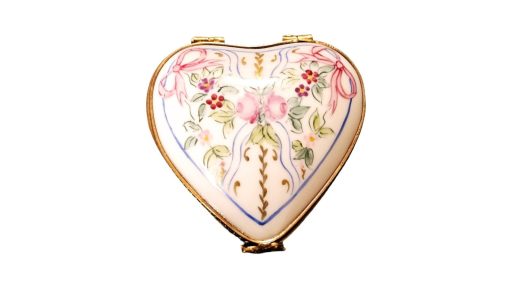
Picture a lady of the French court in the 1770s. Her gown is silk, her hair is powdered and piled high, and tucked into her pocket is something no bigger than a walnut: a tiny painted box. Inside might be a few mouches, the little black taffeta beauty patches she pressed onto her cheek. Or snuff. Or a few sugared pastilles to sweeten her breath.
Small boxes were everywhere at Versailles. Snuffboxes (tabatières) were the gentleman’s accessory of the century, and kings handed out jeweled ones as diplomatic gifts. Patch boxes (boîtes à mouches), pill boxes and bonbonnières followed the same fashion. They were made of gold, enamel, tortoiseshell, lacquer and, more and more, porcelain.
The white gold of the Limousin
For most of the 18th century, France could not make true hard-paste porcelain, the kind China had perfected centuries earlier. The missing ingredient was kaolin, a pure white clay. In the late 1760s, deposits of it were found at Saint-Yrieix-la-Perche, south of Limoges. Within a few years, workshops in Limoges were firing hard-paste porcelain, and in 1784 Louis XVI bought the Limoges manufactory and attached it to the royal works at Sèvres.
Marie Antoinette loved porcelain. Her husband commissioned a famous Sèvres service for her dairy at Rambouillet. The royal taste for delicate, painted objects set the fashion for the whole country, and the little box became a symbol of French refinement.
After the Revolution
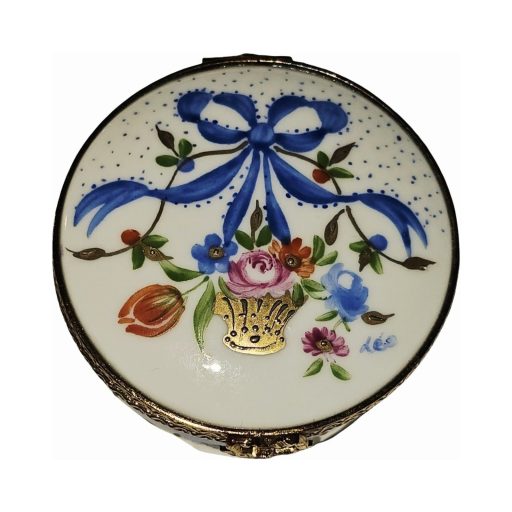
The Revolution swept away the court, but not the craft. Through the 19th century Limoges grew into France’s porcelain capital, with dozens of factories, kilns that never seemed to cool, and a huge export trade, much of it to America. Tableware made the city’s name, but the painters and the small decorative pieces never disappeared.
Limoges today
If you travel to France, Limoges is an easy and rewarding detour, about three hours south of Paris by train. You arrive at the Gare des Bénédictins, often called one of the most beautiful railway stations in France, with its copper dome and clock tower. The Musée national Adrien Dubouché holds one of the great ceramic collections in the world, from Chinese porcelain to Art Nouveau vases, and it shows every step of how a lump of kaolin becomes a translucent cup. Walking the old streets of the city, you still see porcelain shop windows full of tableware, figurines and, of course, little hinged boxes. For a Francophile, it is a chance to see where so much of the French art de vivre on our tables was born.
The modern Limoges box
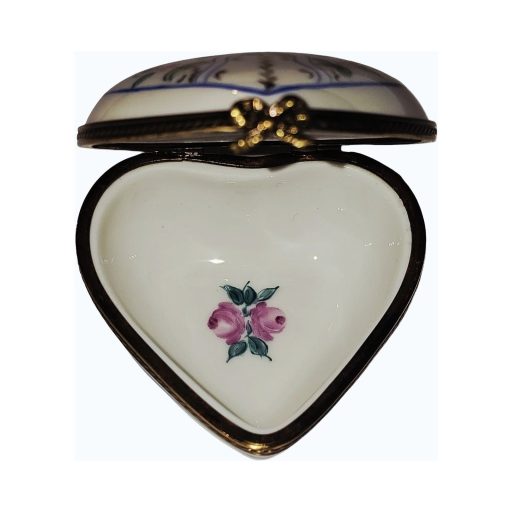
The hinged porcelain box we call a “Limoges box” today is the direct heir of those court trinkets. Each one is a small piece of white porcelain, shaped in a mold, fired at very high heat, then painted by hand and fired again to fix the colors. A tiny metal hinge and clasp are fitted by hand. Many boxes hide a little surprise inside: a painted message, a tiny charm, or a scene that continues under the lid.
What changed is the subject. Instead of portraits of kings, you will find Eiffel Towers and baguettes, cats and teapots, wedding cakes and Christmas trees. Collectors love them because each one tells a story, and because they are small enough to bring home from a trip to France in a coat pocket, just like that court lady’s patch box.
A nod to Marie Antoinette
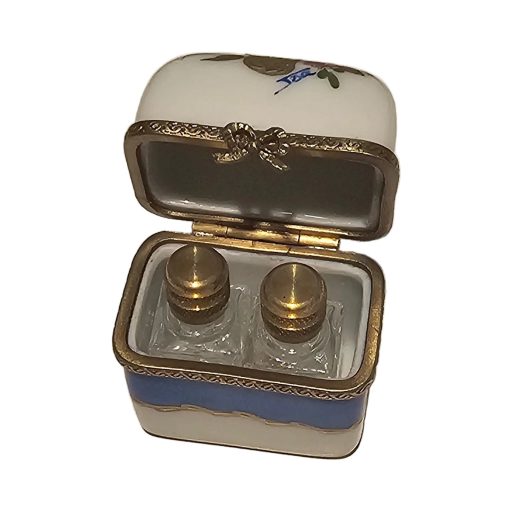
Some of the prettiest designs today look straight back to her era: soft pastel hearts and eggs tied with painted ribbons, garlands of tiny roses, little perfume bottles on a porcelain tray. They are a wink at the queen’s pastel world of the Petit Trianon, and they remain some of the most requested pieces by women who love French style. A single ribbon heart on a dressing table says “France” more quietly, and more elegantly, than any souvenir T-shirt ever could.
How to tell a genuine Limoges box
After 25 years with these boxes, here is my quick checklist:
- Look underneath. A genuine box is marked “Limoges France.” Look for “Peint main” (hand painted). “Rehaussé main” means the design was printed, then touched up by hand.
- Check the hinge. It should open smoothly and close snugly, with a clasp that lines up neatly.
- Look closely at the painting. Hand painting has tiny variations in the brushstrokes. Perfectly uniform, flat color usually means a print.
- Feel the weight. True hard-paste porcelain feels dense and cool, and the white is bright and translucent at the thin edges.
- Be wary of “Limoges-style.” Many boxes are sold as “Limoges style” and are not made in Limoges at all.
Starting a small collection
You do not need a cabinet full of boxes to enjoy them. Many collectors start with one box that marks a moment: a trip to Paris, a wedding, a new baby, a fiftieth birthday. Then a second one arrives for the next milestone, and before long the boxes tell the story of a life. A few tips: choose subjects that mean something to you rather than chasing “investment” pieces, keep the boxes out of direct sun, dust them with a soft brush, and never put them in the dishwasher. Open and close the hinge gently, holding the box by its base, not the lid.
A tradition you can hold in your hand
What I love most is that the little box has never lost its purpose. At Versailles it held a secret, a sweet, a beauty mark. Today it holds a wedding ring on the big day, a baby’s first tooth, a note for an anniversary. It is still a small piece of France that you carry close.
All photos in this article: © Limoges Boutique